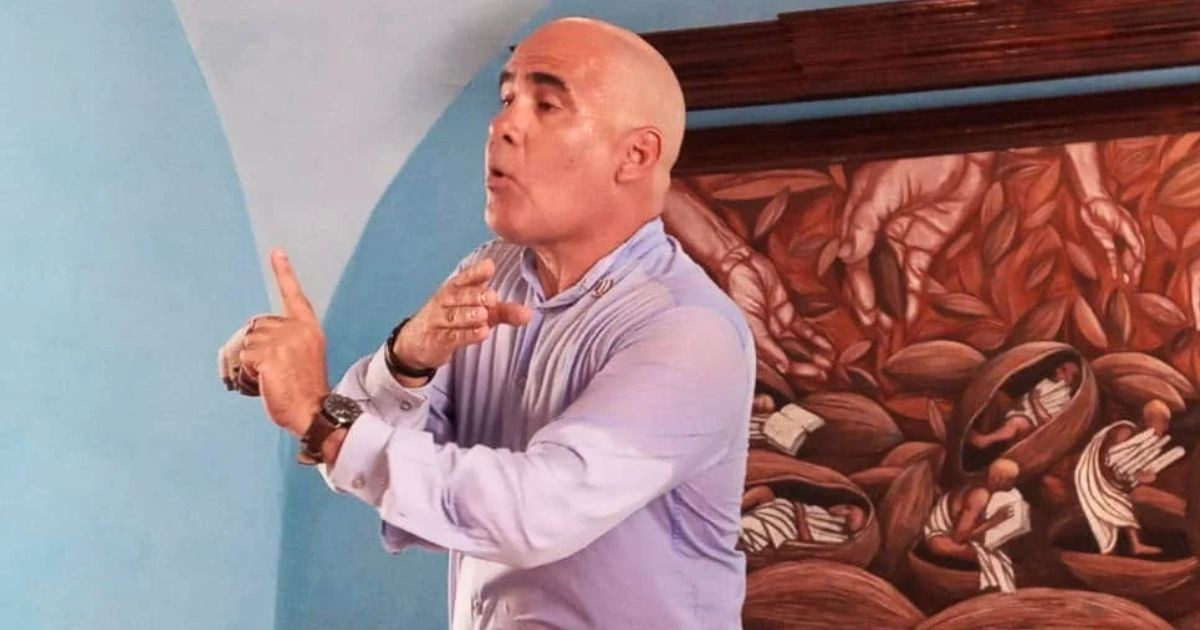
In a recent Facebook post from Santiago de Cuba, legal expert and scholar René Fidel González García urged for the development of a "new political thought in Cuba," emphasizing the urgency of the situation with the words: "We have no more time to waste."
González García, a Doctor in Legal Sciences and former full professor at the University of Oriente, has spent the past several years, with increased focus in 2026, delivering critical statements that paint a pressing political picture of Cuba's current state. This latest post is the most recent in a series of such analyses.
Central to his argument is the notion of political equality. He states, "We must begin to understand the need to aspire to and demand the right of political equality for Cubans, for each of us," identifying it as the "most important and fundamental demand of our time."
From Consumers to Active Citizens
González García makes a significant distinction between active citizenship and passive content consumption. He asserts, "We need politicians who are not content creators; we need to be citizens, not content consumers," urging individuals to embrace politics as both an individual and collective practice, rather than as a cultural commodity.
Describing the Cuban political system, he accuses it of denying citizens' political equality, cautioning that its decline could lead to "the definitive and disastrous ruin of our common home."
A Call for Unity and New Political Thought
The academic advocates for a political mindset that "paves the way and embodies itself in everyday life, in our neighborhoods and communities ravaged by poverty, in our immobilized institutions rendered obsolete by despotism and arbitrariness, by exalted mediocrity." He makes a strong appeal for unity: "We need to be, and we cannot do so without uniting those of us who believe in the same."
González García's recent post is part of a continuum of reflections. In July, he stated that Cubans today have fewer political rights and freedoms than in 1953, under Fulgencio Batista's dictatorship. In August, he introduced the term "political indigence" to describe widespread exclusion, linking it to economic and social deprivation.
By September, he identified a "structural and irreversible disconnection" between the regime and the populace. Early in October, he described Cuba as "a society paralyzed by political underdevelopment," citing statistics from Prime Minister Manuel Marrero about the vulnerable population. Just a week ago, he suggested that a "new politics" requires "new politicians" who practice what they preach.
The Context of Crisis
González García's writings emerge against the backdrop of an unprecedented structural crisis. According to the Cuban Observatory of Human Rights, as of August 2026, 94% of Cubans live in extreme poverty, based on a study involving 1,318 interviews across 79 municipalities in 15 provinces. The Economic Commission for Latin America and the Caribbean (ECLAC) predicts a 10.3% contraction in Cuba’s GDP for 2026, marking the region's worst economic forecast.
Human rights organization Prisoners Defenders has documented 1,372 political prisoners as of October 1, a record high in the island’s history, including numerous women and minors at the time of their detention.
González García himself has faced repercussions for dissent. He was dismissed from his position at the University of Oriente in November 2016 after publishing critical articles in independent outlets; the university claimed his writings lacked scientific rigor and negatively impacted student education.
He and human rights groups argue that his dismissal was a political reprisal. In October 2025, he filed a lawsuit against Miguel Díaz-Canel and Attorney General Yamila Peña Ojeda for alleged constitutional violations.
His latest post concludes with a sentiment that encapsulates many of his statements: that the Cuban people's hope should never again lie in finding elsewhere what is denied to them at home out of love for power, disdain for freedom, and fear of the rights to happiness.
Understanding Political Change in Cuba
What is René Fidel González advocating for in Cuba?
René Fidel González is calling for a new political thought in Cuba, emphasizing political equality and urging for citizens to become active participants rather than passive consumers of political content.
What are some of the key issues González García highlights?
González García highlights issues such as political inequality, the need for new political figures, and the systemic crisis affecting Cuban society, including extreme poverty and a disconnect between the government and citizens.
What has been the response to González García's dissent?
González García has faced political repercussions, including being dismissed from his academic position, which he and human rights organizations view as a retaliatory action for his critical stance.