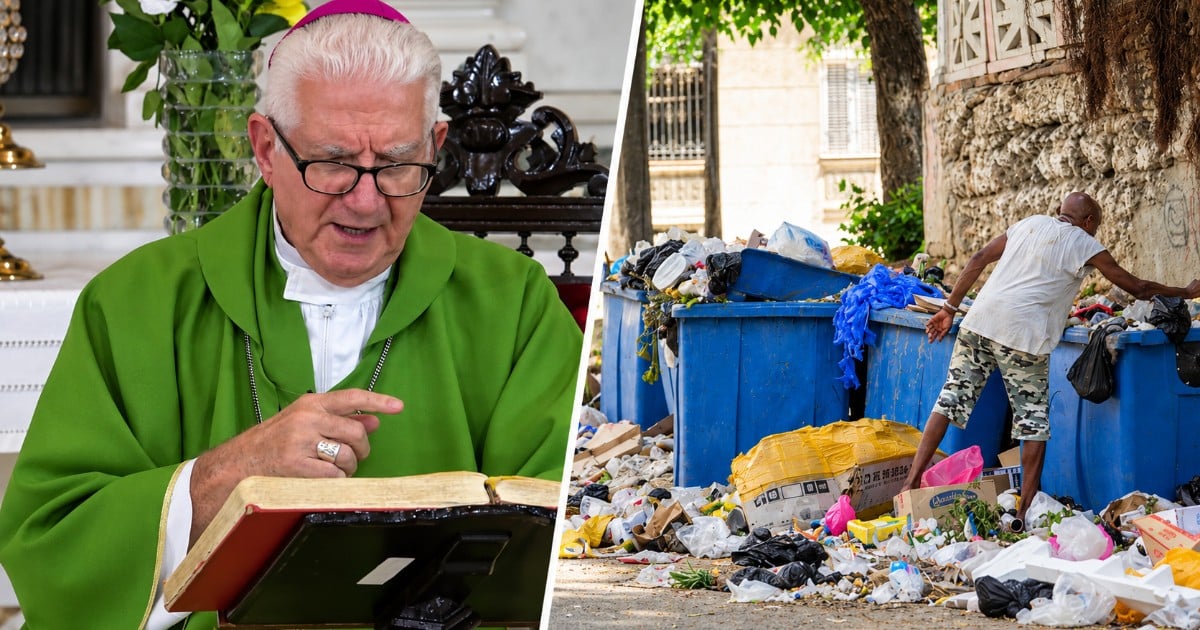
The Archbishop of Santiago de Cuba, Monsignor Dionisio García Ibáñez, voiced his concerns on Sunday, October 11th, about the challenging living conditions on the island. He encapsulated the uncertainty faced by many families with a poignant statement: "We are in trouble, and we don't know how to get out of this."
In his sermon at the Basilica Sanctuary of Our Lady of Charity in El Cobre, the archbishop highlighted the scarcity of medications, inadequate salaries, difficulties in obtaining essentials, and the distress caused by diseases such as dengue and chikungunya.
The Struggles of Daily Life in Cuba
Reflecting on the hopeful messages found in biblical readings, García Ibáñez even mentioned those "picking food from the garbage." He emphasized that faith should offer support to those enduring such hardships, rather than distancing them from their stark reality.
Electricity Woes and Economic Hardships
The archbishop’s remarks come in the wake of a year marked by severe electrical issues. According to the Blackout Observatory by CiberCuba, which compiles reports from the Unión Eléctrica (UNE) and other sector entities, there have been eight total blackouts of the National Electric System (SEN) in 2026. The most recent occurred on September 18th, when a high-tension line failure led to another national grid collapse.
Power outages due to insufficient generation capacity have been equally frequent. CiberCuba's analysis of official reports from September 3rd to October 2nd revealed that 23 out of the 28 days with comparable data saw maximum real impact exceed 2,000 megawatts (MW), meaning the system could not meet the demand.
Just a day before the archbishop's homily, the eastern region experienced another significant disruption. On Saturday, October 10th, the Nuevitas-Las Tunas transmission line tripped, causing a partial disconnection affecting Las Tunas, Holguín, Granma, Santiago de Cuba, and Guantánamo. UNE later reported the restoration of regional interconnection.
For October 11th, the SEN forecast projected a maximum impact of 1,775 MW due to generation deficits, indicating that restoring interconnection does not eliminate blackouts.
Economic Crisis and Inflation: The Roots of the Archbishop's Message
Income levels are another facet of the crisis. In July 2026, the Cuban government set the monthly minimum wage at 3,210 Cuban pesos (CUP). The average monthly salary in the state civil sector was 6,930 CUP in 2025, according to the National Office of Statistics and Information (ONEI). While these figures pertain to different periods and concepts, they provide insight into the financial strain on many households.
The loss of purchasing power is compounded by rising prices of basic goods. Official ONEI statistics indicate a year-on-year inflation rate of 25.19% in August 2026, with food and non-alcoholic beverages accounting for 72.77% of the monthly increase in the consumer price index.
An example illustrating the disparity between wages and prices was seen in Trinidad, Sancti Spíritus, where a carton of 30 eggs sold for 4,500 CUP in mid-September, exceeding the minimum monthly wage. This price was noted at a specific time and place, not as a nationwide standard.
The crisis is also evident in national production. The Center for the Study of the Cuban Economy at the University of Havana estimated a roughly 5% economic contraction in 2025, marking the third consecutive year of decline. Researchers pointed to energy issues and pending production reforms as obstacles to recovery.
In his homily, García Ibáñez urged people to face these challenges without resignation, advocating for justice and peace. His call to action was directed at both Cubans on the island and those abroad, united by concern over their fellow citizens' suffering.
Understanding Cuba's Current Crisis
What are the main issues highlighted by the Archbishop of Santiago de Cuba?
The Archbishop of Santiago de Cuba emphasized the scarcity of medications, inadequate wages, difficulties in obtaining essentials, and diseases like dengue and chikungunya.
How has the electrical crisis affected Cuba recently?
Cuba has experienced frequent power outages, with eight total blackouts of the National Electric System in 2026, and a consistent failure to meet electricity demands.
What economic challenges are Cubans currently facing?
Cubans are dealing with inadequate wages, high inflation rates, and a significant disparity between the cost of living and available income.