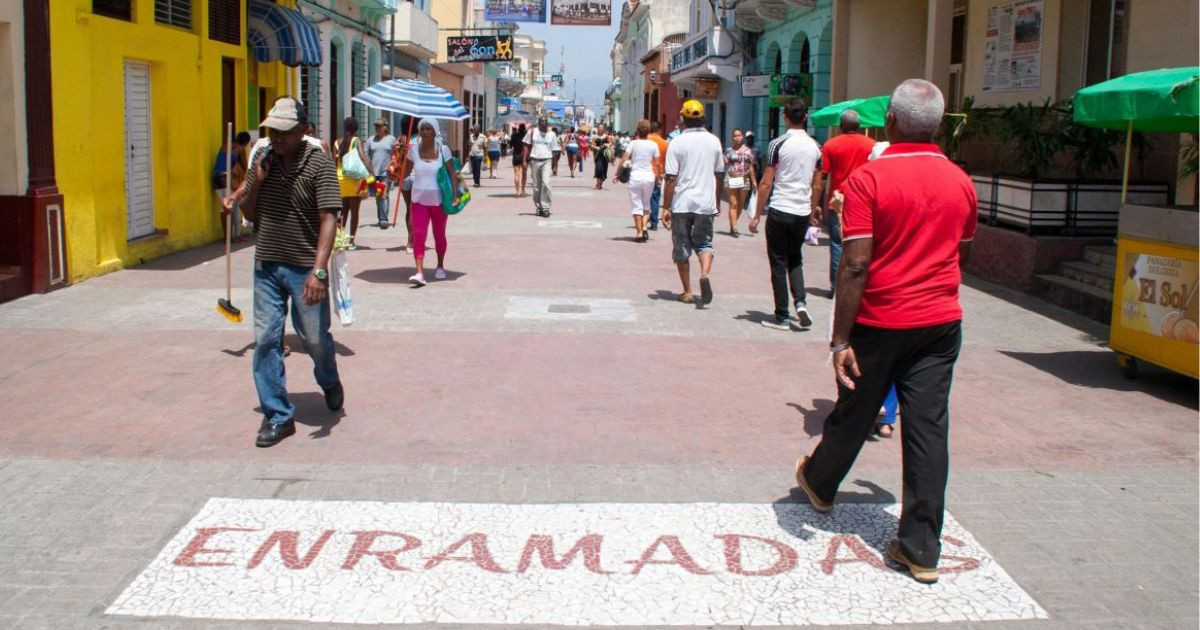
Officials in Santiago de Cuba have acknowledged that 101,359 individuals, representing more than 10% of the province's population, have been classified as vulnerable. These individuals are set to receive food packages distributed through 154 designated warehouses.
This statistic was confirmed by Edelva Marín Medina, the Coordinator of Programs and Objectives at the Provincial Government of Popular Power. She described the initiative as “a policy aimed at targeting resources specifically to individuals rather than providing universal subsidies,” according to the official newspaper Sierra Maestra.
Multidisciplinary groups operating within community councils are responsible for identifying the beneficiaries, updating the lists on a monthly basis.
The guaranteed food package, available until January, includes five pounds of rice, one pound of peas, one pound of sugar, and one kilogram of black beans, the latter provided only once based on availability. This will be recorded in the Ration Book.
Food Distribution Across Municipalities
The 154 warehouses are distributed across eight municipalities: 29 in Palma Soriano, 26 in Santiago de Cuba, 25 in Contramaestre, 21 in San Luis, 16 in Songo-La Maya, 14 in Guamá, nine in Segundo Frente, and seven each in Tercer Frente and Mella.
According to the press, in hard-to-reach areas, products are pre-positioned to cover several months. All units are required to display available items, along with their entry and expiration dates, on informational boards.
Focused Social Protection Model
The announcement aligns with the newly approved focused social protection model by the National Assembly in June, part of a package of 176 economic transformations that replaced universal subsidies with targeted assistance for those classified as vulnerable by community councils on a monthly basis.
Prime Minister Manuel Marrero Cruz recently announced that over 883,000 people deemed most vulnerable will receive monthly allocations of five pounds of rice, one pound of sugar, and one pound of grains until January, as part of a "thorough door-to-door community effort."
The official count of vulnerable individuals has been rising rapidly. In July 2025, Marrero acknowledged 310,000 people in this situation. By July 2026, the number had surged to 876,522, and within just three more months, it exceeded 883,000.
Rising Vulnerability Across Regions
In Holguín, authorities recognized that 90,148 individuals, about one in every ten residents, are considered vulnerable, a proportion nearly identical to Santiago de Cuba.
After conducting 1,318 interviews from June 27 to July 29 across 79 municipalities, the Cuban Observatory of Human Rights (OCDH) found that 94% of the surveyed population lived in extreme poverty.
Economist Pedro Monreal has warned that expanding coverage to all officially recognized vulnerable individuals would require increasing current social protection spending by 4.5 times, to approximately 24.3 billion pesos, a sum beyond the government's financial capacity.
The Economic Commission for Latin America and the Caribbean (ECLAC) forecasts a 10.3% drop in Cuba's GDP in 2026, the worst in Latin America, with an annual inflation rate of 25.19% in August.
As historian Ivette García González recently pointed out, the vulnerable in Cuba are no longer a minority: "They are not just segments. They represent the majority of the population, the average citizen."
Understanding the Vulnerability Crisis in Cuba
What is the significance of the food distribution in Santiago de Cuba?
The food distribution is a targeted initiative to support over 101,000 vulnerable individuals in Santiago de Cuba, representing more than 10% of the province's population. It reflects the government's shift from universal subsidies to focused assistance for those in need.
How are vulnerable individuals identified for aid in Cuba?
Vulnerable individuals are identified by multidisciplinary groups that operate within community councils. These groups update their lists monthly to ensure accurate and relevant distribution of aid.
What challenges does Cuba face in expanding social protection?
Cuba faces significant financial challenges in expanding social protection. Economist Pedro Monreal estimates that meeting the needs of all recognized vulnerable individuals would require 4.5 times the current spending, an expense the government is unable to afford.