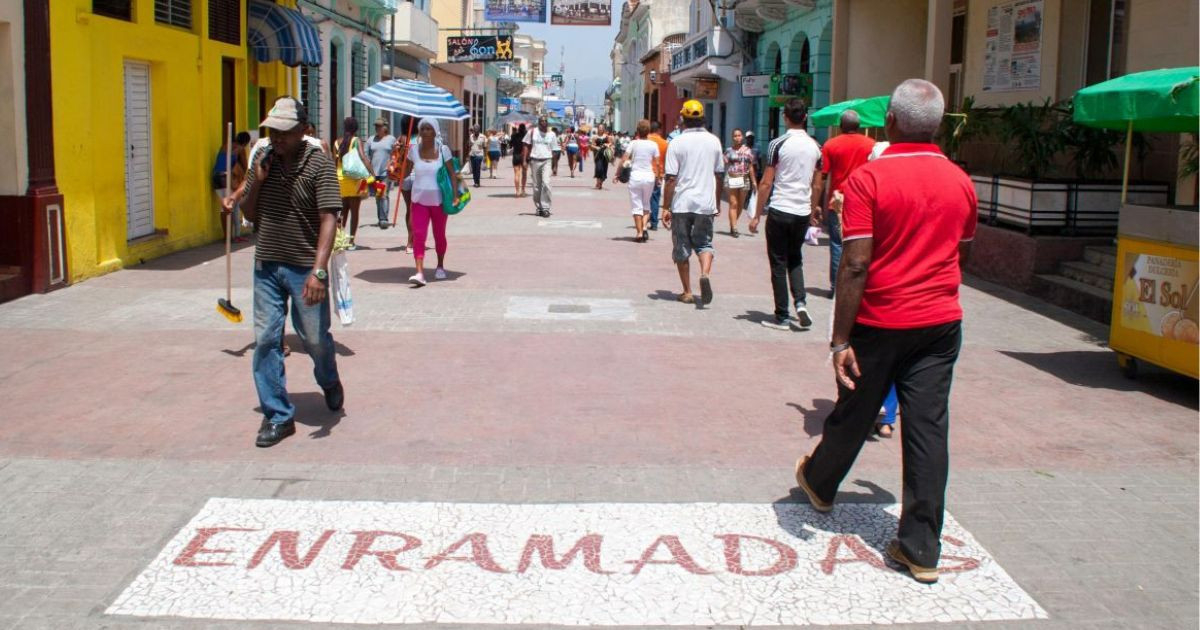
The government of Santiago de Cuba acknowledges that scarcity necessitates the selection of who receives food assistance. This responsibility falls on local councils, which must decide monthly which individuals qualify as vulnerable.
On Saturday, the official newspaper Sierra Maestra published insights from Diamaris Perdomo Hechavarría, the principal specialist in Prevention and Social Work at the Provincial Directorate of Labor, regarding the criteria for identifying those eligible for state food aid through December.
Perdomo Hechavarría explained the rationale behind the mechanism, emphasizing that with the need to "spread scarce resources among many," aid must be directed toward those lacking sufficient support.
She emphasized that economic hardship alone does not automatically make someone vulnerable; each case requires individual assessment.
Who Qualifies for Assistance?
The profiles considered include individuals already receiving assistance from the Directorate of Labor, pregnant women, seniors, children aged zero to five, minors with cancer or growth issues, and mothers leading households with three or more children under 17.
Others in need include the homeless, families of prisoners, and university students whose financial situations hinder their studies. Perdomo stressed the state's duty to prevent abandonment in cases where families cannot provide adequate support.
Regular Review of Vulnerability Status
Classification as vulnerable is neither automatic nor permanent. "It's true that conditions are tough, but not everyone is vulnerable," stated Perdomo, explaining that a person's status can change with their economic circumstances, lasting three to six months.
Local councils handle evaluations. Social Policy groups, comprising representatives from the Ministries of Education, Health, Labor, Culture, the National Institute of Sports, Physical Education and Recreation (INDER), and social workers, assess each case and approve the list of those receiving aid.
This list is updated monthly, meaning a family deemed vulnerable could lose assistance if their situation improves, or new families could be added if theirs deteriorates.
Perdomo also clarified that having an elderly person in the household does not guarantee assistance. Social workers must assess if family members can support them. "Not everyone qualifies. Family responsibility must also be emphasized," she noted.
Food Security Measures
The Directorate of Commerce in Santiago de Cuba announced that those fitting the profiles may receive some food supplies, like rice and sugar, through December.
This initiative is part of a revised social protection model approved by the National Assembly in June, within a package of 176 economic and social measures.
At the end of July, Prime Minister Manuel Marrero Cruz reported that 876,522 people had been identified as highly vulnerable across the country.
In Holguín, Cuba's third most populous province, authorities recently acknowledged that one in ten residents—90,148 people—fall into this category.
Critics warn that the true extent of the issue far exceeds official records. An August report by the Cuban Observatory of Human Rights found that extreme poverty affects 94% of the Cuban population.
René Fidel González García, a legal expert from Santiago de Cuba, rejected the notion that the official figure is abstract. He argued that 876,522 people are "not just a cold number; they are individuals enduring conditions that are simply unacceptable."
Historian Ivette García González was even more forthright: "In Cuba, the vulnerable aren't just segments or minorities. They represent the majority, the everyday citizen."
Understanding Vulnerability in Cuba
What criteria are used to determine vulnerability in Santiago de Cuba?
The criteria include individuals already receiving state assistance, pregnant women, seniors, young children, minors with specific health issues, mothers with large families, the homeless, families of prisoners, and students whose families cannot support their education.
How often is the list of vulnerable individuals updated?
The list is updated monthly, allowing for changes in a family's economic situation to affect their status of receiving aid.
What is the current state of poverty in Cuba according to recent reports?
A report by the Cuban Observatory of Human Rights indicates that extreme poverty affects 94% of the Cuban population, suggesting a far greater issue than official statistics imply.