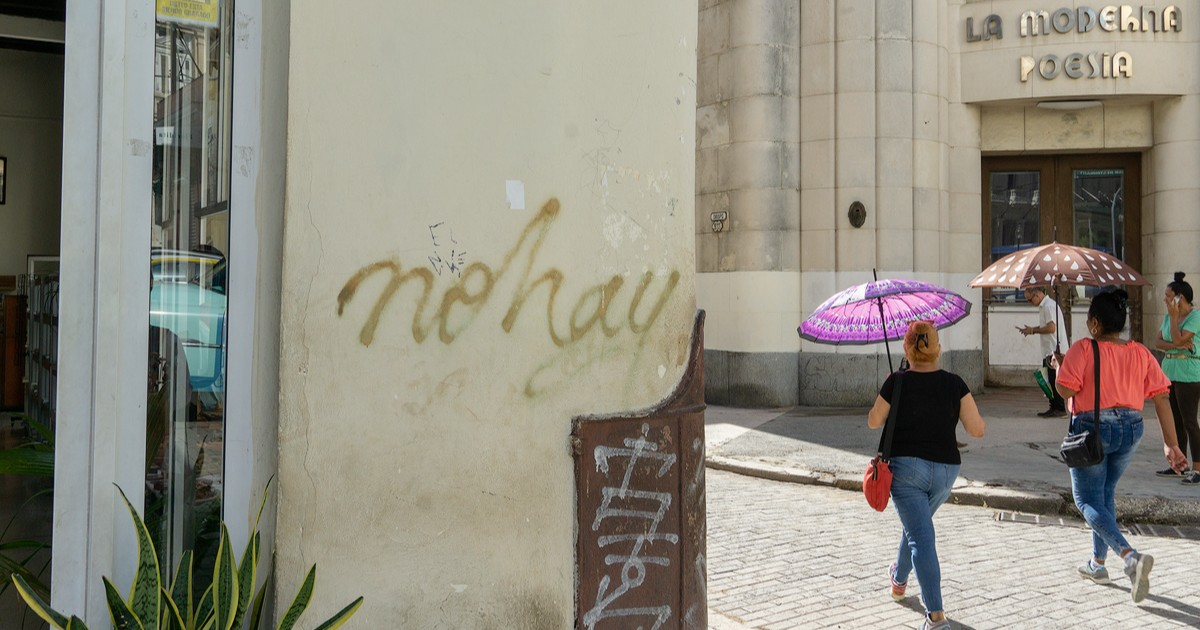
Cuban actress and broadcaster Laritza Camacho shared a thought-provoking reflection on Facebook this past Friday, using a series of metaphors to portray the dire state of life in Cuba. Her most striking image captures the bittersweet irony of longing during a crisis: "No one would miss the taste of bread if they weren't eating stones."
Camacho's reflection begins with a philosophical premise: "Human beings rarely talk or think about the past when living in a good present or anticipating a bright future." From this foundation, she builds a series of analogies to explain why Cubans yearn for what they've lost—not because it was perfect, but because what followed is far worse.
The Ruins of a Nation
The metaphor of a collapsed building serves as the core of her argument. According to Camacho, demolishing a landmark wouldn't be as painful "if the new project replacing it wasn't an abandoned lot or a tasteless little park." This imagery is a direct critique of the regime's management: what was destroyed hasn't been replaced with anything better, only with emptiness and neglect.
Camacho extends this logic to other aspects of life. "No one would miss the intelligence of the spoken word if they weren't hearing stupidity, each more absurd than the last," she writes, criticizing the official discourse that persisted throughout 2026. She adds, "No one in peacetime misses war," concluding with a deeply personal wound: "No one would complain of loneliness if their family weren't absurdly separated, divided, like the nation is today."
A Nation Divided
This final statement speaks to a well-documented reality. According to the National Office of Statistics and Information (ONEI), Cuba saw a negative external migration balance of 251,221 people in 2024. The scale of the exodus could be even larger according to independent estimates: demographer Juan Carlos Albizu-Campos estimated that around 1.79 million people emigrated between 2022 and 2023, an unprecedented figure in the country's recent history.
The material reality underpinning her words is equally dire. According to the Food Monitor Program, 96.91% of the Cuban population lacks adequate access to food. The official average salary hovers around 7,000 pesos per month—equivalent to between 12 and 15 dollars—while approximately 96,000 pesos are needed to cover basic needs.
Unyielding Critique
Extreme poverty now affects 94% of Cubans, according to a recent report by the Cuban Observatory of Human Rights (OCDH) and the Observatory of Social Rights Cuba. Additionally, an unprecedented energy crisis has plunged the country into total blackout eight times so far this year.
Camacho's post is part of a sustained critique she has voiced throughout the year. In July, she declared, "I oppose the Cuban government because the Cuban government is against Cuba." In August, she criticized the regime's economic policies, adding, "This erratic government we keep afloat with our disunity is the most expensive product we're paying for, compatriots." By the end of that month, she sarcastically noted that Cuba is "a country free of everything that would make us a... free country."
In September, she questioned the censorship of images depicting destroyed hospitals, shortages, and economic crisis, asserting, "The problem has never been the photo nor the photographer."
The list that concludes her post this Friday says it all: "heroes, traditional recipes, customs, celebrations, idiomatic expressions, leaders, means of transportation, bookstores, stores, streets, avenues, and even paths." According to Camacho, everything Cubans miss is not out of nostalgia, but because what remains is worse.
Exploring Cuba's Ongoing Crisis
Why does Laritza Camacho use metaphors in her critique of Cuba's situation?
Laritza Camacho uses metaphors to vividly illustrate the stark realities of life in Cuba, emphasizing how what has replaced the past is significantly worse. Her metaphors serve to highlight the pain and irony of the current situation.
What does Camacho say about Cuban families?
Camacho comments on the separation and division of Cuban families, drawing a parallel to the divided state of the nation. She highlights how this separation contributes to feelings of loneliness among Cubans.
What has been the impact of the economic situation in Cuba as described by Camacho?
The economic situation in Cuba has led to extreme poverty affecting 94% of the population, inadequate access to food for 96.91% of people, and an average salary that falls far short of meeting basic needs. This has been compounded by an energy crisis causing frequent blackouts.