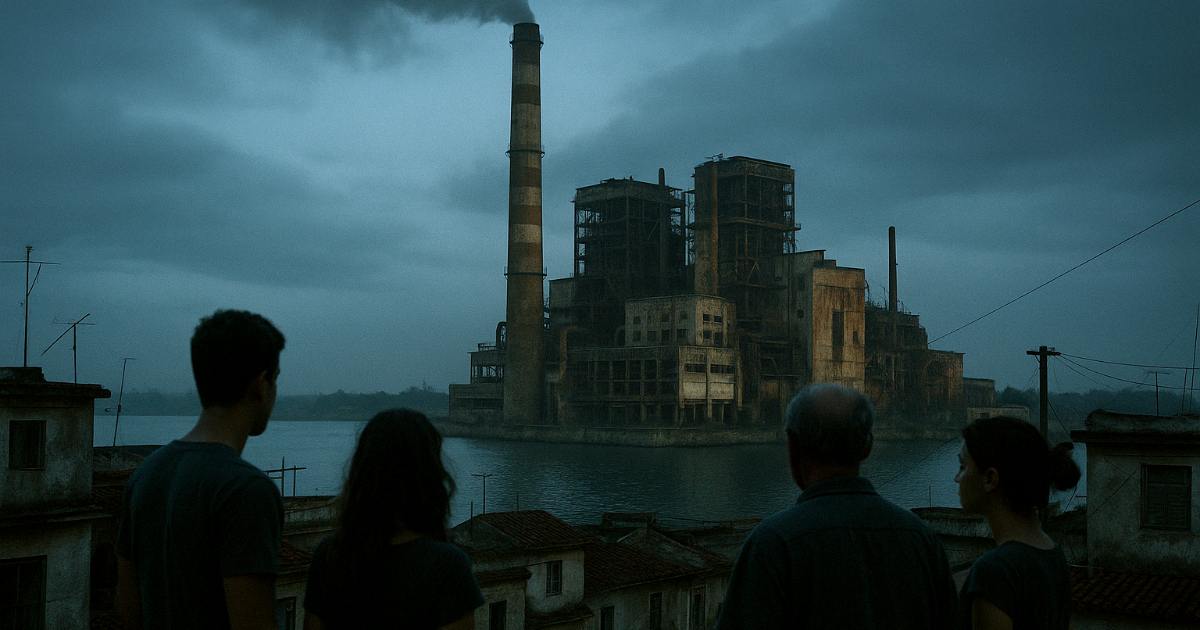
The Ministry of Energy and Mines (MINEM) announced on their official X account that the National Electric System (SEN) was "operational from Pinar del Río to Nuevitas." This statement, made on Saturday, was met with disbelief among many Cubans who had been without power for over 24 hours following the eighth major blackout of the year.
According to the official message, the "stable generation" included the Boca Jaruco combined cycle plant, five units using associated gas, two units from the Mariel thermoelectric plant, and two from the Santa Cruz plant. Meanwhile, two units at the Céspedes plant were reportedly "in the process of starting up."
Cubans React to MINEM's Statement
On Facebook, reactions were swift and critical. "Only in their dreams," commented one user. Another questioned the geography: "Isn't Nuevitas part of Camagüey? Because I don't know where that power is." A third added, "Where is that? Since yesterday, when the system collapsed, I haven't seen the light."
One commenter highlighted the inequality within the capital itself: "Come here, and you'll see the power situation in Old Havana is a joke, they don't let you breathe, and the power in Central Havana is untouchable. Why can't it be cut there? Can you explain that? It's every day. Enough is enough."
Widespread Power Outage
The collapse that prompted the announcement began on Friday, September 18, at 1:52 PM, triggered by the successive failure of two 220 kV high-voltage lines — Matanzas-Cienfuegos and Matanzas-Santa Clara. This was exacerbated by unstable weather conditions, leaving more than nine million people across the island without electricity.
Efforts to restore power were slow and uneven. By Saturday morning, only 3% of Havana's customers had electricity — about 30,277 out of 862,732 — although this increased to 44.2% later, with only six out of 18 main water pumping systems operational.
Additional Complications at Antonio Guiteras Plant
The situation worsened when the Antonio Guiteras plant experienced boiler issues due to mechanical stress from the collapse. General Director Román Pérez Castañeda described the damage as "punctures in several points of the steam generator." Cooling the boiler will take nearly 72 hours, delaying repair efforts until Monday afternoon.
This marks the eighth total disconnection of the SEN in 2026, amidst a structural crisis acknowledged by Minister Vicente de la O Levy in May. He admitted that Cuba lacked any reserves of fuel oil or diesel for power generation.
Understanding Cuba's Power Crisis
Why do Cubans doubt the government's announcement about the electric system?
Cubans expressed skepticism as many had been without electricity for over 24 hours, contradicting the government's claim that the system was operational.
What caused the recent power outage in Cuba?
The outage was caused by the failure of two high-voltage lines, worsened by unstable weather, affecting over nine million people.
How did the power outage affect Havana?
Initially, only 3% of Havana's customers had power, which later increased to 44.2%, though water pumping systems were still largely non-functional.