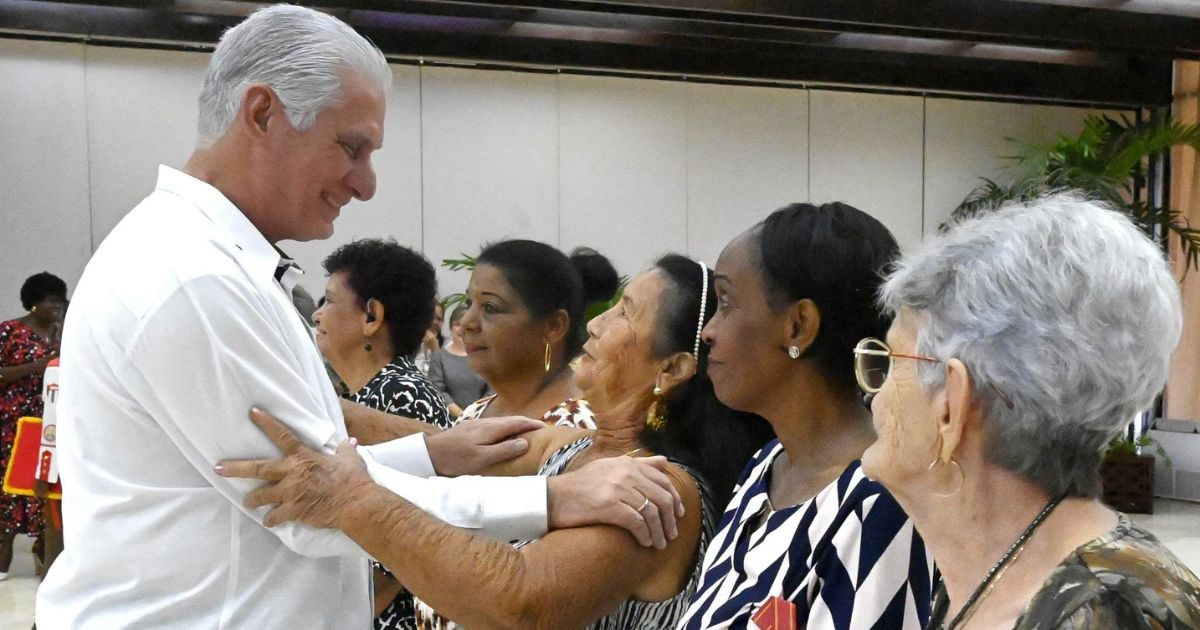
As countless Cuban women grapple with the harsh reality of living without electricity, water, or essential medicines, Miguel Díaz-Canel led a ceremony in Havana on Thursday to honor the 66th anniversary of the Federation of Cuban Women (FMC). This event sparked a wave of ridicule online, highlighting the stark contrast between the lavish official ceremony and the dire conditions faced by the population.
The awards ceremony took place at the El Laguito Protocol Hall in the Palace of Conventions, attended by prominent figures including Esteban Lazo Hernández, President of the National Assembly; Roberto Morales Ojeda, Secretary of Organization of the Central Committee; and Teresa Amarelle Boué, General Secretary of the FMC.
The highest accolade, the Honorific Title of Heroine of Labor of the Republic of Cuba, was awarded to Tamara Silvia Columbié Matos. She was celebrated for dedicating her intelligence and preparation to the struggles of Cuban women for over fifty years as a committed activist.
Additional honors included the Lázaro Peña First Degree Order given to Cedalia Cabrera Monet, the Mariana Grajales Order to four women, the Ana Betancourt Order to 18 members, and the 23 de Agosto Distinction to 300 women across the country, with nine receiving it symbolically at the event. The ceremony also coincided with celebrations for Fidel Castro's centennial.
Social media reactions were overwhelmingly critical. On the Cuban Presidency's Facebook post, sarcasm abounded. One user quipped, "That diploma contains electricity, water, medicines, and food—the basics for living in peace, and it also serves as toilet paper," a sentiment that resonated widely.
Others followed suit, with one remarking, "Now they can take those medals home and boil them for a good soup." Another noted, "After this event, the country is slightly poorer—wasting energy, logistics, and accommodation for nothing."
Some directed their critique at the president: "Circus without bread... the president sure knows how to party! Ceremony and celebration, celebration and ceremony!" One user lamented, "We are all remarkable women who struggle daily to survive," while another added, "This is just another 'bottle' of salaries for doing nothing. They produce nothing, solve nothing, but live well."
The context only amplifies the irony. In 2026 alone, Cuba has endured six total blackouts of the National Electrical System, with a record deficit of 2,411 MW on August 4, and daily outages lasting between 15 and 24 hours in urban areas. Millions lack regular access to potable water due to reliance on electric pumps.
In the health sector, around 7 out of 10 essential medicines are missing from the national basic framework, with only a small fraction of Cubans able to obtain medications without difficulty. Ciego de Ávila province recently operated with just 10% of the necessary drugs available.
Even Amarelle Boué herself acknowledged in July that "Cuban women know the crisis weighs more heavily on our shoulders," though she claimed in February that there was neither a failed state nor a collapse in Cuba. Yet, these are the same women to whom the government awarded diplomas and medals in a protocol hall, while their homes remain dark, water is scarce, and pharmacies are empty.
Key Issues Facing Cuban Women During the Crisis
What was the main event attended by Díaz-Canel in Havana?
Díaz-Canel attended a ceremony in Havana to commemorate the 66th anniversary of the Federation of Cuban Women, where awards were given to women for their contributions.
How did social media users react to the awards ceremony?
Social media users mocked the ceremony, highlighting the irony of celebrating women while the country struggles with severe shortages of basic necessities.
What is the current state of the electrical and water supply in Cuba?
Cuba has faced multiple total blackouts and daily outages, with millions lacking regular access to potable water due to dependence on electric pumps.
What challenges are Cuban women facing in terms of healthcare?
Cuban women are struggling with a severe shortage of essential medicines, with only a small percentage able to access needed medications without difficulty.