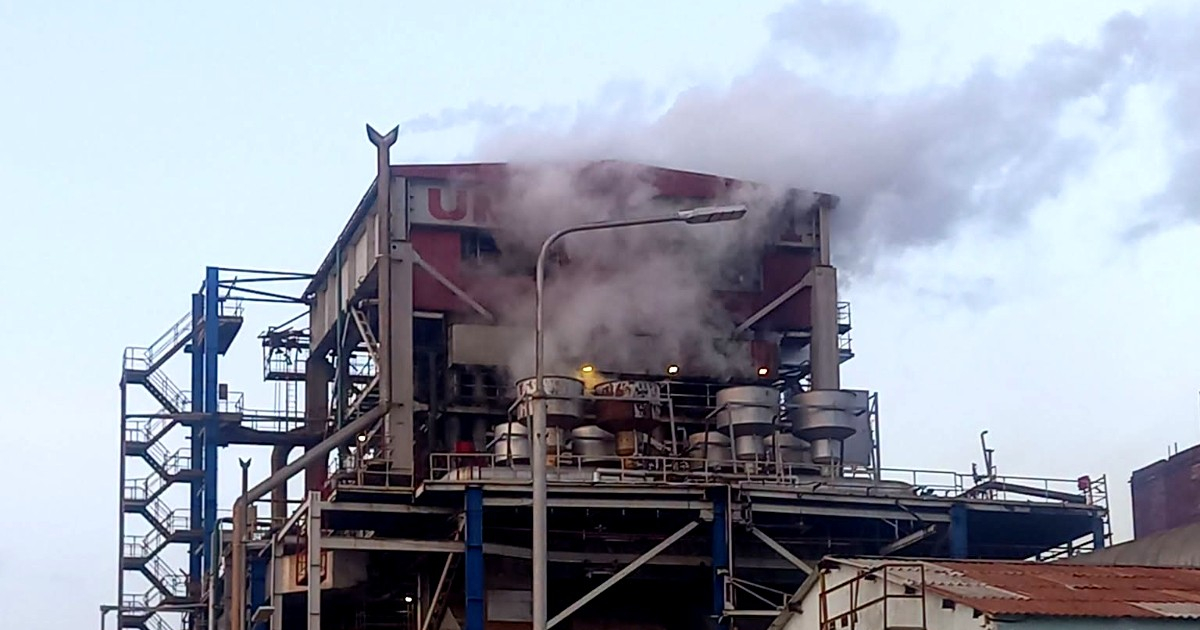
The "Lidio Ramón Pérez" Thermoelectric Plant in Felton, located in the province of Holguín, reported on Wednesday that it is operating at a reduced capacity of just 135 MW due to a "boiler leak." The plant is preparing for an official shutdown of its Unit 2 for targeted repairs, as disclosed by the plant through the Union Eléctrica (UNE).
This breakdown is not a new development; Unit 2 at Felton has been out of operation since at least August 1, making its current status a prolonged failure that further exacerbates the already declining National Electroenergetic System (SEN).
Grim Outlook for Power Availability
The official UNE report for Wednesday paints a dire picture: at 6:00 AM, the SEN's availability was 895 MW against a demand of 2,850 MW, leaving 1,950 MW uncovered.
During the peak evening hours, the forecast is even bleaker. UNE anticipates an availability of merely 1,053 MW against a maximum demand of 3,250 MW, resulting in a deficit of 2,197 MW and a projected impact of 2,227 MW—meaning the system can supply less than a third of the country's needs.
Widespread Plant Failures
The issue at Felton is compounded by other units being out of service: units 5 and 6 at the CTE Mariel, unit 4 at the CTE Cienfuegos, and unit 6 at the CTE Nuevitas. Under maintenance are unit 3 at the CTE Santa Cruz, unit 5 at the CTE Nuevitas, and units 5 and 6 at the CTE Renté. Thermal generation limitations amount to 497 MW.
Tuesday's situation was no better: power cuts persisted throughout the 24-hour period, including the early morning hours, with the maximum impact reaching 2,411 MW at 8:50 PM, according to UNE's own report.
Protests Erupt Amid Energy Crisis
This scenario is part of the worst energy crisis Cuba has faced in decades, with at least seven total collapses of the SEN so far in 2026. The most recent occurred on August 2, when the grid completely disconnected at 10:43 PM.
These outages, which in many areas exceed 20 hours daily, have sparked protests and cacerolazos in several neighborhoods of Havana—such as El Vedado, Playa, Regla, Habana Vieja, Marianao, and Boyeros—and in Santiago de Cuba, with slogans demanding "electricity, food, and freedom."
Washington has been unequivocal in blaming the regime. Secretary of State Marco Rubio stated in March that the blackouts "have nothing to do" with the United States and attributed them to decades of neglect and outdated equipment. In July, the U.S. representative to the UN was more direct: "The real blockade faced by Cubans doesn't come from Washington, but from their own government."
The regime, however, points the finger at the U.S. embargo for the energy collapse, a narrative that contrasts with the reality of power plants equipped with machinery from the 1950s and 1970s, chronic lack of maintenance, and a fuel shortage worsened by reduced supplies from their allies.
Cuba's Energy Crisis: Key Questions Answered
What is causing the energy crisis in Cuba?
The energy crisis in Cuba is primarily due to outdated equipment, lack of maintenance, and fuel shortages. The Cuban government blames the U.S. embargo, but experts point to internal mismanagement and neglect.
How is the energy crisis affecting Cuban citizens?
Cuban citizens are facing daily power outages that last over 20 hours in some areas, leading to widespread protests and demands for improved living conditions, including reliable electricity, food, and freedom.
What actions has the Cuban government taken in response to the crisis?
The Cuban government has largely blamed the U.S. embargo for the crisis and has not shown significant progress in repairing and upgrading the country's power infrastructure.