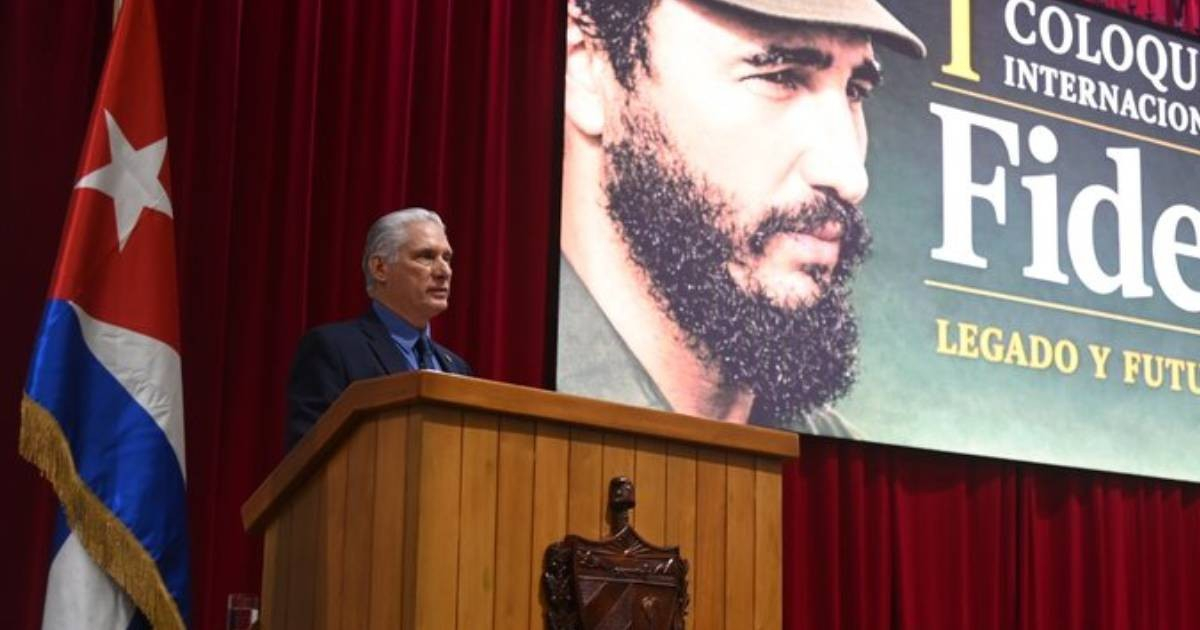
In a recent address to over 1,500 delegates from 63 nations, Cuban leader Miguel Díaz-Canel acknowledged that the country is enduring an economic crisis unlike any seen in decades. However, he attributed this downturn solely to external factors.
This statement was made on Monday during the opening of the inaugural International Colloquium “Fidel: Legacy and Future,” held at Havana’s Palace of Conventions as part of the celebrations marking the 100th anniversary of Fidel Castro's birth.
"I am not exaggerating when I say this colloquium takes place during one of the most challenging periods faced by the Revolution," Díaz-Canel declared in his keynote speech. He candidly listed the adversities burdening the population: "We are overwhelmed by power outages, water shortages, inflation, and long lines," he stated, according to the regime's official page.
Rather than assuming institutional responsibility for the collapse, Díaz-Canel characterized the crisis as a consequence of a "criminal war lasting over six decades" and blamed the "intensification of the blockade and imperial hostility," referring to U.S. sanctions and Washington's pressure.
Monday's address was not an isolated acknowledgment. Throughout 2026, the leader has reiterated similar statements on at least five occasions—March 27, May 9, June 19, July 20, and August 8—framing the crisis as a period of resistance rather than a result of the economic model.
The severity of the situation described extends beyond official rhetoric. According to Infobae, Cuba's economy has experienced a GDP decline of more than 15% since 2020, with an estimated 5% contraction in 2025. The electrical deficit hit a record 2,341 MW in July, leading to power outages lasting up to 20 or 30 hours in some areas. The Minister of Energy and Mines, Vicente de la O Levy, admitted in May that Cuba lacks reserves of fuel oil and diesel. The Cuban peso is trading at nearly 500 per dollar on the informal market.
In July, Díaz-Canel conceded that the regime has had to adopt capitalist practices to survive the crisis. In contrast, in May, he claimed that Cuba had "surpassed the Special Period," a statement at odds with the majority of Cubans who believe the current situation is worse than the hardships of the 1990s.
The colloquium, which gathers over a thousand international visitors in Cuba for the centennial celebrations, continues until August 13. The main event is scheduled to take place in Birán, Holguín, Castro’s birthplace, and the official commemorative program will extend until December 4, 2026.
In his address, Díaz-Canel called for efforts to "protect the Cuban Revolution from one of the gravest threats faced in 67 years" and portrayed Fidel Castro’s ideology as "the most precise compass we have to navigate the storm the Cuban people are enduring," encapsulating the regime’s strategy: invoking the founder of the revolution as a response to a deepening crisis.
Cuba's Economic Challenges and Government Responses
What external factors does Díaz-Canel blame for Cuba's crisis?
Díaz-Canel attributes the crisis to a "criminal war" lasting over six decades and the intensification of the U.S. blockade and imperial hostility.
How has the Cuban economy been performing recently?
Cuba's economy has seen a GDP decline of more than 15% since 2020, with a contraction of approximately 5% expected in 2025.
What is the significance of the International Colloquium in Havana?
The International Colloquium "Fidel: Legacy and Future" marks the 100th anniversary of Fidel Castro's birth and serves as a platform for Díaz-Canel to address the ongoing crisis and rally support for the Revolution.