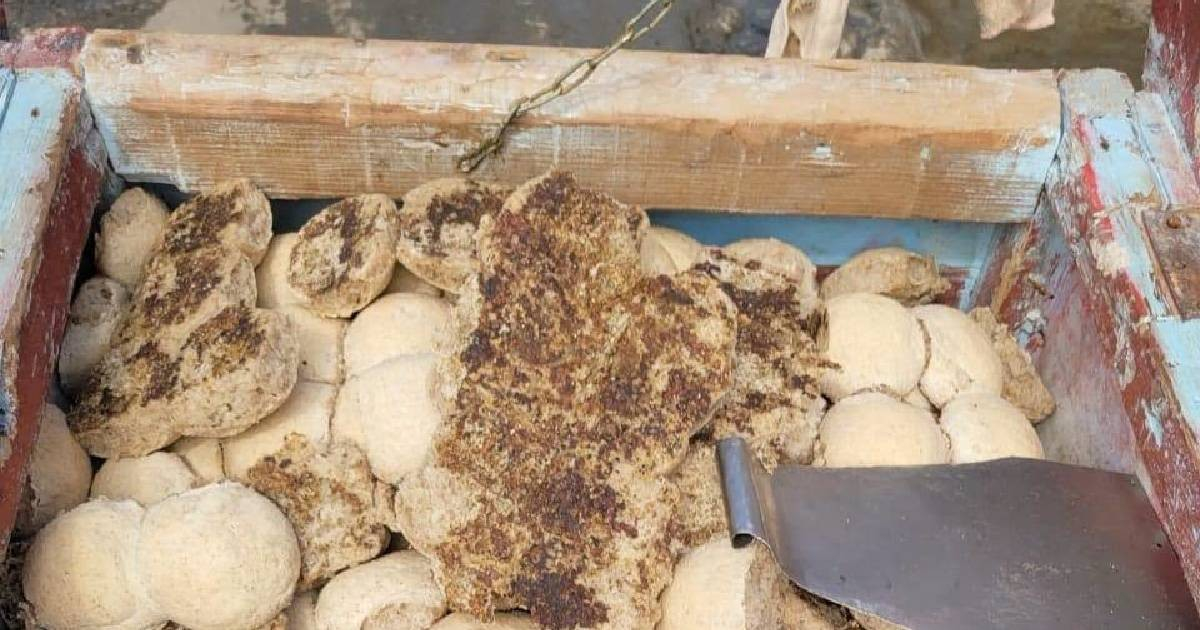
Deformed, flattened, and marred with large dark spots: this is the appearance of bread distributed this Tuesday through ration books by a bakery in the Cuabitas neighborhood of Santiago de Cuba.
The images, shared by independent journalist Yosmany Mayeta Labrada, have triggered a wave of outrage among local residents and on social media platforms.
Mayeta used a Cuban saying to sarcastically comment on the product's condition: "Save bread for May and hay for your horse." He highlighted that although the bread appears aged for months, it was actually made that same day in a local bakery intended to supply the regulated quota.
Voices of Discontent
Testimonials from residents reveal a mix of embarrassment and helplessness. "I'm 68 years old and never thought I would see the day we would be given bread that looks like this. There used to be shortages, but at least bread was bread. Today it's embarrassing to collect the quota," expressed an elderly woman from the area.
A retiree from the same neighborhood described the reality bluntly: "With my pension, I can't buy anything else. I take it because I have no choice, but this lacks quality and respect for the people."
Comparisons with the Informal Market
What stands out is the comparison made by the residents themselves: they claim that bread made by private, underground vendors—commonly known as "merolicos"—has better presentation, more consistency, and superior taste than that distributed by the state.
This situation reveals the collapse of a service that the regime has long touted as a social achievement.
Recurring Issues with State-Provided Bread
The incident in Cuabitas isn't isolated. In June of this year, La Indiana Bakery in Santiago de Cuba was criticized for distributing state-rationed bread with a greenish tint from mold, sour smell, and deteriorating texture.
By July, reports from Guantánamo described bread that was acidic, lacking fat and salt, and containing black spots, with evidence that some of the flour was mixed with cassava, sweet potato, or corn.
Structural Supply Crisis
Behind these quality issues lies a structural supply crisis. Cuba needs approximately 20,000 tons of flour each month to ensure the bread provided through ration books, yet by June 2026, only one of the six contracted shipments of wheat for the entire year had arrived.
In February, bakeries in Holguín resorted to using wood-fired ovens due to electricity and fuel shortages, reaching only about 50% of the population.
The deterioration is also evident in weight and cost. In September 2024, the regime reduced the weight of subsidized bread from 80 to 60 grams due to the flour shortage. By May 2026, in some stores, the ration had dropped to 40 grams, and the price had increased from 0.05 to 0.75 Cuban pesos.
Starting July 2, the Cuban Bread Company implemented new price hikes in Havana: 400-gram bread rose from 240 to 500 Cuban pesos.
Santiago de Cuba is among the hardest-hit provinces: by June 2025, it received only two deliveries of flour on alternate days, compared to an estimated consumption of 25 tons daily.
Complaints about deformed and burnt bread in the city date back to at least February 2025, making the recent events in Cuabitas yet another chapter in a crisis that the state shows no willingness to resolve.
Understanding the Bread Crisis in Cuba
What is causing the poor quality of bread in Santiago de Cuba?
The poor quality of bread in Santiago de Cuba is primarily due to a structural supply crisis, where the island is unable to secure enough flour and other resources necessary for bread production, leading to substandard products.
How are residents reacting to the bread quality issues?
Residents have expressed outrage and embarrassment over the bread's poor quality, highlighting a sense of helplessness as many rely on the state-distributed bread due to financial constraints.
Are there alternatives to state-distributed bread?
Some residents compare the state-distributed bread unfavorably to bread sold by private, underground vendors, which is often reported to have better taste and quality.