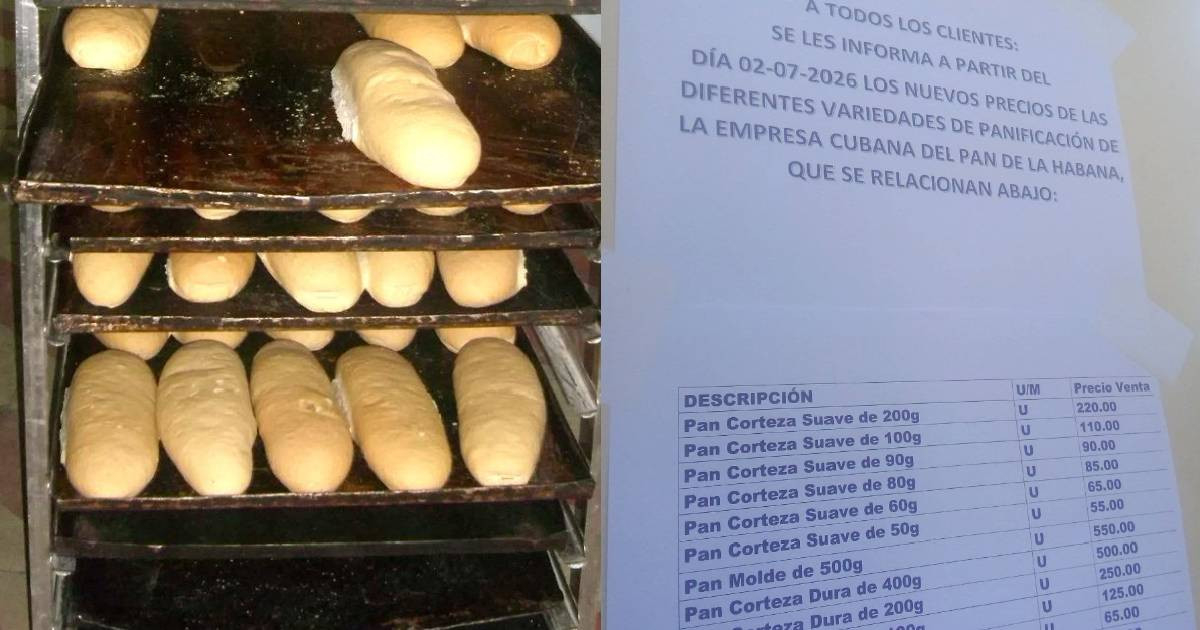
Private entrepreneur and engineer Yulieta Hernández Díaz took to Facebook on Sunday to share a photo of an official notice posted in Havana's Empresa Cubana del Pan establishments. The notice announced that starting July 2, all bread varieties would see a price hike, with no public explanation or transition period provided.
The document stated that soft-crust bread weighing 200 grams is now priced at 220 Cuban pesos, while a 100-gram loaf costs 110 pesos. A 500-gram loaf of sandwich bread is set at 550 pesos, and a 400-gram hard-crust bread at 500 pesos. The 40-gram tortica, one of the more affordable options, is now sold for 40 pesos.
Hernández initially thought the notice was fake. "I saw this on social media... thought it was fake, but it's not," she wrote. While she believes the state shouldn't be producing bread, she criticized the way the decision was implemented.
"These measures, introduced without prior explanation, after decades of state-controlled bread production amidst the current polycrisis, are baffling. At the very least, the decision should have been explained. Then, a transition should have been defined: auction or lease the bakeries transparently, without discretion. You can't change the scheme overnight or raise prices without clear information," she asserted.
Hernández argued that the state should focus on ensuring the importation of wheat and the production and distribution of flour, rather than controlling the entire production chain. In her view, this would allow private producers to benefit from lower logistical costs and greater supply stability.
The Social Toll of Rising Bread Prices
She also warned of the social consequences of the price increase in a context marked by power outages, shortages, and declining purchasing power. "We're on vacation, with children at home. Many mothers have no options to feed them or keep them entertained, with no electricity to preserve food or cook. A piece of bread, in this context, can be a child's or an elderly person's meal," she wrote.
Hernández concluded that the issue isn't just the economic adjustment but how it is executed: "There are ways to implement such decisions without causing such chaos."
Economic Hardship Intensified
The price surge directly impacts Cubans' income. The new minimum wage of 3,210 pesos took effect on July 1, yet workers won't begin receiving it until August. With that amount, a worker could only purchase about 14 loaves of 200-gram bread per month.
Retirees face even harsher conditions, with a minimum pension of 3,056 pesos, while economists estimate that basic needs require about 96,000 pesos monthly.
The announcement stirred outrage on social media, with many users criticizing the government for raising prices without offering solutions to shortages or explaining the decisions. Others recalled the closure or intervention of private bakeries that previously offered a wider range of products and prices.
In February, a mother of eight in Matanzas reported paying 200 pesos for each loaf of soft bread. In Villa Clara, since February, rationed bread has only been provided to children under 13 and seniors over 65.
This increase comes amidst declining flour supplies nationwide. In May, Ciego de Ávila received just 32 tons of flour, enough for two days of rationed bread for its over 430,000 residents. Cuba requires about 20,000 tons monthly to ensure bread for the ration book, while its wheat mills remain idle or operate at minimal capacity.
In 2025, national bread production fell by 100,900 tons, and 17 food sector companies reported losses totaling 364 million pesos.
Understanding the Bread Price Crisis in Cuba
Why did bread prices increase in Havana?
Bread prices increased due to new pricing measures by the Empresa Cubana del Pan, effective July 2, without public explanation or transition period.
How does the price hike affect Cuban families?
The price hike impacts Cuban families by reducing their purchasing power, especially amidst economic hardships like power outages and shortages, making bread less accessible to impoverished families.
What are the social implications of the bread price increase?
The social implications include increased difficulty for families to provide basic meals, particularly affecting children and the elderly, as well as heightened public frustration over the lack of government transparency and solutions.