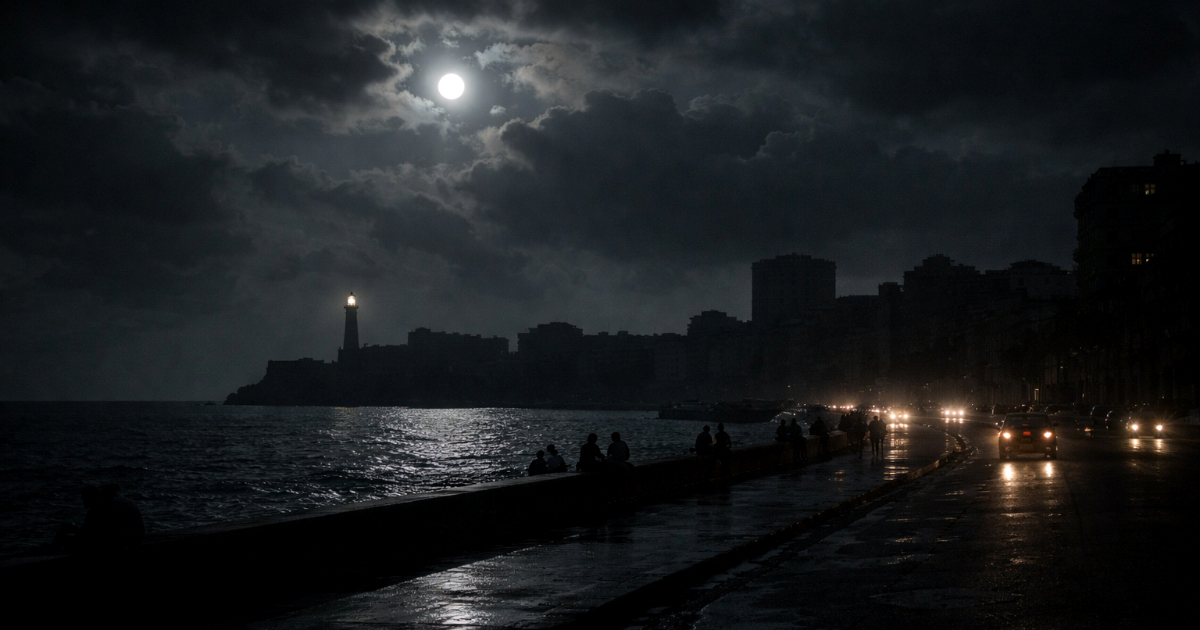
This Tuesday, Cuba is bracing for another day of extensive power outages. The state-run Unión Eléctrica predicts an impact of 2,082 MW during the evening peak, with a meager availability of 1,148 MW against an anticipated maximum demand of 3,200 MW, leading to an expected shortfall of 2,052 MW.
According to the state entity's report, the electrical service faced interruptions throughout the entire day on Monday, including the early hours, due to insufficient generating capacity. The most significant impact occurred at 8:50 PM, when the deficit reached 2,140 MW, affecting all provinces across the nation.
Three thermal power units are currently out of service: Unit 6 of the Máximo Gómez Thermoelectric Plant in the Mariel Special Zone; Unit 6 of the Diez de Octubre Thermoelectric Plant in Nuevitas; and Unit 2 of the Lidio Ramón Pérez Thermoelectric Plant in Felton.
Additionally, four other facilities are undergoing maintenance: Unit 5 of Máximo Gómez, Unit 3 of the Ernesto Guevara De La Serna Thermoelectric Plant in Santa Cruz, Units 5 and 6 of the Antonio Maceo Thermoelectric Plant in Renté, and Unit 5 of Diez de Octubre.
Compounding the issue, 106 distributed generation plants remain offline due to fuel shortages, along with the Regla Barge, the Melones Barge, the Mariel Central Fuel, and the Moa Central Fuel.
On Monday, the 54 solar photovoltaic parks generated 5,011 MW/hour with a peak capacity of 708 MW, but their contribution vanishes at night when demand peaks and the system falters.
This grim scenario unfolds just five days after Cuba's historic electricity deficit on June 25, when the impact soared to 2,208 MW.
The Antonio Guiteras Thermoelectric Plant, the country's largest, rejoined the grid early Monday, but its return did little to ease the crisis. By 6 AM, total availability was only 1,100 MW against a demand of 2,800 MW. The plant has exited the system 16 times thus far in 2026 and hasn't undergone major maintenance since 2010, with damage to over 500 economizer tubes.
The plant's director, Román Pérez Castañeda, acknowledged in May that the facility requires a 180-day shutdown for thorough repairs but admitted that "the country's situation still doesn't allow it."
The crisis stems from deep-rooted issues: decades of underinvestment in infrastructure, aging thermoelectric plants, and the interruption of Venezuelan oil supplies—providing between 25,000 and 30,000 barrels daily—since January 2026. The impact on the population is severe: 20 to 24-hour daily blackouts in Havana, outages over 48 hours in Granma and Santiago de Cuba, and up to 85 consecutive hours without electricity in Matanzas. Between March and April 2026, more than 2,300 protests related to the outages occurred amid the worst energy collapse in Cuba's recent history.
Understanding Cuba's Current Energy Crisis
What is causing Cuba's power outages?
Cuba's power outages are primarily due to aging infrastructure, lack of investment, and the cessation of Venezuelan oil supplies. These factors have led to insufficient power generation capacity to meet demand.
How long are the power outages in Cuba?
Power outages in Cuba can last from 20 to 24 hours daily in Havana, over 48 hours in Granma and Santiago de Cuba, and up to 85 continuous hours in Matanzas.
What are the consequences of the energy crisis for the Cuban population?
The energy crisis has led to widespread blackouts, severely impacting daily life. It has also sparked over 2,300 protests between March and April 2026, highlighting the public's frustration with the ongoing situation.