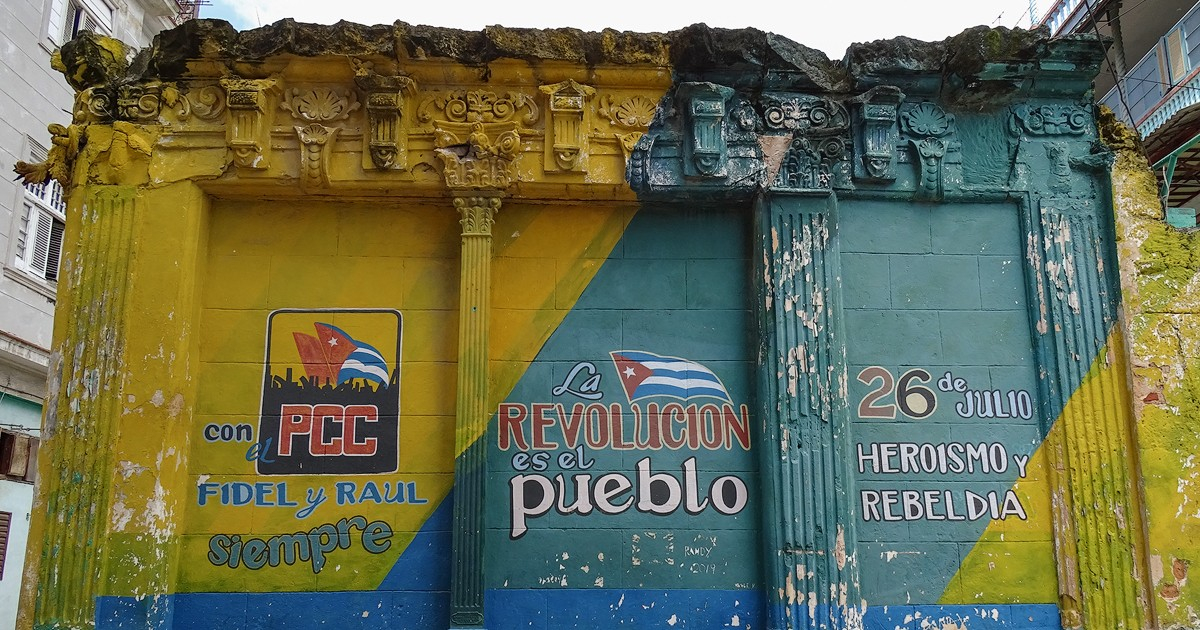
Elizabeth González Aznar took to Facebook this Sunday to publish an open letter addressed to the leaders of Cuba's state and government, questioning the financial burden of maintaining entities like the Communist Party of Cuba (PCC), the Committees for the Defense of the Revolution (CDR), the Federation of Cuban Women (FMC), the Cuban Workers' Central (CTC), and the Union of Young Communists (UJC).
González's criticisms come amid recent governmental reforms that propose reducing the number of ministries from 27 to 20. She argues that if the government is willing to downsize state structures, the same approach should be applied to these political and mass organizations.
The Economic Drain of Mass Organizations
In her letter, González emphasizes that these organizations offer no tangible economic benefit while consuming significant state resources through their extensive bureaucratic networks. "These organizations contribute nothing economically, yet they drain state budgets with their various levels of representation, which I believe are unnecessary," she wrote.
Her focus is particularly sharp on the CDR, established in 1960 as a neighborhood watch mechanism, now comprising about eight million Cubans over 14 years old across 133,000 base committees. González questions the need for four hierarchical levels—local, municipal, provincial, and national—given that modern communication could easily relay directives directly to neighborhoods.
Criticism of Inefficiency and Corruption
González further criticizes the CDR for administrative inefficiency and alleges corruption within these structures. "Behind all this lie resource diversions, theft, bloated payrolls, and officials living off their titles," she claims. Her critique arrives amid growing public discontent with the CDR and its national coordinator, Gerardo Hernández Nordelo, who sparked outrage in June by dismissing criticism with arrogance, citing his 16-year imprisonment in the United States as entitlement to act as he pleases.
Proposing a Shift to Independence
Beyond the CDR, González extends her critique to the FMC, CTC, and UJC, suggesting that these entities should evolve into independent NGOs or civil societies without mandatory state funding. "Ultimately, these mass organizations could transform into NGOs or civil societies dedicated to the social aspects of humanity, rather than being state-funded entities that offer no contributions," she proposed.
Her letter emerged shortly after Prime Minister Manuel Marrero Cruz presented a document on June 20 with 176 transformation proposals grouped into 23 axes, necessitating 32 new legal norms. Notably, none of these proposals address the mass organizations linked to the PCC, which continue to receive funding from the state budget under "Political and Mass Organizations" without public breakdowns by organization.
"I urge the country's leaders to disclose the financial cost of maintaining the entire structure of these organizations," González concluded, demanding accountability that the regime has yet to provide.
Understanding Cuba's Political and Mass Organizations
What is the role of the Committees for the Defense of the Revolution (CDR) in Cuba?
The CDR was founded in 1960 as a neighborhood watch mechanism aimed at promoting vigilance among citizens. Today, it includes nearly eight million Cubans over 14 years old, organized into 133,000 base committees.
Why does Elizabeth González Aznar criticize these organizations?
González criticizes these organizations for their lack of economic contribution while consuming significant state resources. She also alleges inefficiency and corruption within their structures.
What changes does González propose for these organizations?
She suggests that these organizations should transition into independent NGOs or civil societies, eliminating mandatory state funding and focusing on social contributions.