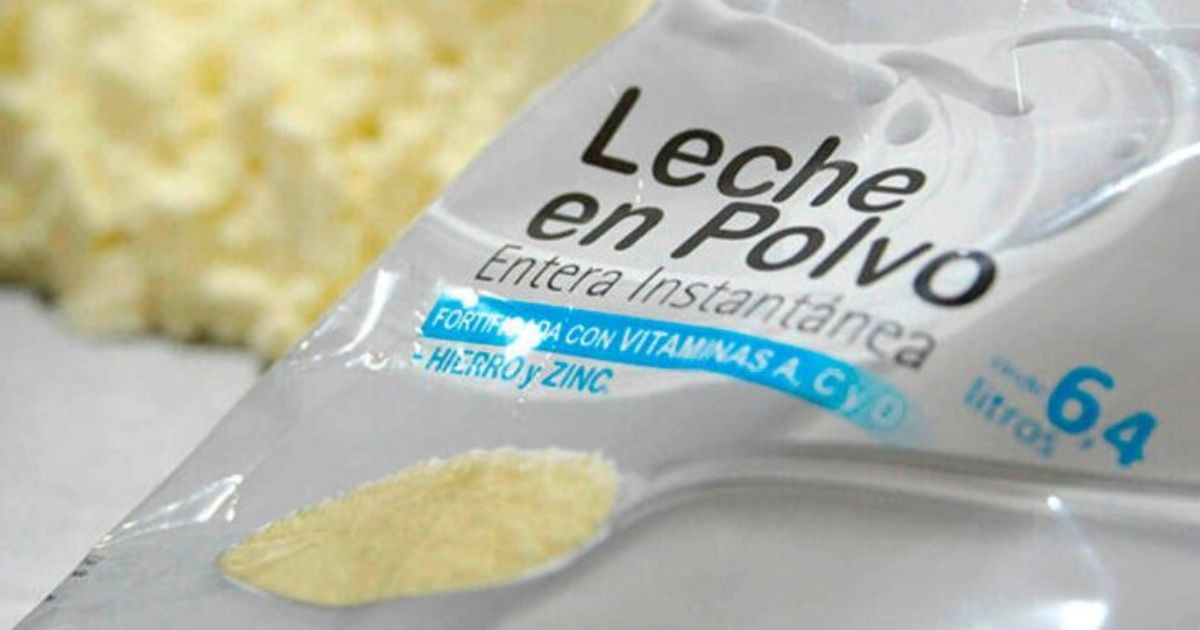
In Ciego de Ávila, the cost for half a kilogram of whole milk powder soared to an astonishing 2,333 Cuban pesos in April 2026, marking the highest price recorded nationwide for this essential product, as reported by the National Office of Statistics and Information (ONEI) on their social media platforms.
This Tuesday, the ONEI released its report titled "Minimum and Maximum Prices of Selected Varieties by Territories, April 2026," highlighting a significant disparity between provinces and painting a grim picture for Cuban consumers.
Cienfuegos followed closely with the second highest price, where 500 grams of powdered milk reached 2,200 pesos.
On the other end, the lowest price in the country was found in Bayamo, Granma province, at 700 pesos, followed by 775 in Havana, 850 in San José de las Lajas, and 880 in Pinar del Río.
These four regions were the only ones where the product remained under 1,000 pesos. In contrast, the minimum price in other parts of the country exceeded this threshold.
Price Disparities Across Provinces
The internal price variations are quite striking. According to the ONEI, "the territories with the most significant variation were Havana and Ciego de Ávila, both with a difference of 1,133 Cuban pesos between the minimum and maximum prices," while Artemisa showed the smallest difference, at just 100 pesos.
This gap becomes even more critical when compared to the average monthly salary in Cuba in 2025, which the ONEI pegged at 6,930 pesos, roughly equivalent to 12 dollars at the prevailing informal exchange rate.
This means that half a kilo of milk powder in Ciego de Ávila could devour up to a third of a state worker's monthly salary. A full kilo at the maximum price would cost more than two-thirds of that income.
The Vanishing Milk Powder and Alternatives
The situation is exacerbated by the fact that milk powder has almost vanished from the rationed food basket.
In December 2024, the Ministry of Domestic Trade admitted its inability to supply milk for all children and offered chocolate mix as a substitute. A month later, in January 2025, some areas received cola syrup as an alternative for children's milk, a stark symbol of the deepening food crisis.
Meanwhile, the product has resurfaced in foreign currency stores managed by the military conglomerate GAESA. In January 2026, milk powder reappeared in Havana supermarkets priced between 7.75 and 8.75 dollars per bag, unaffordable for most Cubans.
In a recent development, Uruguay announced the shipment of milk powder to Cuba, but demanded assurances that it wouldn't be resold in foreign currency stores amid reports that 25-kilogram Conaprole brand bags were being sold in GAESA outlets for 243 dollars.
The ONEI data underscores that, without state distribution, Cubans must turn to the informal market or small private enterprises to obtain a product that should be provided for children under six, paying prices that consume an unsustainable portion of their income.
Cuban Milk Powder Crisis: Key Questions Answered
What is the highest recorded price for milk powder in Cuba?
In April 2026, the highest recorded price for half a kilogram of milk powder in Cuba was 2,333 Cuban pesos in Ciego de Ávila.
How does the price of milk powder compare to the average salary in Cuba?
The price of half a kilo of milk powder in Ciego de Ávila can consume up to a third of the average monthly salary of a state worker, which was 6,930 pesos in 2025.
What alternatives have been provided for milk powder in Cuba?
The Ministry of Domestic Trade offered chocolate mix and even cola syrup as substitutes for milk powder, illustrating the severity of the food crisis.