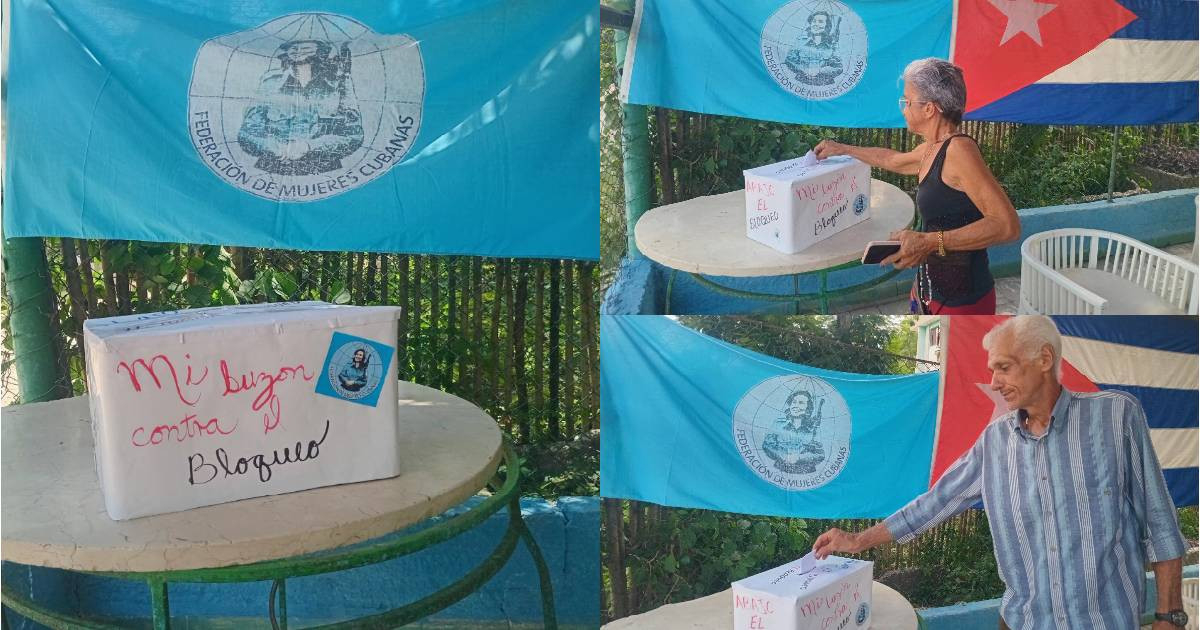
The Federation of Cuban Women (FMC) in Granma province has introduced a new campaign titled #MyMailboxAgainstTheEmbargo. Launched on Friday, this initiative aims to gather letters and written messages condemning the U.S. embargo, coinciding with the Family Day activities held every May 15.
The town of Las Mangas was the first stop in this campaign that plans to cover all municipalities in the province. Open to people of all ages, the call for participation is framed as "support for rejecting the arbitrary policies promoted by Donald Trump's administration," according to a Facebook post by athlete María Elena Cisneros Ferrer, a resident of Bayamo.
White cardboard mailboxes, adorned with slogans like "End the Blockade" and "Break the Embargo," have been placed in outdoor community spaces alongside the FMC flag.
This campaign is part of a broader wave of political mobilizations orchestrated by the Cuban government in recent months amidst heightened tensions between Cuba and the United States, and potential military actions from Washington against Havana's authoritarian regime.
The Communist Party boasted about collecting over six million signatures in the "My Signature for the Homeland" campaign, which were presented to leader Miguel Díaz-Canel on May 1st at the Anti-Imperialist Tribune José Martí in Havana.
That campaign was marred by allegations of coercion. A leaked audio recording revealed a Ministry of the Revolutionary Armed Forces (FAR) official threatening civilian workers of the state corporation Cimex, saying, "If you disagree with this, you can resign."
The day before, Santiago de Cuba hosted the official handover of the provincial signatures, collected even from remote areas of the Sierra Maestra, in an event that also drew ridicule on social networks.
The public response to the new mailbox campaign was similarly skeptical. Comments on the FMC's post were filled with sarcasm and disbelief.
Yandy Ogando questioned, "Oh, so there's paper for letters? And here we are writing medical notes on scraps of paper."
Alexandra Rivas Almarares was more blunt. "The embargo is the audacity of leaving people without electricity for 34 hours while others enjoy privileges that I'm sure many of us don't have," she stated.
Freddy Batista asked, "Why not write letters for political prisoners to be freed? Why not write about human rights when neither you nor anyone else can vote for your country's president?"
Jorge Félix Castro sarcastically inquired, "And what happens to the letters afterward? Do they use them to cast a spell on Marco Rubio, or do they send them to soften his heart?"
Basilio Sanchez highlighted the core issue, questioning, "And what about the internal blockade, which is the main one and can be resolved, when will that be addressed?"
Finally, Leyanis Isabel Silva Jomarrón summarized the widespread sentiment: "This is what we call indoctrination."
The pattern of using letter-writing campaigns as a propaganda tool has parallels in the region. In January, Venezuelan chavismo organized a similar initiative, collecting letters of support for former President Nicolás Maduro and his wife Cilia Flores from Bolívar squares across the South American country, which was met with a similar wave of public mockery online.
The Impact of Political Campaigns in Cuba
What is the purpose of the #MyMailboxAgainstTheEmbargo campaign?
The campaign seeks to gather public letters and messages criticizing the U.S. embargo on Cuba, as a part of activities for Family Day, highlighting opposition to American policies.
How has the Cuban public reacted to the new campaign?
The public has responded with skepticism and irony, reflecting a general disbelief in the effectiveness and sincerity of such campaigns.
What parallels exist between this campaign and others in the region?
Similar to this initiative, the Venezuelan government previously organized a letter-writing campaign to support Nicolás Maduro, which also faced public ridicule.