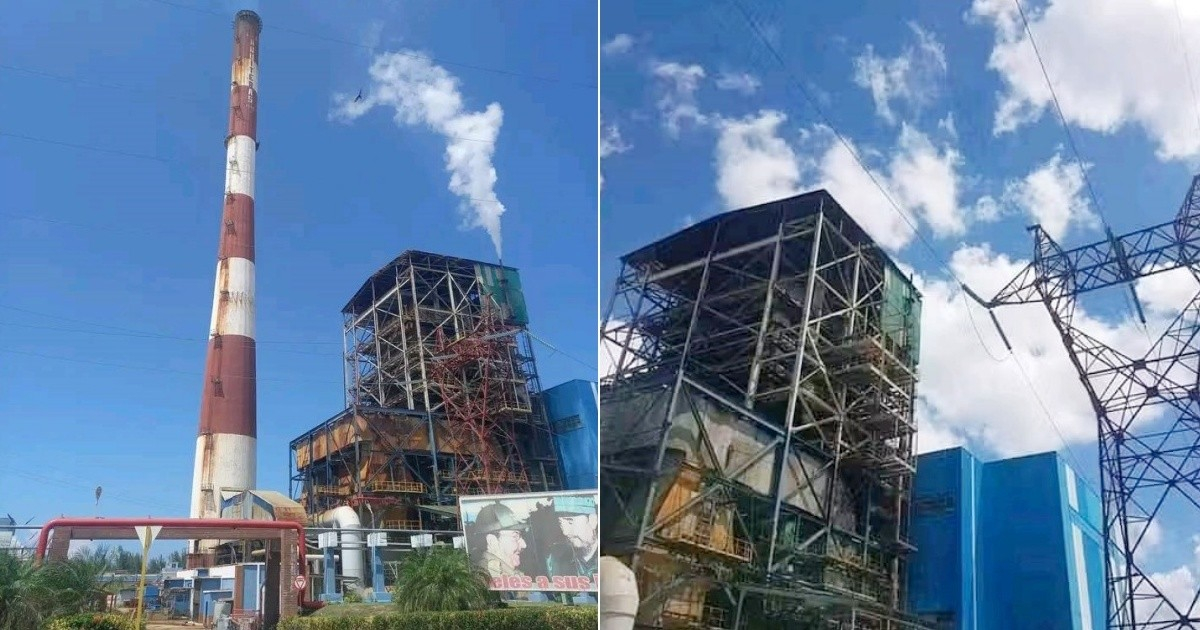
The Electric Union (UNE) announced on Saturday at 8:38 AM that the Antonio Guiteras Thermoelectric Power Plant has been reconnected to the National Electric System (SEN), marking its return four days after its latest malfunction.
Last Tuesday at 9:12 AM, the plant was taken offline due to another boiler malfunction, marking its eighth outage so far in 2026.
Román Pérez Castañeda, the plant's director, confirmed on Saturday that approximately 300 corrective measures were implemented without interruptions to facilitate the restart.
Earlier in the week, Jorge Gómez Sánchez, the production deputy director, informed Radio 26: "If everything continues as it has, Guiteras should be synchronized before Mother's Day and operating above 200 megawatts."
The synchronization was achieved a day ahead of May 10, yet it fails to brighten the bleak electrical outlook for the country.
Electricity Demand vs. Supply
According to UNE's Saturday report, as of 6:00 AM, the SEN's availability was merely 1,390 MW against a demand of 2,790 MW, with 1,422 MW affected at that time.
By midday, an estimated 1,350 MW impact is anticipated.
The situation worsens for the evening peak, with UNE forecasting an availability of 1,590 MW—including Guiteras' 200 MW—against a demand of 3,300 MW, resulting in a deficit of 1,710 MW and an expected impact of 1,740 MW.
Ongoing Energy Crisis
Friday was one of the most challenging days of the week. The peak impact on May 8 reached 1,922 MW at 10:00 PM after an unexpected shutdown of Unit 3 at the Renté Power Plant.
Other units remain out of service this Saturday: Unit 2 at Lidio Ramón Pérez Power Plant and Units 3 and 5 at Antonio Maceo Power Plant are down due to malfunctions; Unit 5 at Mariel Power Plant, Unit 6 at Renté Power Plant, and Unit 5 at Nuevitas Power Plant are under maintenance. Limitations in thermal generation result in 358 MW being offline.
Matanzas, the province hosting Guiteras, ironically suffered the most this week. Power outages in Matanzas exceeded 40 continuous hours on Wednesday, as confirmed by Kenny Cruz González, the provincial Electric Company’s technical deputy director, on TV Yumurí.
Structural Causes of the Crisis
The crisis has deep roots. Cuba needs between 90,000 and 110,000 barrels of oil daily but only produces around 40,000 internally.
The only significant shipment in 2026 was from the Russian tanker Anatoli Kolodkin, delivering approximately 730,000 barrels donated by Russia, which are now depleted. A second Russian vessel, the Universal, carrying around 270,000 barrels of diesel, remains adrift in the Atlantic with no confirmed destination due to U.S. sanctions pressure.
On May 2, Miguel Díaz-Canel acknowledged before international solidarity delegates: "That oil is running out these days and we don't know when more fuel will arrive in Cuba."
As Guiteras contributes 200 MW to the system on the eve of Mother's Day, with a projected deficit of 1,710 MW for Saturday night's peak, prolonged blackouts will continue to burden Cubans.
Understanding Cuba's Energy Challenges
What led to the frequent outages at the Antonio Guiteras Plant?
The frequent outages at the Antonio Guiteras Plant are primarily due to recurring boiler malfunctions, which have caused the plant to go offline multiple times in 2026.
Why is there a significant gap between electricity demand and supply in Cuba?
The gap is largely due to Cuba's reliance on imported oil to meet its energy needs, coupled with insufficient domestic production and equipment malfunctions that limit electricity generation.
What is the impact of the U.S. sanctions on Cuba's energy sector?
U.S. sanctions contribute to difficulties in securing fuel shipments, as evidenced by the Russian vessel Universal, which is unable to confirm a destination due to these pressures.