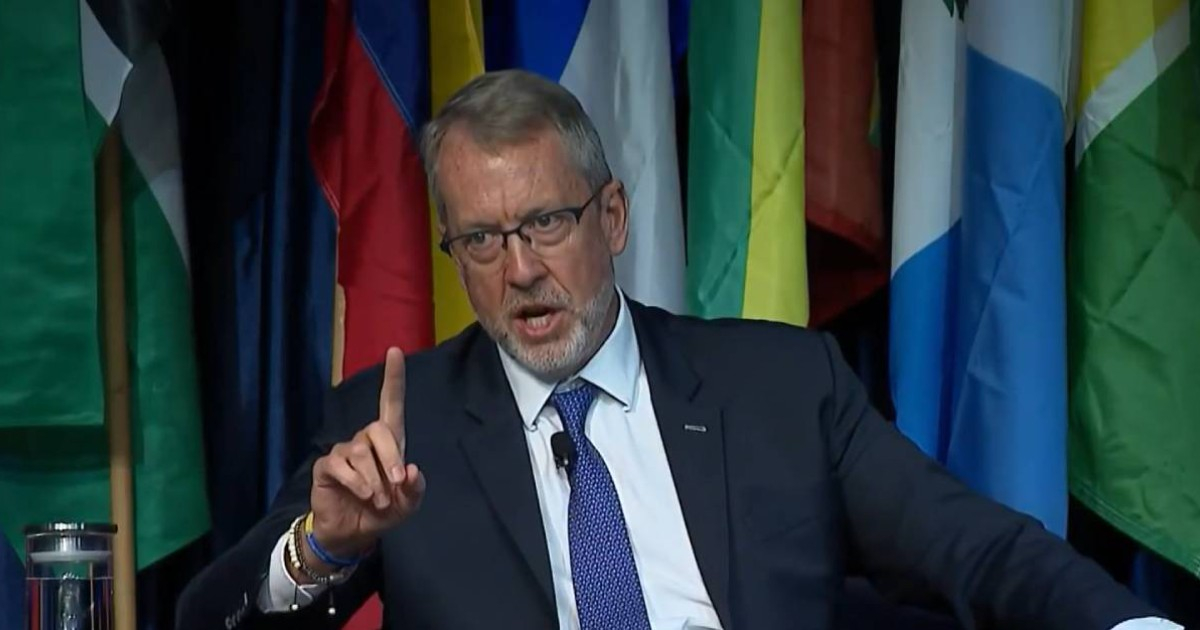
James Story, the former U.S. ambassador to Venezuela, cautioned that postponing democratic reforms in Venezuela plays into the hands of Chavismo and weakens Washington's position. He shared these insights on Wednesday during a forum focused on Latin America's political landscape at Florida International University (FIU) in Miami. The event also featured Cuban activist Rosa María Payá and analyst Frank Mora.
According to Story, each day without concrete steps towards democracy in Venezuela reduces the leverage the U.S. holds. He emphasized the urgency by stating, "Every day we delay the transition, we lose the momentum and opportunities we have." Story, who served as the leading U.S. diplomat to Venezuela during both the Trump and Biden administrations, expressed concerns about strategies solely reliant on diplomatic normalization or oil deals, warning they might inadvertently bolster the Venezuelan political system instead of weakening it.
He mentioned the anticipation surrounding María Corina Machado's potential rise, not only to participate in elections but also to aid in Venezuela's reinstitutionalization. This discussion arises amidst significant political shifts occurring in Venezuela.
Meanwhile, Secretary of State Marco Rubio unveiled a three-step plan—stabilization, recovery, and transition—following Nicolás Maduro's capture on January 3, 2026, during the so-called "Operation Absolute Resolution." Deputy Secretary of State Christopher Landau has urged patience, noting the transition commenced just four months ago. The U.S. reopened its embassy in Caracas on March 14, 2026, formally recognizing Delcy Rodríguez as the interim head of state.
The forum also touched on the situation in Cuba, revealing differing viewpoints. Story pointed out a crucial distinction between the two nations: "At least in Venezuela, there was room for democratic opposition... so I question myself: what can be done in Cuba?"
Mora argued that economic sanctions alone have historically failed to instigate political change in Cuba, emphasizing that internal pressure is key, citing the July 11, 2021, protests as a case in point.
Conversely, Payá advocated for economic pressure on the Cuban regime, stating, "The interests of those criminals in power in Cuba must be affected to force them to submit to the Cuban people's will for change."
Additionally, Payá criticized the regime's recent distribution of a family guide for potential military aggression as a fear tactic. "The Cuban regime is, as always, heightening rhetoric to sow panic, while the true violence comes from those in power," she declared.
The repressive climate in Cuba supports this view: the Cuban Observatory of Human Rights documented 366 repressive actions in April alone, including arrests, harassment, and surveillance against activists and families of political prisoners. By late February 2026, Prisoners Defenders reported 1,214 political prisoners in Cuba.
Insights on Venezuela's Political Transition
What are the potential consequences of delaying democratic reforms in Venezuela?
Delaying democratic reforms in Venezuela may strengthen the Chavismo regime, reducing the diplomatic leverage and opportunities the U.S. has to influence positive change.
How does the U.S. plan to support Venezuela's transition?
The U.S. has laid out a three-phase plan involving stabilization, recovery, and transition, following a significant political shift marked by Maduro's capture in early 2026.
Why is economic pressure on Cuba considered necessary by some activists?
Economic pressure is seen as crucial by some activists because it targets the interests of the ruling regime, potentially forcing them to yield to the population's desire for change.