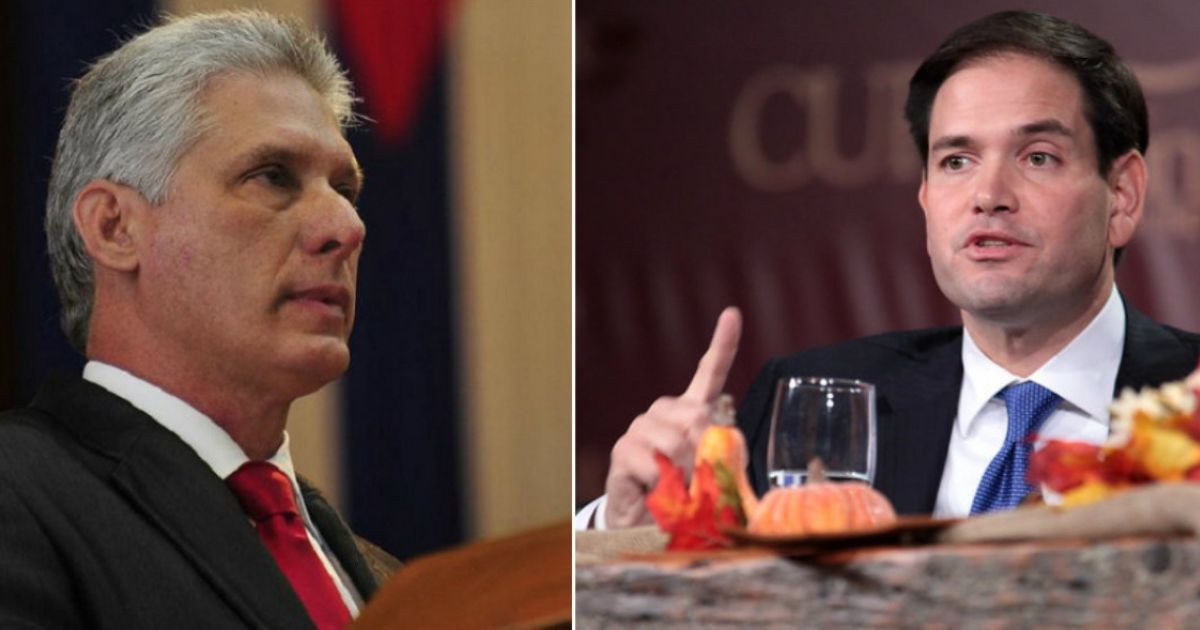
On Wednesday, Miguel Díaz-Canel took to social media platform X to directly address Secretary of State Marco Rubio's recent public denial of a U.S. oil embargo against Cuba. Díaz-Canel expressed "astonishment" at what he described as Rubio's apparent ignorance of his own government's policies.
During a White House press briefing, Rubio had previously stated there was no formal oil blockade on Cuba, instead blaming the island's energy crisis on the cessation of free Venezuelan oil, which ended after Nicolás Maduro's capture in early January.
Díaz-Canel countered by referencing Executive Order 14380, signed by President Trump on January 29: "It's surprising that a senior U.S. government official publicly claims there is no energy blockade against Cuba, unaware of the Executive Order issued by his own president."
The Cuban leader went further, questioning Rubio's awareness: "It's shocking that he hasn't heard his president or the White House spokesperson address the issue."
Additionally, Díaz-Canel dismissed Rubio's attribution of Cuba's economic woes to alleged Cuban incompetence: "Equally astonishing is his blaming of Cuban incompetence for the economic challenges, which the U.S. government has actively sought to exacerbate by investing significant resources and political capital."
Foreign Minister Bruno Rodríguez Parrilla had already responded to Rubio on Wednesday, accusing him of lying and contradicting the President and the White House spokesperson, labeling Rubio as the "architect of the siege."
Executive Order 14380 labeled Cuba as an "unusual and extraordinary threat" to U.S. national security and imposed secondary tariffs on any country, shipping company, or entity supplying oil to Cuba, slashing the island's energy imports by 80% to 90%.
The impact on the ground has been dire for the Cuban populace: power outages lasting up to 25 hours a day affect over 55% of the territory, exacerbated by a malfunction at the Guiteras thermoelectric plant, which has raised the energy deficit to 1,750 megawatts.
Russian oil, considered a partial substitute for Venezuelan supplies, only meets about 10% of Cuba's energy needs, while the country produces approximately 40,000 barrels daily against a demand of 90,000 to 110,000 barrels.
On May 1, Trump signed a second executive order expanding sanctions against the regime to sectors including energy, defense, mining, and finance, imposing secondary sanctions on foreign banks dealing with sanctioned Cuban entities.
This exchange occurs amidst heightened tensions: last Sunday, Díaz-Canel evoked the "War of All the People" doctrine, warning of an alleged imminent U.S. military assault, while Rubio suggested upcoming changes without specifying measures, describing Cuba as an "unacceptable situation" just 90 miles from U.S. shores.
Since January 2025, the Trump administration has implemented over 240 sanctions against Cuba and intercepted at least seven oil tankers bound for the island, while Cuba's economy is projected to contract by 7.2% in 2026, according to The Economist Intelligence Unit.
Cuba-U.S. Tensions and Energy Embargo
What is Executive Order 14380?
Executive Order 14380, signed by President Trump, declared Cuba an "unusual and extraordinary threat" to U.S. national security and imposed secondary tariffs on entities supplying oil to Cuba, significantly reducing the island's energy imports.
How has the U.S. oil embargo impacted Cuba?
The embargo has led to severe energy shortages in Cuba, causing power outages of up to 25 hours daily for over 55% of the territory and contributing to a significant energy deficit.
How has the Trump administration intensified restrictions on Cuba?
Since January 2025, the Trump administration has imposed over 240 sanctions against Cuba, targeting sectors such as energy, defense, mining, and finance, as well as intercepting oil shipments to the island.