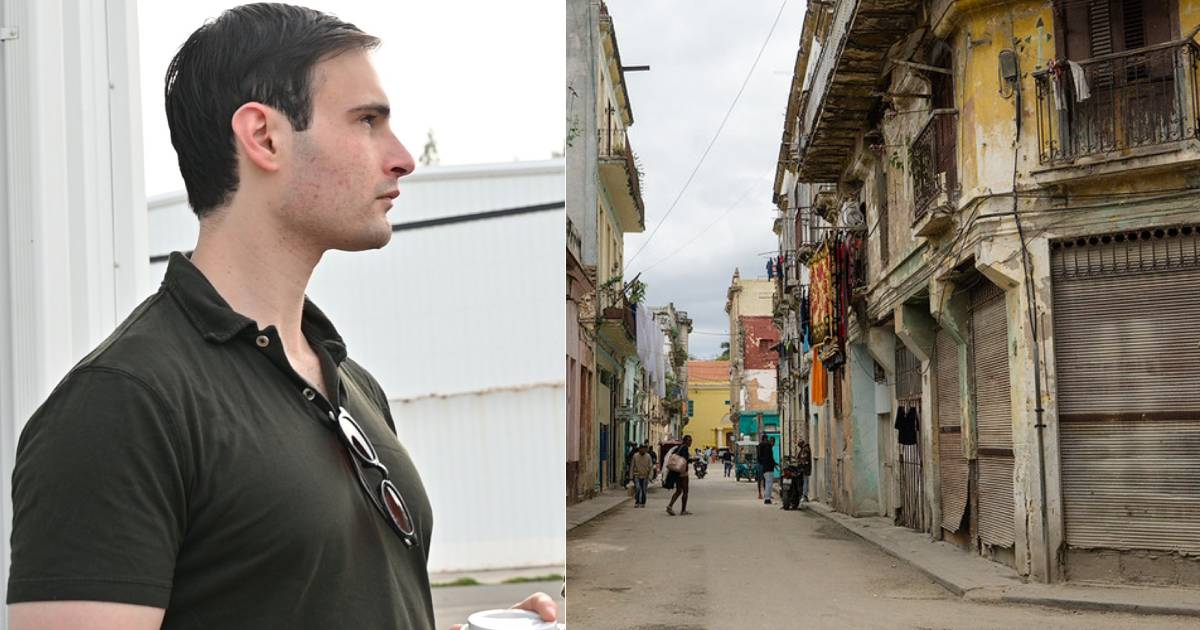
Jeremy Lewin, Deputy Secretary of Foreign Assistance for the State Department and Senior Adviser to Secretary Marco Rubio, labeled Cuba's communist system as a "cruel deception" in a post on X this past Sunday. His remarks were a direct response to an AP report detailing the collapse of the island's ration card system.
The article Lewin responded to highlighted the dire condition of state-run stores in Havana during April and May of 2026, where shelves were almost completely bare, leaving thousands of families without food options.
"Store shelves are utterly devoid of essential goods due to decades of rampant corruption and unfathomable incompetence by the regime's elites," Lewin wrote.
He accused the Cuban regime of diverting resources solely toward domestic repression and state-run tourism ventures, "which merely serve to inflate the offshore accounts of GAESA and the regime's kleptocrats."
Lewin concluded by pointing out, "It's no surprise that over a million Cubans fled to the U.S. during the Biden years alone," as a direct consequence of such a system.
The Collapse of Cuba's Ration Card System
The report that prompted Lewin's comments paints an unprecedented crisis. José Luis Amate López, a Havana storekeeper responsible for 5,000 assigned clients, reported having no customers for nearly two weeks at the end of April.
During that month, his store had only rice, sugar, and split peas available.
"No Cuban can truly survive on ration card goods," Amate López told the AP.
Ana Enamorado, a 68-year-old resident of Havana, managed to purchase only split peas and a kilogram of sugar in April. Her combined salary and pension amount to 8,000 Cuban pesos, roughly equivalent to $16 per month.
"The ration card offers almost nothing. We're practically living on air," she said. "Now we have to cut back, eat once a day, and live on memories."
Economic and Social Implications
This dire situation is part of the historic collapse of the ration card system in 2026. Cuba imports up to 80% of the food it consumes, yet the regime lacks the funds to sustain this system, according to William LeoGrande, a professor at American University, who noted that the government "botched" the 2021 monetary unification, leading to inflation rates as high as 470%.
Lewin's statements are not isolated. In February, he asserted that the Cuban regime has deliberately kept the country impoverished to maintain absolute control. In March, he criticized Cuban medical missions as one of the worst examples of modern slavery, noting that the state withholds between 70% and 85% of the doctors' salaries.
On the same day Lewin published his post, Díaz-Canel admitted to foreign communists gathered in Havana that Cuba "will eat what we are able to produce," an implicit acknowledgment of the failure of the subsidized import model.
Rising Food Insecurity
The food crisis has reached alarming proportions: deaths from malnutrition increased by 74.42% between 2022 and 2023, and 96.91% of the population lacks adequate access to food, according to the Food Monitor Program.
Some 80% of Cubans believe the current situation is worse than the Special Period of the 1990s.
Rosa Rodríguez, a 54-year-old without overseas remittances, earns 4,000 pesos — about eight dollars — a month and in April, only received a donation of four pounds of rice from her local store.
"Everything is scarce here, everything, even that damn bread they give us. If I buy beans, I can't afford sugar. If I retire, I'll starve," she told the AP.
Key Questions on Cuba's Economic Crisis
What triggered the recent criticism of the Cuban system by U.S. officials?
The criticism was prompted by an AP report detailing the collapse of the ration card system in Cuba, highlighting severe shortages in state-run stores and widespread food insecurity.
How has the Cuban government responded to the food crisis?
Díaz-Canel admitted that Cuba will only be able to consume what it can produce, acknowledging the failure of the subsidized import model amidst the ongoing crisis.
What impact has the economic situation had on the Cuban population?
The economic situation has resulted in increased malnutrition, with deaths rising by 74.42% between 2022 and 2023, and a significant portion of the population lacking access to adequate food.