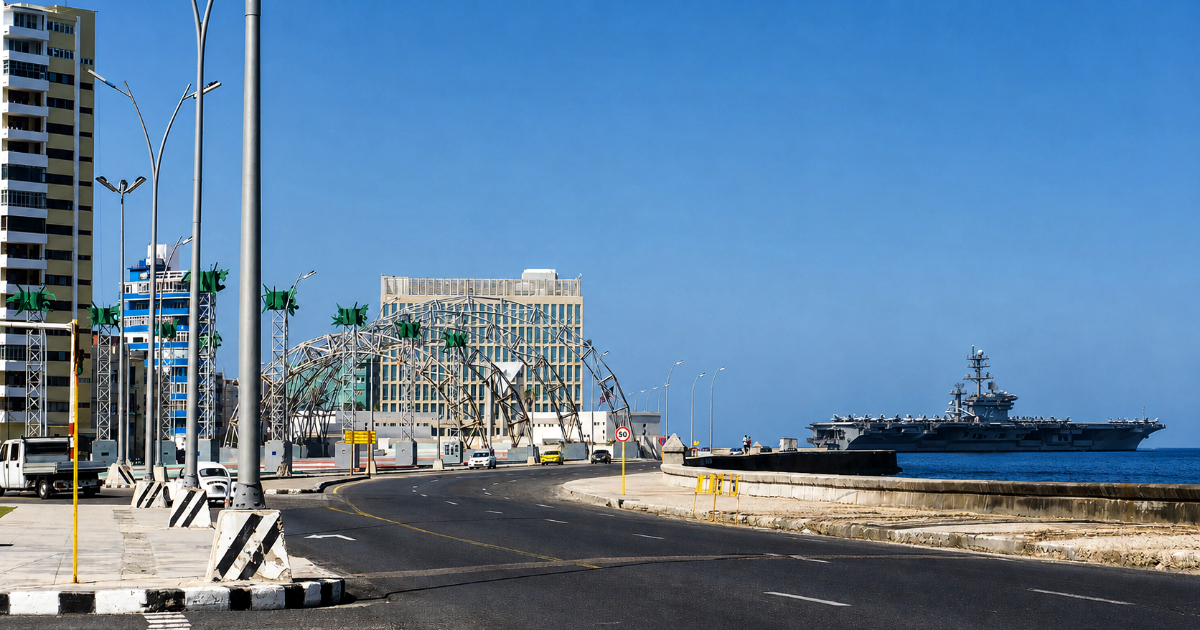
The thought of a U.S. aircraft carrier stationed near Havana's iconic Malecón may seem like something out of a movie, yet in today's climate, it feels less like fiction. This powerful symbol could serve as a direct challenge to the oppressive Cuban regime.
While the regime's reaction is predictable, the more pressing question is: how would everyday Cubans respond?
The response is complex, but there are clear indicators.
The Current Crisis and Its Impact on Cuban Society
Cuba is currently enduring an exceptionally challenging period in its history. The nation faces extensive power outages lasting over 20 hours, severe shortages, crumbling public services, and a rapidly deteriorating quality of life, pushing the country to its limits.
Adding to these hardships is a persistent rise in spontaneous protests centered on demands for food, electricity, and improved living conditions, despite the regime's relentless repression.
Potential Reactions from the Cuban Population
In such a critical environment, how might Cubans react to the sight of a U.S. aircraft carrier off their shores? There are three potential paths of response:
The First Path: Release of Pent-Up Frustrations
The accumulated exhaustion among Cubans is not just theoretical; it's tangible. Hunger, darkness, soaring inflation, shortages, endless queues, plummeting production, and the spread of waste and disease have all taken a toll. Hospitals lack essential resources, exacerbating the crisis.
This societal strain has previously manifested, notably during the protests of July 11, 2021, and is resurfacing through banging pots and pans, nighttime protests, and localized outbursts.
The appearance of an aircraft carrier near Havana might not be seen as a threat by many but as an unprecedented signal in 67 years of fraught relations with the neighboring superpower. This might ignite a spark for change, potentially serving as a catalyst for action.
While it may not lead to an organized movement immediately, it could start as a chaotic ripple, growing into a massive uprising with Cubans taking to the streets.
People might begin by stepping onto balconies, gathering in the streets, gazing out to sea, and openly discussing what was once spoken in hushed tones. In some neighborhoods, this could trigger immediate, spontaneous protests, while in others, it might create a tense anticipation.
Such a popular reaction could spark larger, more organized protests driven by an unprecedented social dynamic: a shift in fear. With a military power potentially shielding them from violent repression, Cubans might feel emboldened to express themselves and demand their rights.
For years, Cubans have awaited a turning point—a response from the international community to end what they, powerless against a totalitarian dictatorship, cannot achieve through peaceful means.
The Second Path: Fear and Hesitation
Decades of systemic control through surveillance, repression, and exemplary punishment have instilled deep-seated fear among Cubans. Recent detentions, political prisoners, and the persecution of dissidents remain everyday realities.
This fear won't vanish with the sight of a ship on the horizon.
Many Cubans would first consider the potential consequences: what happens if they protest? What if nothing changes? What if violence ensues? Experience has taught them that protests come at a cost.
Therefore, despite widespread discontent, not everyone would rush into the streets. Caution, silence, and observation would prevail as people await the first move, the regime's response, and the subsequent reaction from the U.S. administration.
The Third Path: Emotional Division and Uncertainty
Social media discussions already hint at a divided scenario, yet one not necessarily dominated by the fear of all-out war.
Some demand immediate action, even without further announcements. Others remain skeptical. A third group watches cautiously, trying to discern what kind of reality might unfold.
This nuance is critical. If military action were to occur, it likely wouldn't resemble a classic invasion or prolonged conflict.
Recent events point to a different dynamic: swift, surgical operations targeting strategic objectives to incapacitate the regime, as seen in Venezuela with the capture of Nicolás Maduro following select attacks on key installations.
In this light, perceptions within Cuba shift. It's not the fear of open war but the uncertainty of a rapid strike altering the power balance in mere hours or days.
Many Cubans aren't contemplating massive bombings but envision a scenario where the regime is paralyzed, losing its ability to maneuver. This more tangible possibility coexists with the desire for immediate change.
An important factor is the regime's internal decay. This weakens its control not just economically but socially as well. Popular support has plummeted to its lowest in decades, significantly impacting any crisis scenario.
Moreover, the Venezuelan precedent has reshaped the rules. The operation that led to Maduro's capture and forced a power shift sent a clear message: the U.S. doesn't require a lengthy war to intervene decisively.
This introduces a crucial variable in the Cuban regime's calculations.
If it opts for mass violence against protesters amidst high tension—such as demonstrations sparked by an aircraft carrier's presence—the risk of an external response escalates dramatically.
It wouldn't necessarily be an invasion but a controlled escalation aimed at neutralizing specific capabilities, acting as a deterrent.
What Could Actually Happen?
The most likely scenario involves extreme tension, localized protests, spontaneous social movements, and a population closely monitoring every development. Not a war, but a moment of immense pressure where every stakeholder carefully considers their actions.
Cubans have long awaited a tipping point, not necessarily a conflict but an event to break the inertia.
An aircraft carrier off the Malecón could symbolize precisely that.
While it wouldn't immediately trigger change, it could create something equally significant: the perception that the impunity enjoyed by a violent regime for decades might finally be challenged.
In a country where control has largely relied on the belief that nothing will ever change, altering that perception could mark the beginning of a much deeper transformation.
Key Questions Surrounding U.S. Military Presence in Cuba
How might Cubans react to a U.S. aircraft carrier near Havana?
Reactions could vary, with some seeing it as a catalyst for change, others feeling hesitant due to fear, and many experiencing a mix of hope and uncertainty.
What is the current state of Cuba's crisis?
Cuba is facing severe economic hardships, including long power outages, extreme shortages, and a collapse of basic services, leading to widespread protests.
Would a U.S. military presence necessarily lead to war?
Not necessarily. The presence could serve as a deterrent, with potential for controlled escalation rather than full-scale conflict, altering power dynamics without prolonged warfare.
What impact might the Venezuelan precedent have on Cuba's situation?
The Venezuelan scenario demonstrated that decisive intervention could occur without a lengthy war, influencing calculations within the Cuban regime regarding potential external responses.