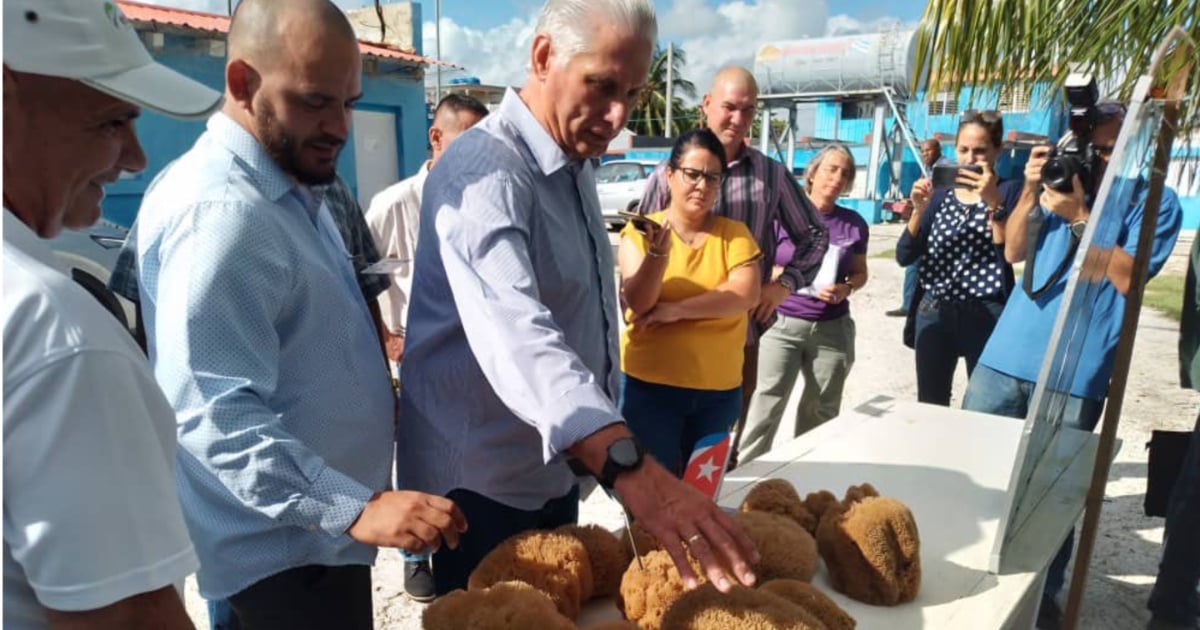
Amidst Cuba's escalating crisis, leader Miguel Díaz-Canel posed with sea sponges earmarked for export during a visit to the CAIMAR Enterprise Unit in Caibarién, as part of a governmental tour of Villa Clara.
During this tour, Díaz-Canel expressed an "interest" in employee wages, company profits, and strategies to enhance energy efficiency in the fishing sector's capture levels.
The official delegation also made a stop at the REMpeZ microenterprise, which focuses on food production, emphasizing the message that its products should "reach the people."
At CAIMAR, alongside Roberto Morales Ojeda and various local officials, Díaz-Canel inquired about employee compensation and the company's outcomes. He listened to management discuss "potential alternatives" for boosting energy efficiency in the fishing operations.
During the tour, the president was showcased with "high-quality export" sponges from the vessel Plástico 317 of the UEB CAIMAR, creating a photo-op scene.
In a conversation with Michel Leiva Pérez, captain of the Plástico 19, the crew's initiatives were highlighted, marking them as "the most productive team in the country for scalefish capture" so far this year.
On the same day, the leader visited the REMpeZ-Cooperative Production Center for Commerce and Gastronomy in Caibarién, engaging with workers on production lines, diversification goals, wages, working conditions, and raw material acquisition.
Founded in 2021 in Remedios, the REMpeZ microenterprise produces various baked goods, pizzas, fine pastries, hamburgers, sausages, and processes and packages meat, agricultural, and seafood products.
As of August 13, it became linked to the Caibarién Commerce and Gastronomy Company's Production Center to "supply the population" with basic and safe foods at affordable prices through local stores and butcheries, according to its head, Lázaro Morilla Quintana.
Local reports on the visit emphasized the "quality of the products" and deemed the initiative an "excellent idea for local development," framing it as part of the government's tour of Villa Clara.
The media coverage included the president's photo with export sponges, while the official rhetoric reiterated goals to increase captures and expand production models to deliver affordable food.
However, the official narrative is far removed from the harsh realities faced by Cubans, where food scarcity is worsening, increasing vulnerability to nutritional deficiencies, impairing physical and cognitive development, and weakening immune defenses.
The Food Monitor Program (FMP) has warned that most households rely on a highly repetitive diet, lacking in essential micronutrients and fiber, and are dependent on ultraprocessed foods like ground meat and sausages rather than fresh proteins like fish or beef.
This poor diet, according to the FMP, perpetuates a "hidden hunger" that directly affects health and quality of life.
To underscore the problem's severity, the observatory disclosed that two adults in Havana would need at least 41,735 pesos monthly for even a minimally adequate diet—a figure equivalent to nearly 20 minimum wages or two years of minimum pensions in Cuba.
Over six months, the monitoring assessed 29 products across eight food groups in both state and private networks, aiming to meet basic needs for two healthy young adults.
Even when prioritizing cheaper, less nutritious foods, the basic food basket remains out of reach for most households.
Cuba's Food Crisis and Economic Challenges
What are the main challenges faced by Cuban households in terms of food security?
Cuban households face a repetitive diet lacking essential micronutrients and fiber, relying heavily on ultraprocessed foods instead of fresh proteins, leading to nutritional deficiencies and "hidden hunger."
How much does it cost for two adults in Havana to maintain a minimally adequate diet?
Two adults in Havana would need at least 41,735 pesos per month to afford a minimally adequate diet, which is almost 20 times the minimum wage in Cuba.