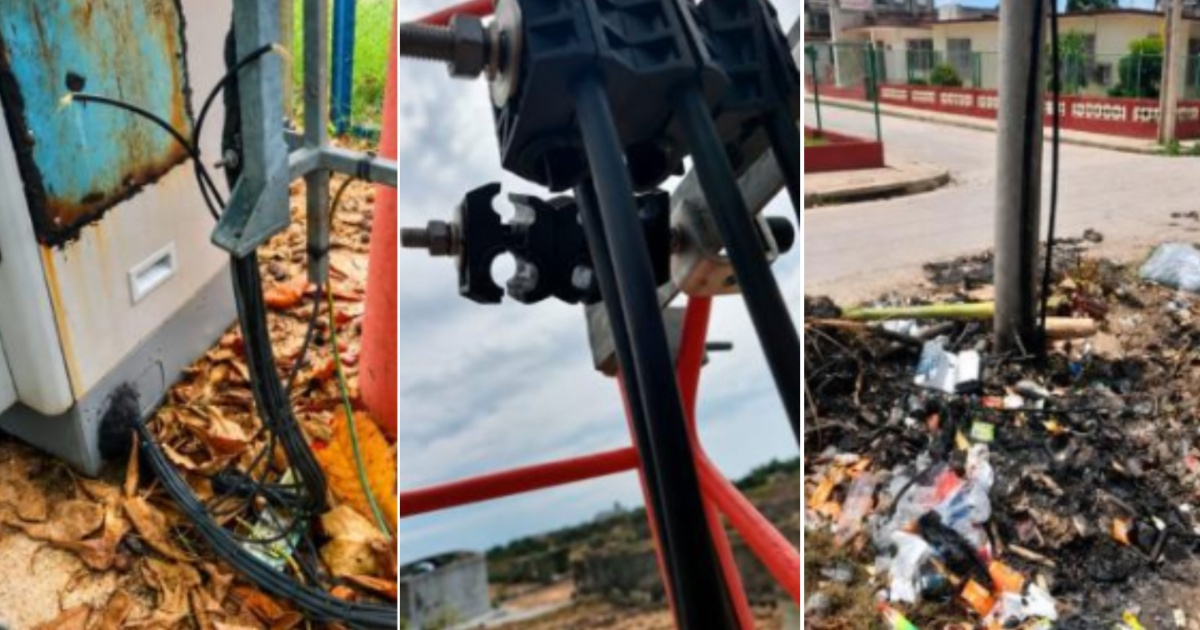
The Cuban Telecommunications Company, ETECSA, has reported a surge in vandalism targeting its infrastructure in Camagüey. This has left numerous neighborhoods without telephone or mobile data services, as highlighted in an article by the official newspaper Granma published on Sunday.
Yoan Álvarez Fonseca, the Network Operations Manager, revealed a striking detail: "We are missing over 2,000 meters of cables. Our cables and power lines are being stolen."
Areas impacted include the city of Camagüey, Esmeralda, Florida, and Vertientes, according to Edel Mendoza Valdivia, Head of Wireless Network at the Territorial Directorate.
Recurring Vandalism Patterns
The attacks typically involve cutting fiber optics that feed data transmission equipment, stealing power supply cables, and taking breakers and breaker boxes. Alarmingly, in several instances, the stolen materials are left behind, suggesting acts of sabotage rather than theft for profit.
"Some resources have no practical use for the public, and they are cut and left behind, showing that the intent is to cause damage," Mendoza Valdivia stated, noting that some sites have been vandalized multiple times, with service restoration taking over two months in certain cases.
Impact on Families and Infrastructure
Families suffer directly from these vandalisms. Nereisy Gutiérrez Labrada, a local resident, experienced a three-month absence of a landline connection after cables linking her home to the network were stolen. "These acts disrupt families and have economic repercussions for everyone, including the State and ETECSA," she commented.
Another incident involved a fire at a trash site next to a distribution cabinet, affecting over 300 services and requiring a week's work to restore. "It's like providing complete service to the area all over again," explained Iván Casalís Milanés, the cable brigade leader.
Challenges with Material Shortages
The shortage of necessary materials exacerbates the situation. Luel García Lorenzo, ETECSA's territorial director in Camagüey, admitted that required repair equipment is not available locally: "Our warehouses are empty, and we have to 'improvise' solutions with every breakdown."
Veteran worker Juan Menéndez Barroso, who has spent 48 years with the company, noted that fiber optic cables used in repairs are often recycled from discontinued services since "we don't manufacture them here, and imports are scarce." ETECSA attributes this shortage to the U.S. embargo, although Cuba's telecom infrastructure has suffered from years of underinvestment.
Vandalism Beyond Camagüey
This issue is not confined to Camagüey. In Holguín, 27 vandalism incidents against ETECSA installations were reported in 2025, leading to losses exceeding 529,000 Cuban pesos. Meanwhile, in Santiago de Cuba, community watch programs have been established to safeguard infrastructure following numerous thefts of solar panels and batteries.
In Camagüey, locals like those in Nereisy's neighborhood have begun organizing by installing LED lights and staying vigilant against suspicious activity around telecommunications infrastructure. ETECSA has initiated "barriodebates," community discussions aimed at raising awareness about the importance of protecting telecom resources, especially as the province faces potential blackouts that could disable over a hundred radio bases simultaneously.
Understanding the Vandalism Impact on ETECSA
How has vandalism affected ETECSA's services in Camagüey?
Vandalism has led to significant disruptions in telephone and mobile data services, affecting entire neighborhoods due to stolen and damaged infrastructure.
What measures are being taken to address these acts of vandalism?
ETECSA and local communities are implementing measures such as community watch programs and awareness initiatives like "barriodebates" to protect infrastructure and prevent further vandalism.
What challenges does ETECSA face in repairing vandalized infrastructure?
Repair efforts are hampered by a shortage of materials, as essential components are not readily available locally, forcing improvised solutions and delaying service restoration.