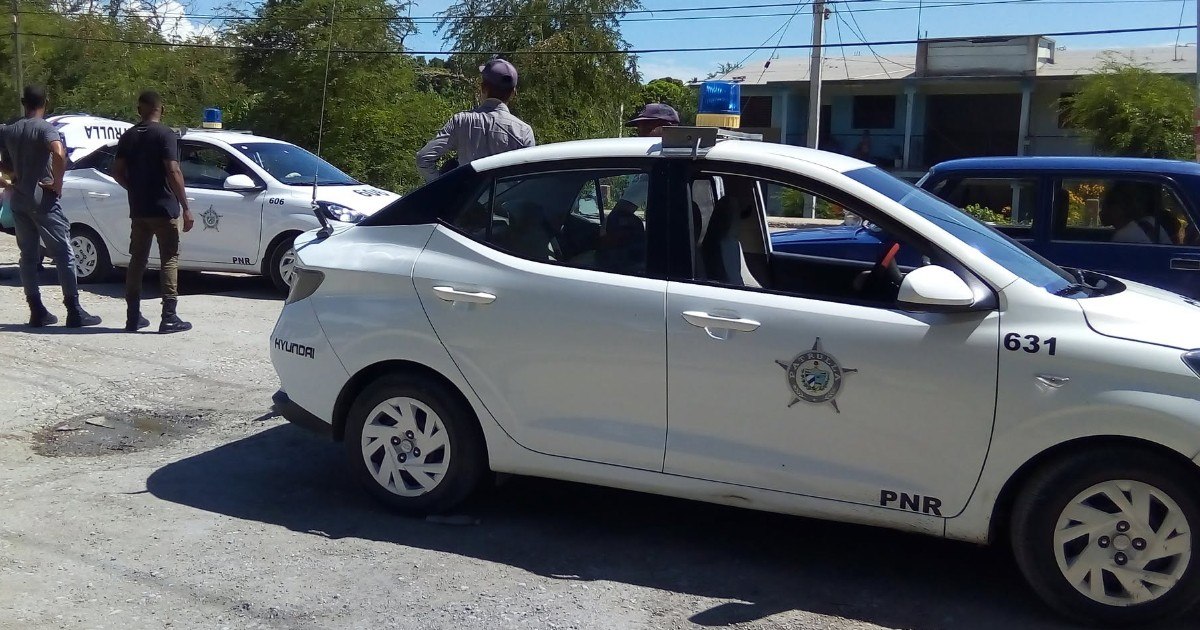
A large-scale operation conducted by the Ministry of the Interior (MININT) on Sunday across all Popular Councils in the San Miguel del Padrón district of Havana resulted in the arrest of 71 individuals. These detainees were taken to the 11th Municipal Unit of the National Revolutionary Police (PNR), as reported by the state-run newspaper Tribuna de La Habana.
While the regime portrayed this as a crackdown on criminal activities, it masks a practice that has outraged millions of Cubans. Among those detained are individuals labeled by authorities as "undocumented and illegal in the capital with maladjusted behavior," meaning Cuban citizens residing in Havana without the required administrative residence permit mandated by Decree-Law 217.
The news initially surfaced on the PNR's Facebook page "Héroes de Azul en Cuba," but the post was swiftly removed, contributing to the opacity surrounding an operation that had already sparked backlash on social media.
Other detainees face charges for possession of drugs, engaging in prostitution, carrying weapons, conducting illicit economic activity, and failing to pay fines. The regime indiscriminately grouped these charges with those of individuals simply living in the capital without proper documentation.
The Impact of Decree-Law 217
This approach highlights the rationale behind Decree-Law 217, enacted in April 1997 under Fidel Castro's government. It requires any Cuban from another province wishing to reside in Havana to obtain prior administrative authorization. Failure to do so can lead to fines and forced deportation back to their home province.
The decree effectively turns Havana into a quasi-state with its own borders within national territory, disproportionately affecting "orientales"—Cubans from Santiago de Cuba, Guantánamo, Granma, Holguín, or Las Tunas—who are subjected to identity checks in transportation terminals and central areas of the capital.
Human Rights Watch reported that, according to a Cuban official, police had forcibly expelled people from Havana approximately 20,000 times under this decree. As early as May 1997, around 2,000 individuals were sent back to their provinces in the first weeks of the law's enforcement.
Life Without Papers: A Constant Struggle
Those living informally in the capital cannot access state jobs or purchase the subsidized basic food basket in Havana. The fear of being intercepted is ever-present.
The paradox of this situation reignited debate weeks prior when Cuban content creator Lil Lemon shared a viral testimony describing the cycle of expulsions: "Obtaining Havana residency as an 'oriental' was very difficult, and some relied on temporary permits of two or three months," he explained. "They could be deported on January 1 and return on January 16."
The response on social media was swift. "I was deported to Camagüey twice in one week," one user commented on the video.
In 2011, Decree 217 was partially amended by Decree 293, which eased some conditions for family reunification but left its core restrictions unchanged. By April 2026, a report presented to the UN's CEDAW Committee documented that women internal migrants from eastern Cuba continue to face police harassment, forced evictions, and exclusion from basic services in the capital.
Meanwhile, the PNR celebrated the operation with a now-deleted Facebook post reading: "The street speaks, the complaint arrives, and the response is swift. Citizen tranquility is built every day, street by street, neighborhood by neighborhood."
Understanding Decree-Law 217 and Its Implications
What is Decree-Law 217?
Decree-Law 217, enacted in 1997, requires Cubans from other provinces to obtain administrative approval to reside in Havana. Without it, they risk fines and deportation.
How does this law affect Cuban citizens?
The law disproportionately impacts "orientales," or Cubans from eastern provinces, by restricting their ability to live and work in Havana and subjecting them to frequent identity checks and potential deportation.
What changes were made to Decree-Law 217 in 2011?
In 2011, Decree 217 was amended by Decree 293, which relaxed some conditions for family reunification but did not alter the core restrictions of the original law.