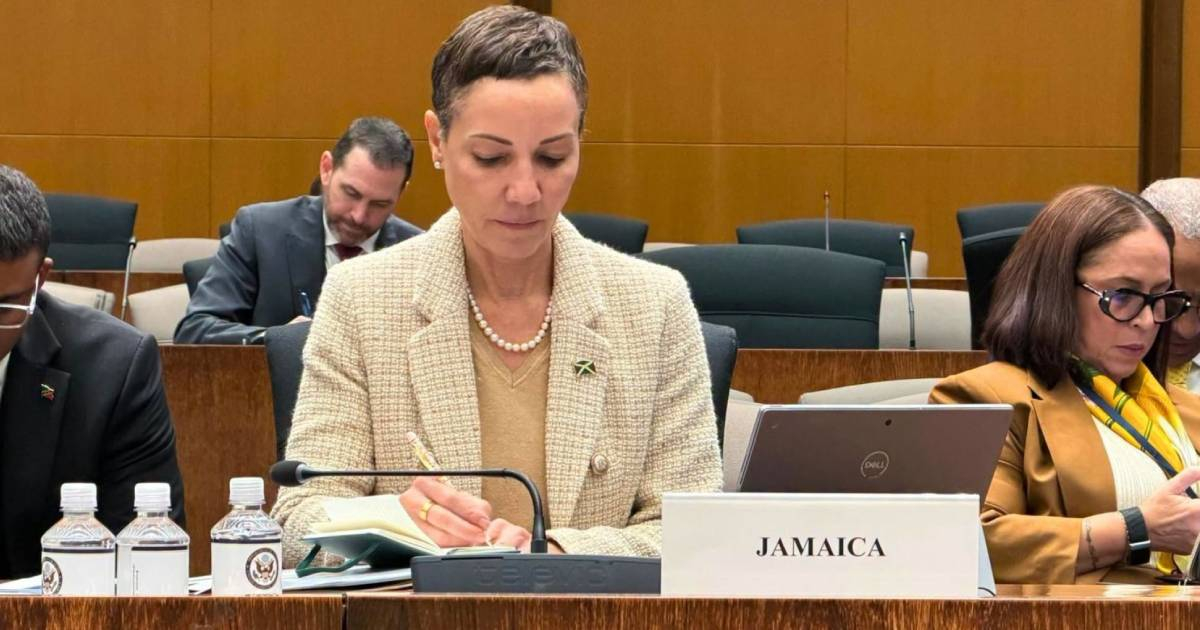
Jamaica's Foreign Minister, Kamina Johnson Smith, firmly denied accusations from former Prime Minister P. J. Patterson on Sunday. Patterson had labeled Jamaica's decision to abstain from a United Nations vote regarding the U.S. embargo on Cuba as an "abominable betrayal."
Johnson Smith emphasized that Jamaica's stance against the embargo remains unchanged and clarified that their abstention was not an endorsement of economic sanctions against the island.
"Mr. Patterson's suggestion that abstaining equates to supporting the embargo or ignoring Cuba's suffering is simply incorrect," declared Johnson Smith in a statement released on November 1st on the official website of Jamaica's Ministry of Foreign Affairs and Foreign Trade.
She added, "Jamaica did not vote against the resolution. We abstained. And we did not remain silent. We formally explained our position immediately after the vote."
Former Leader Criticizes Government for Alleged Betrayal
The controversy erupted following Patterson's outspoken criticism of Jamaica's abstention during the UN General Assembly meeting on October 28th. For over thirty years, Jamaica had supported the resolution calling for the end of the U.S. embargo, but this year, it chose not to cast a vote.
Patterson argued that this shift marked a departure from Jamaica's diplomatic tradition of solidarity with Cuba. He described the decision as an "abominable betrayal that history will never forget" and accused the government of compromising the country's sovereignty and longstanding foreign policy principles.
He also questioned the timing, noting that the abstention came just one day after the Jamaican Parliament unanimously passed a motion concerning Cuba's economic and humanitarian situation.
The former prime minister contended that such contradictions represented a grave offense against parliamentary authority, suggesting that under similar circumstances, ministerial resignations or censure should ensue.
Foreign Minister Defends Abstention, Highlights Internal Challenges in Cuba
Johnson Smith responded by stating that Patterson's criticisms were based on interpretations that did not withstand factual scrutiny. She explained that Jamaica's delegation at the UN acknowledged the impact of external economic restrictions on Cuba but also pointed to the internal economic and structural challenges facing the nation.
The foreign minister advocated for exploring alternatives that would enhance the living conditions of Cubans, instead of merely endorsing an annual resolution that has failed to achieve its primary goal.
She also reminded that Jamaica had called for reducing economic constraints, fostering dialogue, and facilitating Cuba's greater integration into the global economy.
Johnson Smith refuted claims that the government had defied Parliament, asserting that the approved motion did not mandate a vote in favor of the UN resolution. Furthermore, she denied that the decision was influenced by foreign pressure or the pursuit of favors from other governments.
The minister reiterated that every administration is responsible for making foreign policy decisions aligned with national interests.
The resolution against the U.S. embargo was passed with 130 votes in favor, 17 against, and 25 abstentions.
Understanding Jamaica's Position on the Cuba Embargo
Why did Jamaica abstain from the UN vote on the Cuba embargo?
Jamaica abstained to express its unchanged opposition to the embargo while also highlighting the need for addressing internal economic and structural issues in Cuba.
What was former Prime Minister P. J. Patterson's reaction to the abstention?
Patterson criticized the abstention as an "abominable betrayal" and accused the government of compromising Jamaica's diplomatic principles.
How did the Jamaican government justify its decision?
The Jamaican government stated that their abstention was not an endorsement of the embargo and emphasized the importance of exploring solutions to improve the conditions in Cuba.