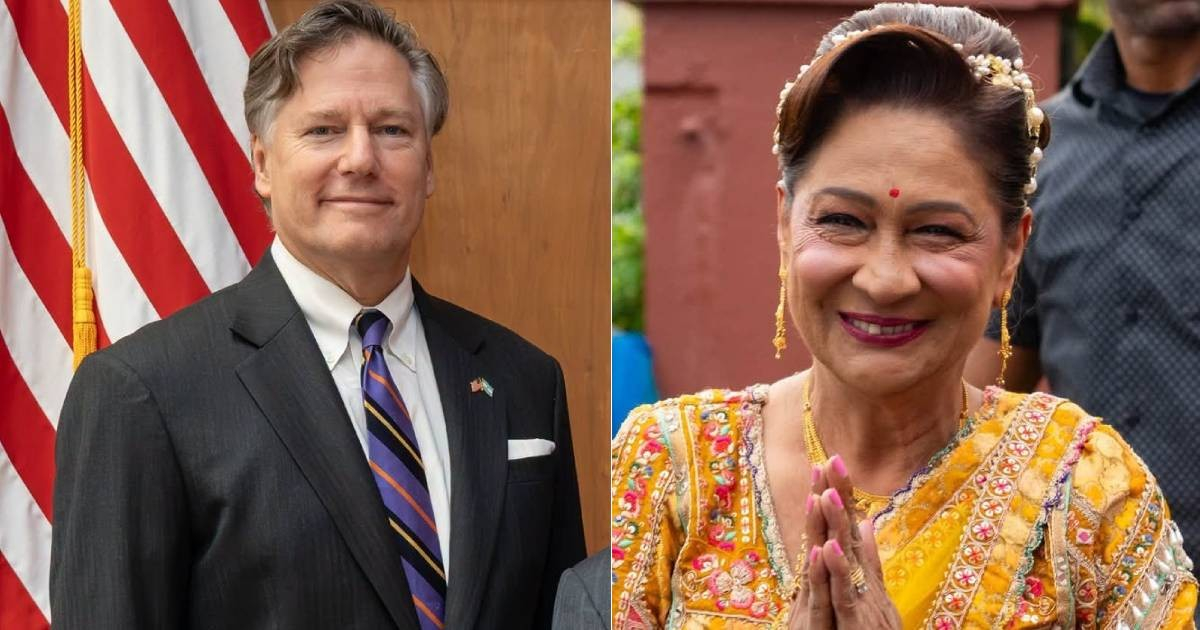
The U.S. Undersecretary of State, Christopher Landau, extended his gratitude to the government of Trinidad and Tobago for voting against a United Nations resolution demanding an end to the embargo on Cuba—a move he interpreted as support for democratic change on the island.
In a statement posted on X, Landau acknowledged Prime Minister Kamla Persad-Bissessar for her administration's decision to break from over three decades of backing the annual UN resolution.
"Prime Minister, the United States appreciates your government's vote for a democratic transition in Cuba at the UN this year," wrote Landau, as reported by the Trinidad Guardian.
"We are proud to stand with Trinidad and Tobago and other regional democracies in condemning the repressive Cuban regime," he added.
Landau also criticized nations that continue to support Havana and posed a direct question: "How can countries vote in favor of a regime that has not allowed its people to vote for nearly 68 years?"
The Prime Minister responded to the U.S. acknowledgment by reaffirming her stance on Cuban political rights.
"The government of Trinidad and Tobago upholds democracy, freedom, human dignity, and the right of all citizens, including the Cuban people, to freely determine their political future," stated Persad-Bissessar.
This exchange followed Trinidad and Tobago's vote on Wednesday, October 28, siding with the U.S. against the resolution calling for the lifting of the economic, commercial, and financial embargo on Cuba.
It was the sole nation from the Caribbean Community (CARICOM) to oppose the resolution, while other countries in the region, such as Jamaica and Guyana, chose to abstain.
The initiative received approval from the General Assembly with 130 votes in favor, 17 against, and 25 abstentions.
Trinidad and Tobago had previously abstained in 1992, when the resolution was first debated, and had voted in favor of its passage since 1993. This decision marked a substantial shift in its foreign policy toward Havana.
Following the vote, Persad-Bissessar publicly defended her position, asserting that her government would not support what she described as a "military dictatorship" in Cuba.
Understanding Trinidad and Tobago's Stance on Cuba
Why did Trinidad and Tobago vote against the UN resolution on the Cuban embargo?
Trinidad and Tobago voted against the UN resolution as a show of support for democratic reforms in Cuba, breaking away from its long-standing history of backing the resolution.
How did the U.S. respond to Trinidad and Tobago's vote?
The U.S. expressed gratitude and recognition to Trinidad and Tobago for their vote, seeing it as alignment with democratic values and a stance against the Cuban regime.
What was the reaction of Trinidad and Tobago's Prime Minister?
Prime Minister Kamla Persad-Bissessar reaffirmed her position on political rights and democracy, emphasizing the right of the Cuban people to determine their future.