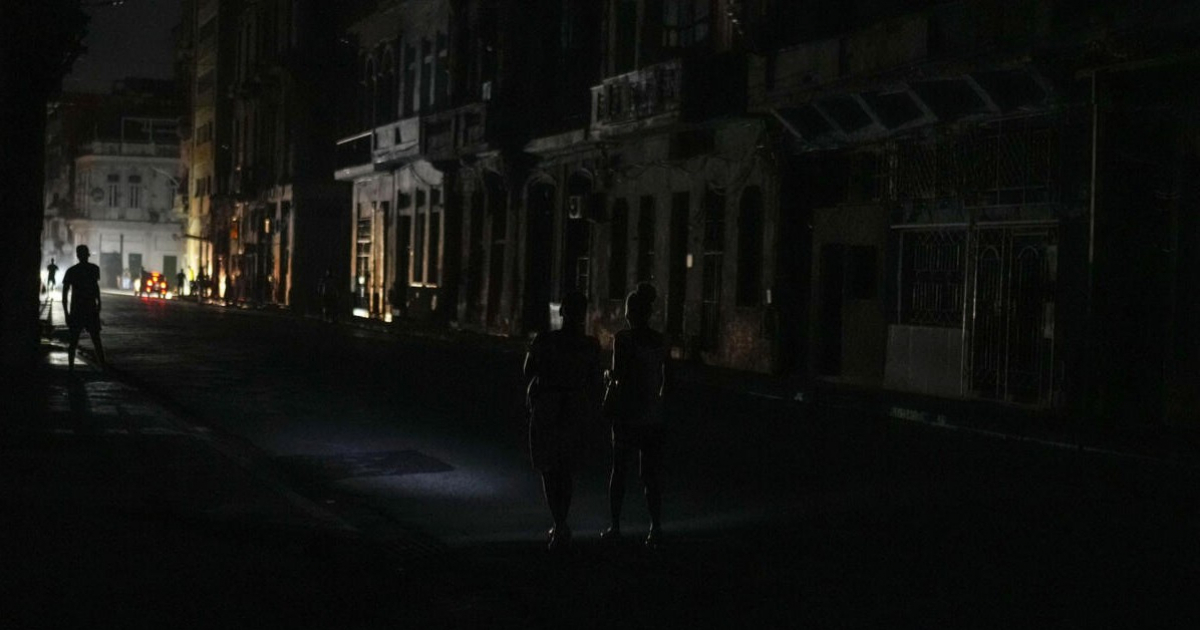
The National Electric Union (UNE) anticipates a substantial power deficit of 1,965 MW during peak demand hours this Sunday, as outlined in the latest report from the National Electric System released this morning. The grid will face a precarious situation with only 965 MW available against a forecasted demand of 2,900 MW, resulting in a generation shortfall of 1,935 MW.
On Saturday, October 31st, the situation deteriorated beyond expectations. The maximum impact reached 2,022 MW at 7:20 PM, surpassing the previous forecast of 1,810 MW by 212 MW. The official statement attributes this deviation to a specific issue: "the maximum impact was 2,022 MW at 7:20 PM, exceeding planned expectations due to delays in bringing unit 6 of Nuevitas online."
By 6:00 AM this Sunday, the scenario was already dire, with 965 MW available and a demand of 2,350 MW, leaving 1,380 MW affected at that moment. Projections for midday estimate 1,450 MW out of service, likely escalating to 1,965 MW during the evening peak.
Thermal Generation Challenges
Constraints on thermal generation reach 630 MW, with three units undergoing maintenance: unit 3 of the CTE Santa Cruz (Ernesto Guevara de la Serna), unit 5 of the CTE Nuevitas (October 10), and unit 5 of the CTE Renté (Antonio Maceo). Meanwhile, units in breakdown include unit 1 of Santa Cruz, unit 2 of Felton (Lidio Ramón Pérez), and units 3 and 6 of Renté.
Solar Contribution Falls Short
On Saturday, photovoltaic solar parks generated 4,204 MWh, with a peak power of 654 MW at midday, marking an increase of 110 MW over Friday. However, this output does not offset the structural deficit, as solar energy is absent during the night peak when demand is highest.
This Sunday's forecast indicates a deterioration of 155 MW compared to the previous day. The final days of October consistently exceeded 2,000 MW of impact: 2,004 MW on the 29th, 2,039 MW on the 30th, and 2,022 MW on the 31st, with the month's worst record on October 2nd at 2,130 MW affected.
Regional Disparities in Power Impact
The crisis's impact varies across regions. In Holguín, the provincial electric company's official channel reported a maximum outage of 17 hours and 32 minutes this Sunday, while circuits like La Caridad, La Naza, and Nipe experienced up to 24 hours and 15 minutes without service by Saturday's end. In Cienfuegos, state enterprises acknowledged outages lasting between 70 and 89 continuous hours at October's close. Meanwhile, in Havana, 168 circuits were still affected by Saturday afternoon, with a generation deficit resulting in a 385 MW impact.
Given the projected availability for this Sunday's peak, the Cuban electric system will only meet about a third of the expected maximum demand.
Understanding Cuba's Power Crisis
What is causing the power shortages in Cuba?
The power shortages in Cuba are primarily due to outdated infrastructure, maintenance delays, and insufficient generation capacity to meet demand. Additionally, economic constraints and lack of investment exacerbate the situation.
How are solar energy sources contributing to Cuba's power supply?
Solar energy sources contribute to Cuba's power supply by generating electricity during the day, but they are insufficient to cover the nightly demand peaks, as there is no solar generation at night.
What measures are being taken to address the power crisis?
Efforts to address the power crisis include maintenance and repair of existing facilities, exploration of alternative energy sources, and seeking international cooperation for infrastructure upgrades.