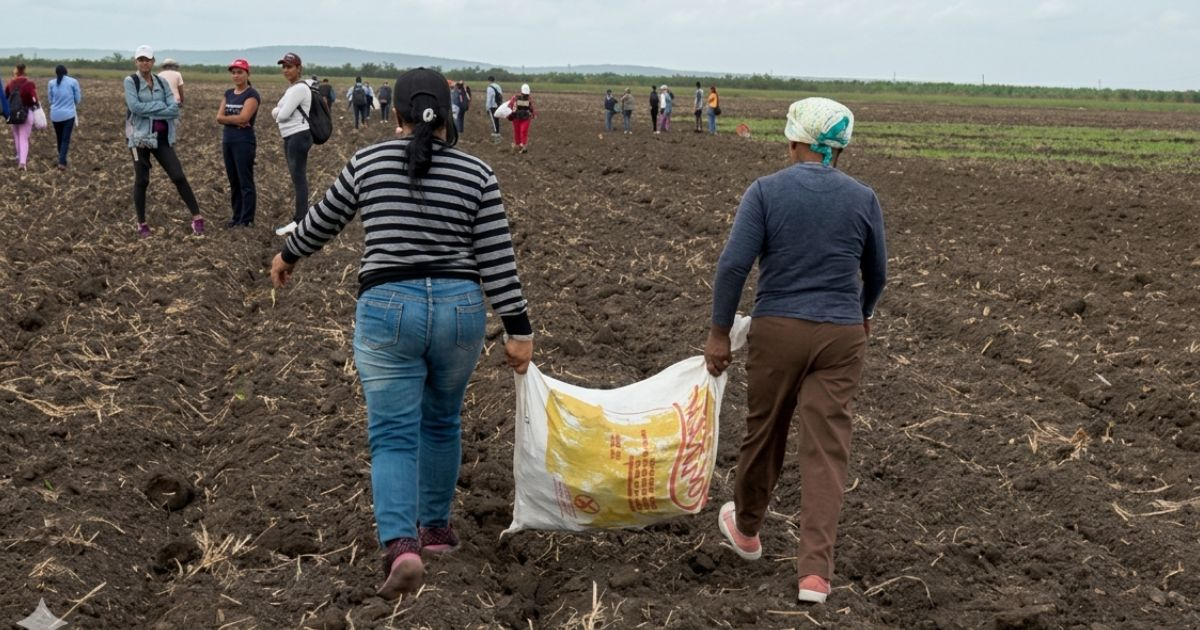
In Cuba, a mere one out of four agricultural land titleholders is a woman. Official statistics from the Cuban Observatory on Gender Equality (OCIG), as reported by Alas Tensas magazine, reveal that women account for just 23% of those with rights to agricultural plots, compared to 77% for men.
As of the end of 2024, this figure shows a slight progression from the 22.6% recorded in 2023, marking a negligible increase of only 0.4 percentage points over one year.
The disparity deepens when considering the size of the land plots. A significant 36.1% of female titleholders possess less than one hectare of land—double the proportion of men, which stands at 18.3%.
Regarding land tenure, 62% of women hold lands in usufruct, meaning they can use the land without owning it, while only 38% have ownership rights. Factoring these percentages into the total number of titleholders, women make up roughly 25.6% of all agricultural landowners in Cuba.
This land access inequality is compounded by a severe income gap. A study by the Center for Women's Studies, supported by the United Nations Population Fund (UNFPA) and published in 2025, highlighted that nearly half of rural women had no personal income in 2024.
Research conducted by the Friedrich Ebert Foundation and FLACSO-Cuba specialists documented that the proportion of men with their own income surpasses that of women by over 20 percentage points nationwide, with the gap widening in rural areas.
Data from 2019 indicated that women made up only 13% of those in agricultural cooperatives and 33% of the workforce in agricultural enterprises.
The national report "Cuba 2019: Ascending to the Root" already noted that while women represented 46.3% of the rural population, they comprised merely 26.1% of the economically active population.
"The absence of personal income can severely limit the economic independence of women, particularly when they rely on other household members," the analysis from Alas Tensas warns, emphasizing that these documented inequalities are longstanding issues, stemming from decades of policies that have systematically overlooked the plight of Cuban rural women.
Many Cuban women laboring in agriculture aren't even included in official records. They engage in activities like animal husbandry, tending to smaller crops, and other family farm tasks without being recognized as titleholders, often on land registered under their partners' or other relatives' names.
This statistical invisibility is exacerbated by the unequal burden of domestic work. According to the 2016 National Gender Equality Survey, a staggering 98.39% of rural women participated in household chores, compared to 94.49% of men, and 55.96% took on caregiving roles versus 29.67% of men.
In this challenging environment, the independent organization Latin American Federation of Rural Women (FLAMUR), which celebrated its 30th anniversary on October 15, has been advocating for reforms in Cuba's agrarian model for years.
Since 2019, they have been pushing the "Without the Countryside, There is No Country" campaign. FLAMUR's president in Cuba, Katia Hernández Torres, has called for farmers to have the autonomy to decide what to produce, sell their harvests directly, and set prices without being bound by mandatory state intermediaries.
Their activism has come at a cost: in February 2026, Hernández Torres and other activists were summoned and interrogated by the Technical Investigation Department in Pinar del Río. She publicly held the State Security responsible for any harm to herself or her husband.
In July 2026, the regime enacted the Agricultural and Forestry Land Law 185, effective since September, which acknowledges gender equality as a principle of agrarian policy and grants preferential access to women and young people.
Nevertheless, the Food Monitor Program has raised concerns that the law maintains structural constraints: private ownership is capped at 67.10 hectares, leasing and sharecropping remain prohibited, and the state retains control over land transfer and productive use.
Understanding Land Rights and Economic Disparities in Rural Cuba
What percentage of agricultural land titleholders in Cuba are women?
Women account for just 23% of agricultural land titleholders in Cuba, highlighting a significant gender disparity in land ownership.
How does the income gap affect rural women in Cuba?
The income gap severely limits the economic independence of rural women, with nearly half lacking personal income and the proportion of men with incomes exceeding that of women by over 20 percentage points.
What challenges do rural Cuban women face in terms of domestic work?
Rural Cuban women face a disproportionate burden of domestic work, with the vast majority participating in household chores and caregiving activities, significantly more than their male counterparts.