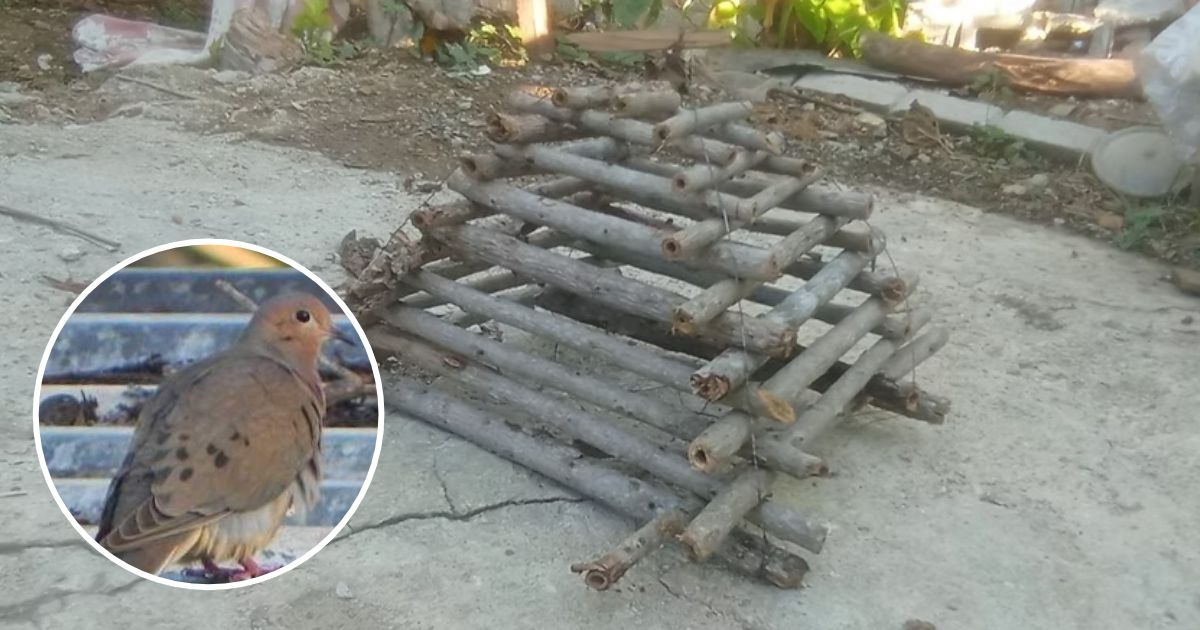
The severe food scarcity and low incomes have pushed some Cubans to adopt a survival strategy reminiscent of the toughest years of the Special Period: hunting wild pigeons to bring some meat home.
With homemade traps set up on rooftops, balconies, and yards, individuals with no hunting experience are attempting to secure food that their salaries or pensions simply can't buy.
A report by the Food Monitor Program (FMP), aptly titled "Wild Pigeon Hunting in Cuba: Chronicle of an Announced Famine," highlights how the food crisis has resurrected primitive bird-catching techniques, even in urban areas where such practices were not traditionally part of daily life.
Among the most poignant accounts is that of Arquímedes, a 71-year-old retiree living in the city of Guantánamo. After dedicating his entire life to the state sector, he now finds himself seeking alternative means to feed himself.
"I ended up doing this out of necessity because I had nothing to eat," he shared with an independent media outlet.
Arquímedes explained that his monthly pension doesn't even come close to covering basic necessities, let alone meat.
"I receive a pension of 5000 Cuban pesos, and that's not enough for anything," he lamented, describing the struggle to secure essentials like rice, sugar, and other staple foods.
Living alone, Arquímedes acknowledges that his daughter occasionally sends him food, yet he is reluctant to fully rely on her due to her own financial hardships.
This prompted him to start capturing pigeons, a pursuit he never envisioned undertaking after a lifetime of work.
His aim isn't to amass large quantities of meat, but rather to have some protein to prepare his meals.
"With two or three pigeons, you can make a very decent soup," he recounted.
The story exemplifies how the lack of resources can dramatically alter the routine of an elderly individual, shifting them from relying on their pension to foraging for food through wild animal capture.
The report details the use of traps known as "cimbras" or "caravanas," crafted from simple materials like sticks, wires, and threads.
These setups are placed in yards, balconies, and rooftops, lured with small baits of bread or rice to attract the birds.
FMP pointed out that these methods are not new to Cuba: during the economic crisis of the 1990s, similar techniques were employed, especially in rural areas. However, now the phenomenon has also emerged in urban spaces among people who had not previously engaged in hunting.
The organization links this situation to the loss of purchasing power, rising food prices, and the inefficiencies of the state distribution system in providing basic goods.
The issue particularly impacts senior citizens who depend on pensions in national currency and lack the means to purchase food in the private market.
FMP also warns about the health risks of capturing and consuming wild birds without veterinary control or proper handling conditions.
Contact with pigeon droppings can pose health risks, partly due to the potential presence of fungi associated with diseases like cryptococcosis.
Improper handling and preparation of wild animals can also increase exposure to other infectious agents.
Pigeon hunting is just one of several meat-obtaining practices through animal hunting previously documented in Cuba.
In November 2025, FMP reported on the capture of birds, cats, and iguanas, as well as fishing with dangerous chemicals, as strategies employed by some individuals to secure food.
The report warned that the protein shortage and economic hardships were fostering practices that also pose risks to animal welfare, species conservation, and human health.
Another instance was recorded in Camagüey. In May 2020, reports emerged that farmers in Céspedes municipality had resumed hunting and consuming the majá de Santamaría, an endemic Cuban boa, due to food shortages.
This practice, rooted in old rural customs, reappeared as a means to obtain meat amid the economic crisis.
In July 2024, animal protectors reported an increase in the capture of cats for human consumption in Guantánamo, a situation that caused concern among pet owners and animal welfare organizations.
Independent media at the time described how food shortages led some people to resort to these animals, despite the health risks and ethical conflicts involved in their sacrifice.
Understanding Cuba's Food Crisis and Its Impacts
What is causing the food shortage in Cuba?
The food shortage in Cuba is primarily driven by economic mismanagement, loss of purchasing power, rising food costs, and inefficiencies in the state distribution system.
Why are Cubans resorting to hunting pigeons?
Cubans are turning to pigeon hunting as a survival tactic due to the inability to purchase sufficient food with their limited incomes. It provides a source of protein that they can't afford otherwise.
What are the health risks associated with consuming captured pigeons?
Consuming captured pigeons poses health risks due to potential exposure to fungi like cryptococcosis and other infectious agents if the birds are improperly handled and prepared.