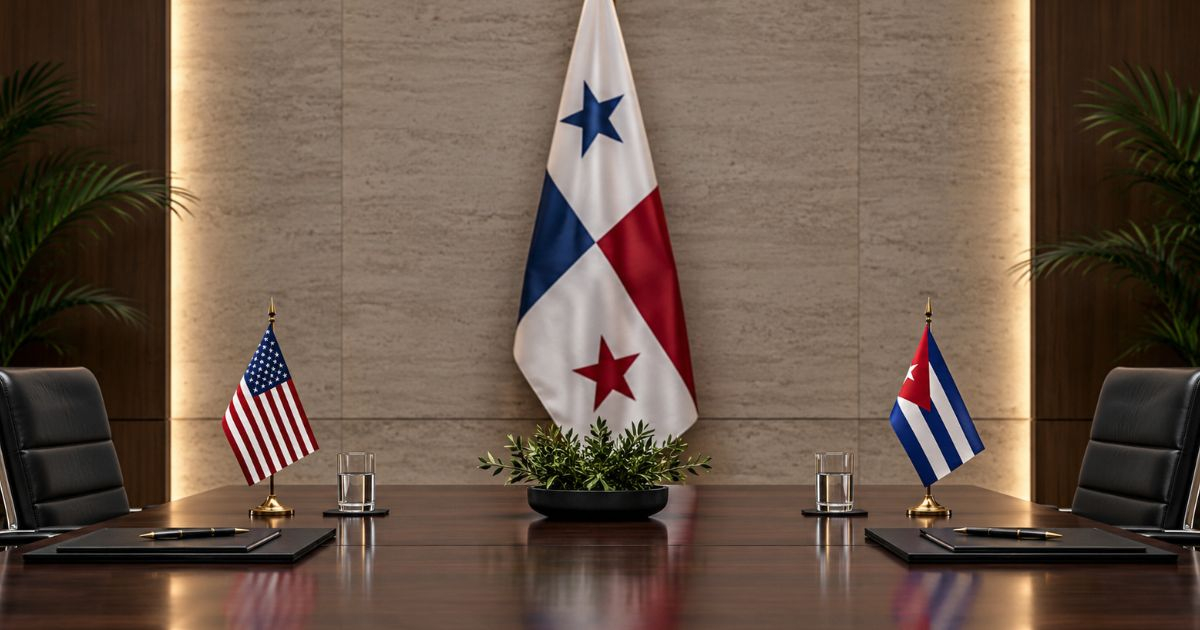
Panama has reiterated its readiness to act as a neutral ground for potential discussions between the United States and Cuba, aiming to ease the longstanding tensions between Washington and Havana.
This proposal follows several months of interactions between the two governments, which have publicly disagreed on the scope of these conversations.
According to a report by the EFE agency on Thursday, Panama's Foreign Minister, Javier Martínez-Acha Vásquez, expressed his country's interest in hosting diplomatic meetings. This initiative was reintroduced by President José Raúl Mulino's government on Wednesday at the United Nations.
"We hope for an opportunity for dialogue between Cuba and the United States," stated the Panamanian Foreign Minister, advocating for Panama's role in creating conducive conditions for easing tensions.
Martínez-Acha believes Panama's diplomatic experience might be beneficial in bridging the substantial political differences between the two governments.
"With our tradition and history of understanding, Panama could provide a space for these talks. A neutral stance might allow for progress," he asserted.
The foreign minister emphasized that the initiative would rely on the willingness of both Washington and Havana, clarifying that this was not a pre-established agreement.
"If both countries desire, they must be willing to engage in dialogue," he added.
These comments were made during the official visit to Panama by German Foreign Minister Johann Wadephul, on a day marked by the aftermath of the recent debate about Cuba at the UN General Assembly.
UN Resolution and International Reactions
Panama's proposal regained attention after the UN's vote on October 28, which saw the approval of a resolution calling for an end to the economic, commercial, and financial embargo imposed by the United States on Cuba.
The resolution received 130 votes in favor, 17 against, and 25 abstentions, highlighting a decrease in international support for Cuba's initiative compared to the previous year.
Since 1992, Havana has annually presented this non-binding resolution, which does not compel Washington to alter the existing sanctions.
During its UN address, Panama championed dialogue as a tool to overcome state differences and promote international cooperation. However, the nation's willingness to facilitate discussions did not translate into unconditional support for the Cuban government.
Panamanian authorities urged Havana to strengthen its democratic institutions, ensure respect for human rights, and encourage citizen participation.
Previous Offers and Diplomatic Dynamics
This offer is not new. On June 22, Panama had already expressed its willingness to mediate between the U.S. and Cuba during the General Assembly of the Organization of American States (OAS) in Panama City.
At that time, Martínez-Acha mentioned discussions with Miguel Díaz-Canel and Cuban Foreign Minister Bruno Rodríguez Parrilla, stating that Havana had accepted the offer.
"The Cubans accepted, but the United States has not, though they see it as a possibility," the Panamanian minister had declared.
Four months later, the renewed declaration reiterates the Central American country's readiness to be a potential meeting point.
Panama's fresh offer comes amid ongoing differences between the U.S. and Cuba over the extent of their recent interactions.
U.S. and Cuban Stances on Dialogue
On October 7, the U.S. State Department confirmed that talks with the Cuban regime were still ongoing but blamed the island's authorities for the lack of agreements.
"The discussions are continuing, but so far, the regime has not been willing to reach any agreement that would help the Cuban people and ultimately threaten their total control," Washington noted.
The U.S. response followed remarks by Lianys Torres Rivera, head of the Cuban Embassy in Washington, who said both governments maintained communication channels but lacked formal negotiations.
The diplomat acknowledged existing contacts through meetings, calls, and messages, but noted the absence of a negotiating agenda.
Cuba's position was reiterated on October 16 by Tanieris Diéguez, deputy head of mission at the Cuban Embassy in the U.S., who recognized exchanges with U.S. representatives but ruled out progress toward formal dialogue.
"We've had several contacts, but we don't see progress toward serious dialogue, which is what we are willing to undertake," Diéguez stated.
The official assured that Havana is open to talks without preconditions but insisted it would not accept challenges to its political system or so-called constitutional order.
In contrast, on September 23, U.S. Secretary of State Marco Rubio expressed that the U.S. was willing to support political and economic transformation in Cuba, though he noted the regime's representatives remained "quite intransigent."
Rubio suggested that any change process should involve political and economic freedoms, while Cuban officials have been adamant about excluding their power structure from discussions.
Frequently Asked Questions on U.S.-Cuba Relations
What role is Panama proposing in the U.S.-Cuba dialogue?
Panama is offering itself as a neutral venue to host potential diplomatic discussions between the United States and Cuba, aiming to facilitate dialogue and reduce tensions.
What prompted Panama to make this offer now?
Panama's renewed offer comes after several months of contacts between the U.S. and Cuban governments, highlighting ongoing differences and a need for neutral ground to facilitate discussions.
Has Panama offered to mediate between the U.S. and Cuba before?
Yes, Panama previously expressed its willingness to mediate during the OAS General Assembly in June, and this new declaration reinforces that offer.