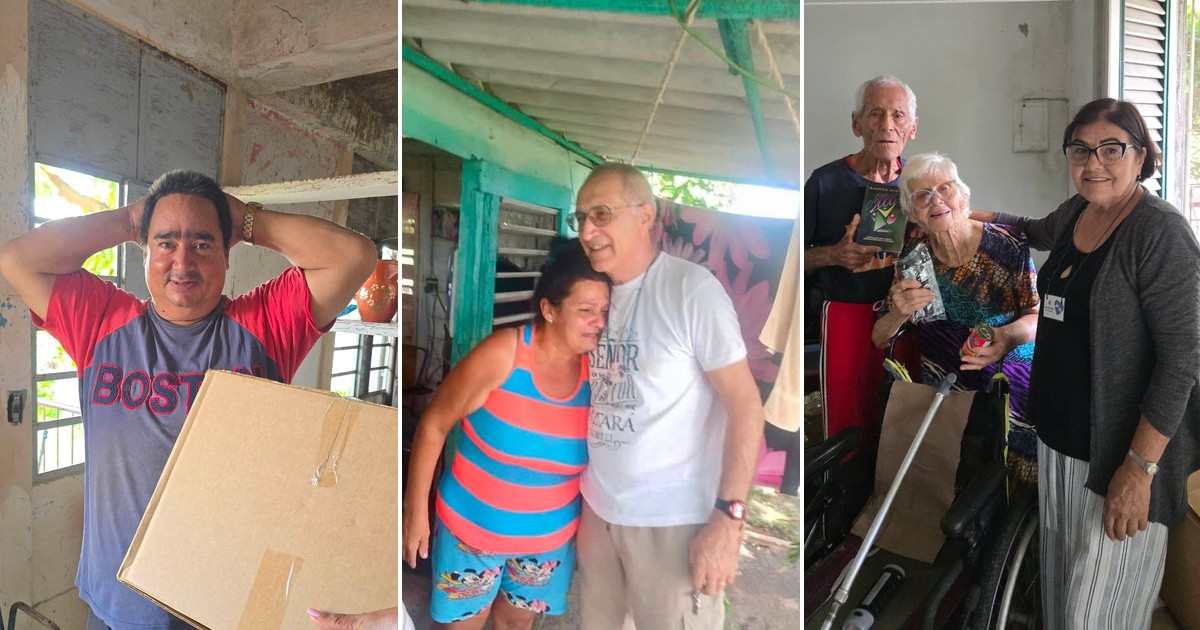
The volunteers at Guanajay Parish in Artemisa extended a heartfelt thank you to the United States government this Thursday after successfully distributing humanitarian aid to vulnerable families within their community. This effort is part of a $100 million assistance program spearheaded by Washington.
"We are grateful to the Government of the United States for this humanitarian aid, which is crucial for our people. It enables us to support numerous families experiencing challenging times," the parish team wrote in a message published by Caritas-Pinar del Río on Facebook.
The event commenced with a Mass led by Father Daniel and continued from early morning until late afternoon.
Volunteers traversed neighborhoods and rural areas of the municipality, including Gelabet, Finca del Americano, Ojo de Agua, Noroña, La Cooperativa, and Reparto de la Granja, delivering aid packages directly to homes.
This distribution is part of the second shipment of humanitarian aid received by the Diocese of Pinar del Río, which arrived in Cuba on Monday with 700 food kits and 700 hygiene packages.
Italian priests Daniele and Damiano coordinated the distribution alongside local volunteers at the parishes of Guanajay and Bahía Honda.
Each food kit is stocked with rice, beans, cooking oil, sugar, pasta, and canned fish. The hygiene modules include toiletries, detergent, and water purification products.
The first shipment of the month reached José Martí International Airport on October 8, also with 700 food kits and 700 hygiene modules, with distribution commencing two days later across six rural communities in Candelaria and Quiebra Hacha.
This entire operation falls under the $100 million humanitarian aid program for Cuba announced by Secretary of State Marco Rubio on May 8, 2026, following his meeting with Pope Leo XIV in Rome.
Out of the total, $60 million was allocated to Catholic Relief Services (CRS), which collaborates with Caritas Cuba and the parish network to deliver supplies directly to families, ensuring that neither funds nor goods pass through the Cuban government or the military conglomerate GAESA.
The program aims to reach nearly 200,000 households, translating to over 500,000 individuals across the island. Priority is given to elderly individuals living alone, pregnant women, nursing mothers, people with disabilities, and families with children under five years old at risk.
The Cuban regime, which initially dismissed the offer as "fantasy" and "falsehood" through Foreign Minister Bruno Rodríguez, eventually accepted the aid, framing it as a contribution from the "people of the United States" rather than the Washington government, while also accusing the U.S. of political motives.
The parish publication concluded with a sentiment capturing the essence of the day: "Today, Guanajay has shown that, even amid difficulties, it still has a big heart, willing hands, and a faith that manifests in service."
Frequently Asked Questions about U.S. Humanitarian Aid to Cuba
What is the purpose of the U.S. humanitarian aid program for Cuba?
The program aims to provide essential supplies to vulnerable families in Cuba, helping over 500,000 individuals by distributing food and hygiene kits.
How is the aid distributed in Cuba?
The aid is distributed by local volunteers and coordinated by Catholic Relief Services and Caritas Cuba, ensuring direct delivery to families without involving the Cuban government.
What items are included in the aid packages?
The food kits include rice, beans, oil, sugar, pasta, and canned fish, while hygiene kits contain toiletries, detergent, and water purification products.