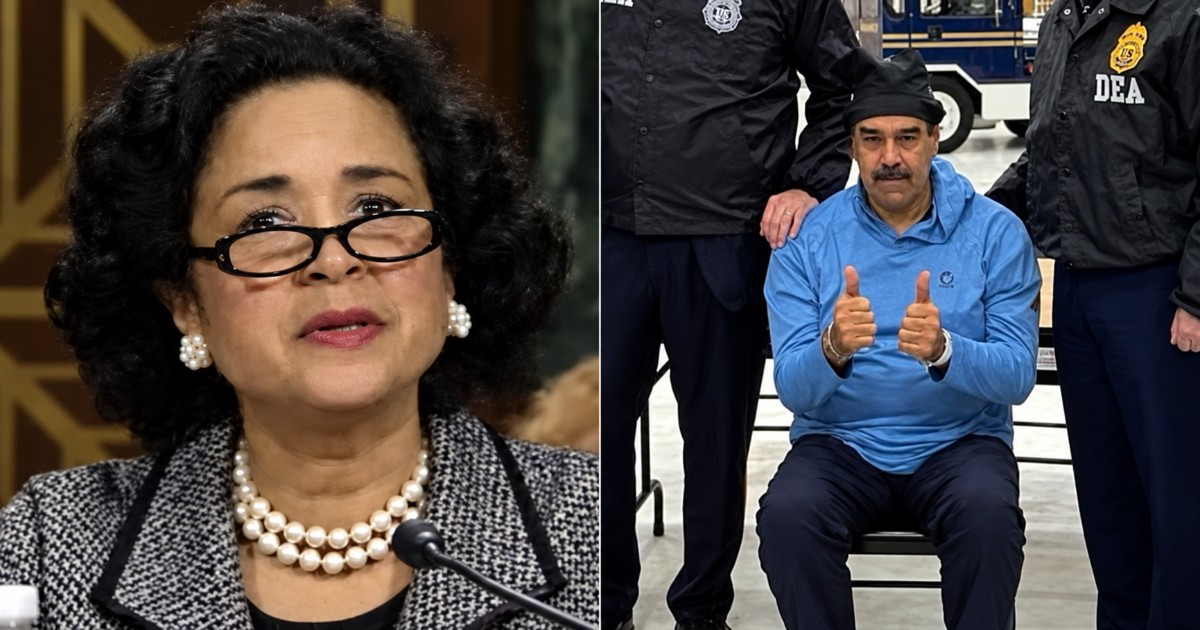
Federal judge Analisa Torres, appointed by President Barack Obama in 2013 and serving in the Southern District of New York, has taken charge of the criminal narcoterrorism case against Nicolás Maduro and his wife Cilia Flores. This follows the death of Judge Alvin K. Hellerstein, who passed away at the age of 92 on the same day.
The reassignment of the case occurred through the court's standard procedure for cases of deceased judges, which randomly distributes cases among other federal judges. Judicial spokesperson Edward Friedland confirmed that Hellerstein's cases "will be randomly assigned to another federal judge."
Torres inherits the case during its pretrial phase, with a crucial hearing scheduled for November 17 and another on December 17. The actual trial is set for June 14, 2027.
The judge's immediate priority will be addressing the sovereign immunity motion filed by the defense on September 2, 2026. Attorney Barry Pollack argued for dismissal of all charges, claiming Maduro acted as a foreign head of state. The prosecution counters that Washington recognizes Delcy Rodríguez, not Maduro, as Venezuela's legitimate authority.
Torres will take on the entire case without restarting proceedings but retains the authority to adjust the hearing schedule.
Background and Experience of Judge Torres
Born in New York City in 1959 with Puerto Rican heritage, Torres hails from a family deeply rooted in the judiciary. Her father, Frank Torres, served as a judge on the state Supreme Court in the Bronx, and her grandfather was also a federal judge. She graduated with honors from Harvard and earned her law degree from Columbia University. Before joining the federal bench, she spent over a decade as a judge in New York's civil, criminal, and state Supreme Courts.
Among her notable cases was the July 2023 ruling in the legal battle between the Securities and Exchange Commission and Ripple Labs, where she determined that XRP token sales in public markets did not constitute securities transactions under federal law, setting an important precedent in cryptocurrency regulation.
Origins and Developments in the Maduro Case
The case against Maduro originated in March 2020 when the prosecution filed the initial charges of narcoterrorism, conspiracy to import cocaine, and possession of destructive weapons. On October 8, 2026, a superseding indictment expanded the charges to include conspiracy to commit torture, detailing alleged abuses against Venezuelan and American political prisoners, and formally added Flores to the narcoterrorism charges.
Following the superseding indictment, Maduro and Flores pleaded not guilty for the second time before Judge Hellerstein on October 15, 2026.
Judge Hellerstein, who passed away at the age of 92, had presided over the case since its inception in 2020 and oversaw the first appearance of Maduro and Flores after their transfer to the United States in January 2026. He was renowned for managing the massive litigation following the September 11, 2001 attacks.
If convicted on all charges, Maduro and Flores face mandatory minimum sentences of approximately 50 years, with some individual counts carrying potential life sentences.
Key Questions About the Narcoterrorism Case Against Maduro
What are the charges against Nicolás Maduro?
Nicolás Maduro faces charges of narcoterrorism, conspiracy to import cocaine, possession of destructive weapons, and conspiracy to commit torture.
What is the significance of Judge Analisa Torres presiding over this case?
Judge Analisa Torres brings extensive legal experience and a notable judicial background to the case, inheriting it at a critical pretrial phase with the authority to manage and potentially adjust the proceedings.
How does the U.S. government view Maduro's role?
The U.S. government does not recognize Nicolás Maduro as Venezuela's legitimate authority, instead acknowledging Delcy Rodríguez in that role, which influences the legal strategy in this case.