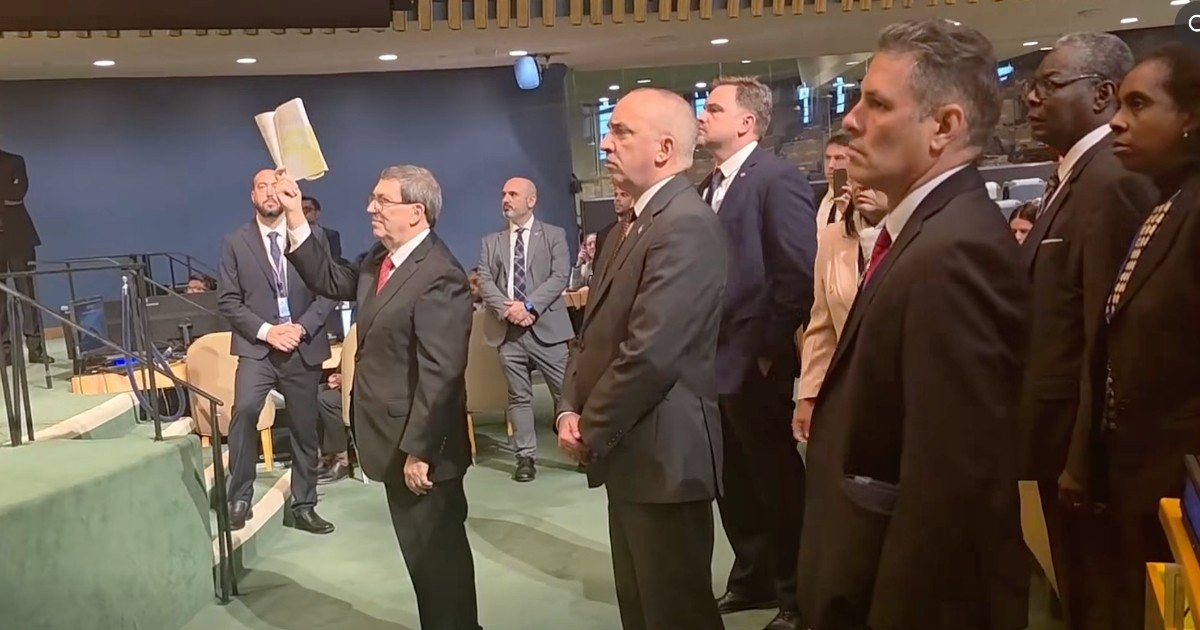
Cuban author Wendy Guerra shared her thoughts on Facebook this past Wednesday, reflecting on the recent incident involving the Cuban delegation at the United Nations that occurred on Tuesday. She examines the regime's seven decades of diplomatic confrontations, ultimately concluding that the aggressive behavior of its officials is not a display of strength, but rather an indication of vulnerability.
The incident took place on October 27 during a session of the General Assembly. Cuban Foreign Minister Bruno Rodríguez Parrilla abruptly rose from his seat, making his way towards the podium as U.S. Ambassador Mike Waltz was speaking, in an apparent attempt to disrupt his address. The Cuban delegation responded by banging on tables and submitting at least three motions, all of which were rejected. The President of the General Assembly, Khalilur Rahman, was forced to briefly suspend the session. Meanwhile, Richard Tur de la Concepción, First Secretary of the Cuban mission to the UN, attempted to snatch the phone from U.S. spokesperson J.P. Freire who was recording the confrontation.
Guerra contextualizes this episode within the longstanding tradition of Cuba's aggressive rhetoric in international forums. She recalls Raúl Roa’s declaration at the UN in November 1960, denouncing the United States, and Ernesto Guevara’s chilling statement in December 1964 about executions. In 2022, Rodríguez himself described the embargo as a "deliberate act of economic warfare aimed at crippling the country's financial income and undermining the government."
However, Guerra distinguishes between that past rhetoric and the events of the recent outburst, suggesting a shift in diplomatic demeanor. "Back then, career diplomats adapted to the rebellious tone of the Revolution; today, these 'streetwise diplomats' exhibit gestures, violence, and the unrestrained, vulgar tone of their era," she argues.
She draws a parallel to a domestic incident: the January 2021 clash where Culture Minister Alpidio Alonso struck independent journalist Mauricio Mendoza during a peaceful protest in Havana. According to Guerra, both acts exhibit a pattern where officials, unable to counter arguments, resort to physical aggression to silence dissent.
"Such undiplomatic acts of repudiation, whether here or there, only reveal the desperation of Cuba's makeshift officials, indicating that everything is spiraling out of control. There are no rules; no dignity or restraint exists within any level of Cuba's political strata," Guerra wrote.
"Why did Bruno Rodríguez have to walk to the proscenium to attempt to stop the U.S. ambassador's speech? What truth needed to be halted if, supposedly, they were all 'imperialist lies'? Do their arguments feel so fragile today?" Guerra questioned.
The U.S. responded promptly to the UN incident: Secretary of State Marco Rubio signed an order for Tur's expulsion, mandating his departure from the U.S. within 24 hours. Waltz warned that any further physical confrontations with American diplomats would have consequences.
Despite the spectacle by Cuban diplomats at the UN, it is evident that Havana continues to lose international support. The General Assembly approved Cuba's resolution against the embargo with only 130 votes in favor, a stark decline from 165 votes in 2025 and 187 in 2024, marking the weakest result since Cuba began advocating for this resolution in 1992.
Understanding the Recent UN Incident Involving Cuba
What sparked the recent altercation involving Cuba at the UN?
The altercation was sparked by Cuban Foreign Minister Bruno Rodríguez Parrilla interrupting U.S. Ambassador Mike Waltz's speech at the General Assembly, leading to a series of disruptive actions by the Cuban delegation.
How did the United States respond to the incident?
The United States responded by expelling Richard Tur de la Concepción, First Secretary of the Cuban mission, from the country, with Secretary of State Marco Rubio signing the order for his departure within 24 hours.
What does Wendy Guerra suggest about Cuba's diplomatic behavior?
Wendy Guerra suggests that the aggressive behavior of Cuban officials is not a sign of strength but rather a demonstration of weakness and desperation, reflecting a loss of control and standards in Cuba's political landscape.