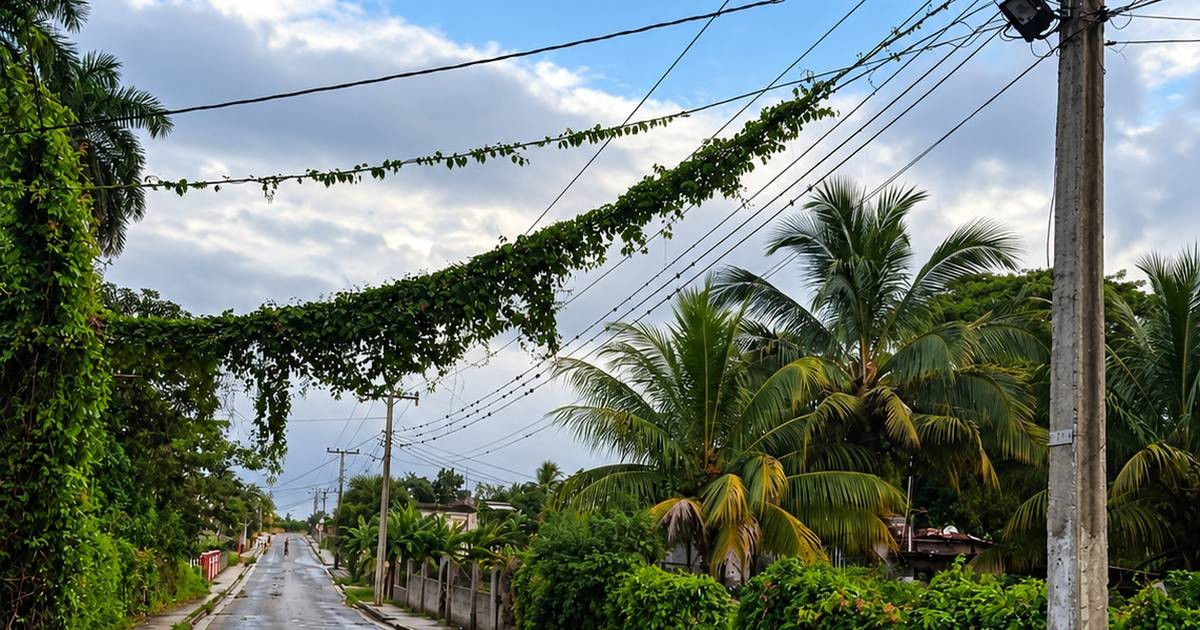
The small village of Cantel, located in the Cárdenas municipality of Matanzas, has been enduring an astonishing 109 days without electricity. Residents describe this dire situation as being utterly neglected by the Cuban authorities.
Christian Arbolaez, a local communicator, highlighted the issue on his Facebook page, sharing a photo that depicts the village's electrical wires completely entangled with vines.
"Cantel, in Cárdenas, Matanzas, seems destined to be one of the first places to revert to primitive times. And I am not exaggerating. Just look at the photos: the electrical cables are covered in vines," Arbolaez remarked.
Prolonged Blackout with No End in Sight
A local resident confirmed in the comments section of Arbolaez’s post that the complete power outage began on July 10, aligning with the 109-day timeline.
This is not the first blackout for Cantel. Back in May, the town endured more than two weeks without electricity. Although power was restored on May 19, the supply was sporadic for about a month and a half before the current outage began.
Approximately a week ago, the local outlet Telebandera announced an impending resolution to the issue but failed to provide a concrete timeline.
The vague promise sparked outrage among the villagers. "A week, a month, six months, several years? Because for a family that's been in darkness for over a hundred days, 'soon' is neither a date nor a solution," Arbolaez criticized.
Families in Cantel resort to cooking with charcoal when they can afford it and when food is available. They rely on nearby communities to charge their phones and lamps and endure stifling nights without fans.
Refrigerators have been out of service for months. Arbolaez explains, "Many are filled with mold and moisture, while others remain propped open to prevent further decay inside."
Water Crisis and Governmental Neglect
The power outage has also led to a severe water crisis, as the pumps require electricity to function.
One resident starkly described the situation: "Water is another critical issue. Most people rely on rainwater and borrowing from neighbors to drink. After 109 days, the municipality hasn't ensured even one daily water delivery. It's chilling to see elderly people aged 65, 75, and 85 pulling water from a community well."
The lack of mobile phone coverage further isolates the community. "If an emergency happens now, there's no way to communicate because there's no signal. It's criminal," warned another commenter.
No government officials have visited Cantel to provide updates or assistance, as several residents noted in the post's comments.
Cantel’s ordeal is part of a broader electrical collapse affecting Cárdenas and the entire province of Matanzas. As of late August, the province had reported 175 cases of stolen dielectric oil, over 55,950 liters taken, 91 transformers damaged, and 43 of the 98 provincial substations affected.
On July 30, the Minister of Energy and Mines, Vicente de la O Levy, admitted to the National Assembly that some communities had gone as long as 105 consecutive days without power due to the inability to replace damaged special transformers, highlighting Cantel's situation as one of the most extreme publicly recorded cases.
"At this rate, when the transformer finally arrives, we'll need to explain to neighbors what electricity is," Arbolaez concluded.
Understanding the Crisis in Cantel, Cuba
What is the current situation in Cantel, Cuba?
Cantel has been without electricity for over 100 days, causing severe disruptions to daily life, including a water crisis due to non-functional pumps.
How are residents coping with the lack of electricity?
Residents are using charcoal for cooking, relying on nearby communities for charging devices, and enduring hot nights without fans. Refrigerators are inoperative, leading to issues with food preservation.
What has been the government response to this crisis?
The government's response has been inadequate, with no concrete timeline for resolution and no official visits to provide assistance or information to the affected residents.