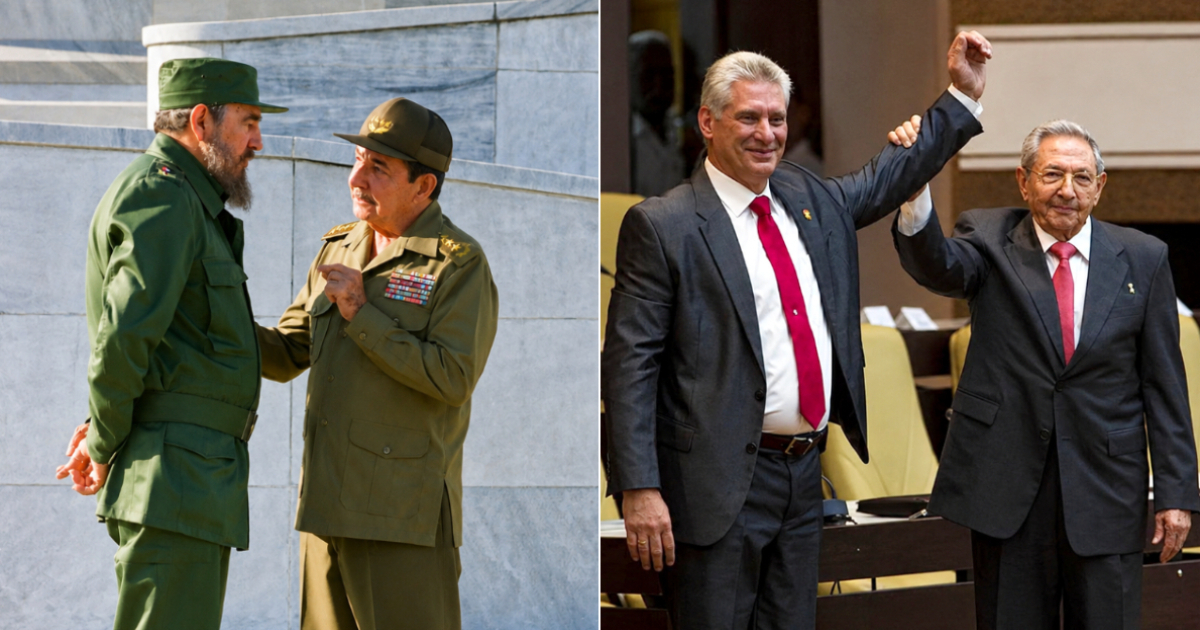
"Stay ready to serve. At your command!" With these words, Miguel Díaz-Canel addressed Raúl Castro in May 2026 during an official campaign to support the former leader, who was nearing his 95th birthday.
While this might appear to be a simple gesture of respect towards his predecessor, it exposes a political contradiction. Díaz-Canel, holding the dual role of president of the Republic and first secretary of the Communist Party of Cuba (PCC), invites a retired official to continue wielding influence.
This wasn't an isolated incident. In September, official media once again portrayed Raúl as a warrior "ready for action." On Monday, Díaz-Canel congratulated José Ramón Machado Ventura on his 96th birthday, claiming the veteran leader remained "active at the forefront."
The Quest for Political Legitimacy
The so-called "continuity" seems intent on proving that its founders remain in control, even after formally stepping down.
This raises an essential question beyond mere accolades: where does Díaz-Canel's political authority stem from, and what legitimacy can his government claim once the leaders of the so-called "Cuban revolution" are gone?
Power vs. Authority: A Critical Distinction
Inheriting power does not equate to inheriting authority. Fidel Castro's leadership was built on revolutionary triumph, personal charisma, and a gradual concentration of political power. Raúl Castro added to this legacy with his guerrilla experience, command over the Armed Forces, and decades of influence within the state apparatus and military-led economy.
Both men justified their rule through an origin story tied to the overthrow of Fulgencio Batista's dictatorship and the political transformation of 1959. This legitimacy was later used to uphold the one-party system, despite the country's dramatically changed circumstances.
Díaz-Canel lacks this foundational experience. His rise through the ranks reflects his grooming within the Castro-created apparatus. While he attained the presidency in 2018 and the top party position in 2021 through institutional mechanisms, this did not automatically transfer personal authority from his predecessors.
Power enables decision-making and enforcement; authority requires recognition of one's right to command. Legitimacy justifies that right. These concepts are related but not identical.
Constitutional Claims and Popular Support
The Cuban regime often cites the 2019 Constitution, ratified by 86.85% of voters according to official results, as evidence of popular support. However, the constitutional referendum lacked the political competition and expression conditions typical of a democracy.
The 2019 constitutional process was dominated by the PCC, with no independent national media to challenge the official campaign. The Inter-American Commission on Human Rights documented reports of intimidation and aggression against activists advocating a negative vote.
The Constitution itself reveals limits: Article 3 states sovereignty resides in the people, but Article 4 declares the socialist system irrevocable, even endorsing armed struggle to defend it. Further, Article 5 enshrines the Communist Party as the leading political force.
While citizens could theoretically vote for or against the Constitution, they couldn't choose alternative political systems or establish multiparty competition for power. A favorable majority in 2019 doesn't equate to irrevocable consent in 2026, especially with the system preventing legal political alternatives.
Changing Social and Political Landscape
Cuba's political and social landscape has evolved significantly since the 2019 referendum. Economic decline, blackouts, shortages, mass emigration, and public protests have reshaped the regime's claim to authority. The information environment has also transformed, with independent media, the internet, and social networks allowing Cubans to contrast government narratives with non-official sources.
Despite the state's vast censorship and control capabilities, it no longer monopolizes information as it did in the early Castro years. This shift complicates maintaining a political narrative reliant on the historic prestige of the "revolution."
External Pressures and Revolutionary Discourse
Internationally, Cuba faces pressure from the U.S. administration under Donald Trump, combining sanctions, economic restrictions, and political demands. While Havana and Washington maintain communication channels, no formal negotiations have occurred.
U.S. pressure helps the regime bolster its historical discourse of national resistance and confrontation with an external enemy, but foreign pressures don't resolve internal legitimacy issues. Defending national sovereignty doesn't necessitate preserving the same leaders or party structures indefinitely.
The central question remains: what mechanisms allow Cuban citizens to freely express consent or withdraw support for the political system?
The Future of Cuba's Political Legitimacy
With the passing of Ramiro Valdés in June 2026, the founding generation approaches its inevitable end. Raúl Castro, Machado Ventura, and Guillermo García Frías are all in their 90s, their public roles increasingly ceremonial. Yet, official institutions continue to hail them as political icons.
While the "continuity" has sustained the system's fundamental structures post-Castro, the PCC retains political monopoly, and the military and state institutions remain pivotal. However, institutional survival shouldn't be mistaken for democratic legitimacy.
Díaz-Canel can continue exercising powers granted by Cuba's political system without direct orders from Raúl Castro. What he cannot inherit is the supposed citizen recognition long claimed by his predecessors.
The ongoing portrayal of veterans as active leaders suggests their historical authority still legitimizes the current regime. This underscores a significant contradiction: while claiming the regime can outlast its founders, it leans on them to justify the successors' authority.
Time will address part of this issue. The last of the founding generation will eventually leave the political scene. The enduring question will be what legitimacy a system can claim that has depended on loyalty to its founders and continues to lack democratic mechanisms for citizens to choose its continuation.
Understanding Cuba's Political Dilemma
What is the significance of the 2019 Cuban Constitution?
The 2019 Cuban Constitution is often cited by the regime as evidence of popular support. However, it was adopted in a context lacking democratic competition and expression, with the Communist Party maintaining a political monopoly.
How has Cuba's information landscape changed since 2019?
Since 2019, independent media, the internet, and social networks have allowed Cubans to access information beyond official narratives, challenging the government's monopoly on information.
How does external pressure affect Cuba's internal legitimacy?
U.S. sanctions and political demands create external pressure, but they do not resolve Cuba's internal legitimacy issues. National sovereignty shouldn't imply indefinite preservation of current leaders and party structures.