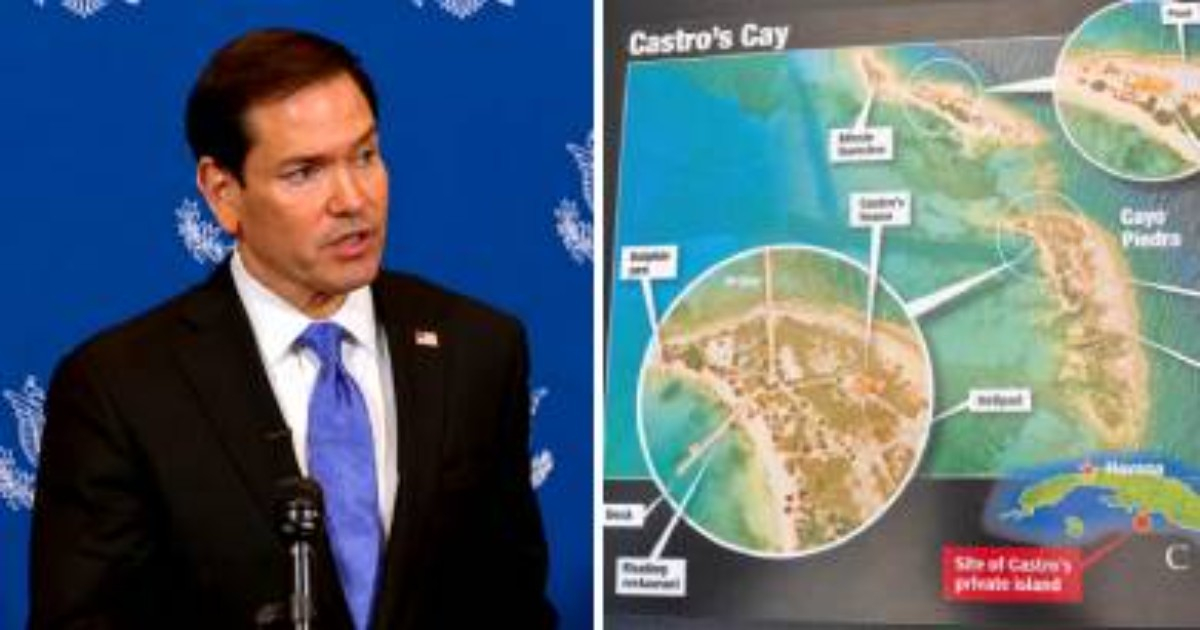
On Tuesday, Secretary of State Marco Rubio shared a satellite infographic of Cayo Piedra on platform X. Described as the "Private Island of the Corrupt Regime in Cuba," this move furthered the diplomatic offensive initiated by U.S. Ambassador to the UN, Michael Waltz, during his speech at the General Assembly.
The infographic, titled "Castro's Cay," meticulously points out each facility on the island: Castro's main residence, a guest house, a swimming pool, a helipad, a dock, a floating restaurant, a dolphin enclosure, and a missile launcher on the northern side.
That same day, Waltz posted a 41-second video on his official account, sarcastically describing the location: "Why settle for seaside mansions when you can have your very own private island? Yes, the Castro family owns their private island, Cayo Piedra: a private marina, a yacht, a floating restaurant, luxurious guest accommodations, a pool, and even a dolphin lagoon for pets."
The ambassador also mentioned that the regime owns another island with exotic animals, highlighting the central contradiction: "The corruption of the Cuban regime is staggering: they relax on their private island while their people have nothing to eat and no electricity."
Cayo Piedra's Hidden Legacy
Located roughly 15 kilometers south of the Bay of Pigs on the southern coast of Matanzas, Cayo Piedra's facilities were primarily constructed in the 1970s under Osmany Cienfuegos's direction. Its existence remained a secret to most Cubans for decades.
The main source of information about the enclave is a book by former bodyguard Juan Reinaldo Sánchez, who protected Castro for 17 years. He detailed how the Cuban leader discovered the island after the Playa Girón invasion in 1961, turning it into his private summer retreat. Among the notable visitors to the island were Gabriel García Márquez, Barbara Walters, and Ted Turner.
Waltz's Diplomatic Offensive
The display of Cayo Piedra was part of a broader diplomatic push by Washington at the UN. Waltz also showcased images of Fidel Castro's two Rolex watches—valued at $40,000, equivalent to 55 years of the average Cuban salary—a 14,000 square meter beach retreat in Varadero, and a 50-meter yacht sailing the Mediterranean.
Waltz directly challenged the regime's narrative on the embargo: "Somehow this so-called blockade that doesn't exist doesn't apply to luxury items. Somehow these items reach the Cuban regime's elites."
The session turned into one of the most chaotic episodes of the General Assembly in recent years: Foreign Minister Bruno Rodríguez Parrilla physically approached the podium where Waltz was speaking, prompting Assembly President Khalilur Rahman to briefly suspend the session. Additionally, a member of the Cuban delegation attempted to snatch Waltz's spokesperson's phone while recording the confrontation.
Waltz stood his ground, stating, "Mr. Minister, this is how it's going to work: every time you interrupt me, I will continue to explain how corrupt this regime is, and I'll do it more slowly."
International support for the Cuban resolution against the embargo has steadily declined: from 187 votes in 2024 to 165 in 2025 and down to 136 in the extraordinary session of July 2026, marking the lowest level in over a decade. The final vote was scheduled for this Wednesday.
Understanding the Diplomatic Dispute Over Cayo Piedra
What is Cayo Piedra?
Cayo Piedra is a private island located south of the Bay of Pigs in Cuba, known to be owned by the Castro family. It features luxurious facilities including a private marina, a floating restaurant, and a dolphin lagoon.
Why was Cayo Piedra highlighted by Marco Rubio and Michael Waltz?
Rubio and Waltz highlighted Cayo Piedra to draw attention to the corruption within the Cuban regime, contrasting the lavish lifestyle of its elites with the suffering of the Cuban people.
How did the Cuban delegation react during the UN session?
The Cuban delegation's reaction was chaotic, with the Foreign Minister physically approaching the podium and attempting to disrupt the session, forcing a temporary suspension.