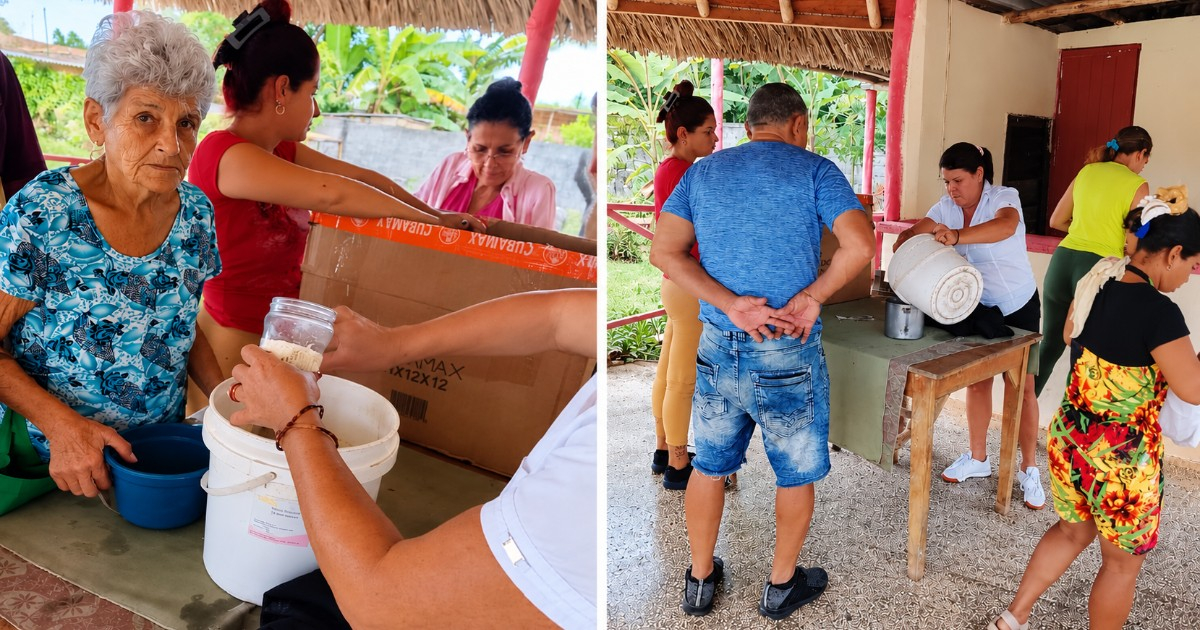
For more than 45 days, residents in the municipality of Remedios, Villa Clara, have been grappling with life without electricity, spoiled food, and immense challenges in meeting their basic needs. This grim reality was acknowledged by a Cuban state enterprise, which shared images of a community initiative aimed at providing food to vulnerable individuals.
The Villa Clara Agroforestry Company announced on Facebook that the affected families are from areas supplied by electrical circuits 67 and 152, where the prolonged lack of power has severely deteriorated living conditions. "More than 45 days without electricity have tested the resilience of numerous families in circuits 67 and 152 of #Remedios," the company admitted.
The company described the hardships faced by the community, highlighting "dark nights, lost food, and numerous shortages" as part of their daily struggles. Accompanying the message were photos depicting several individuals gathered in a community space, where food was being prepared and distributed using household containers and utensils.
Among the images, an elderly woman is seen holding a plastic container while other women assist in the preparation and distribution of meals. Neighbors are gathered around a table in what appears to be a collective food assistance activity, illustrating the extreme difficulties families are enduring after more than a month and a half without power.
"Amidst this situation, workers from the Forestry Unit, led by their director and a member of the local Defense Council, have extended support to the most vulnerable," noted the company in its post. While the efforts of these workers and neighbors are commendable, the food distribution does not solve the underlying issues that have forced these families into severe hardship, highlighting the precarious conditions faced by the population.
The duration of the blackout raises critical questions about the capabilities of the electrical authorities to repair or replace essential infrastructure components. The crisis in Remedios had already been publicly condemned before the state company formally acknowledged the extent of the power outage.
On October 9th, a local resident reported the ongoing blackouts in Remedios and the lack of explanations regarding a transformer failure that left numerous families without service. She claimed that about half of the town was affected and criticized the absence of clear information on when a resolution could be expected.
Her testimony echoed the issues now recognized by the Agroforestry Company: spoiled food, sleepless nights due to heat, and particularly severe difficulties for households with children and the elderly. Unfortunately, the situation in Remedios is not an isolated incident within Cuba's broader electrical crisis. These hardships are increasingly becoming a daily reality.
In July, Energy and Mines Minister Vicente de la O Levy acknowledged that some Cuban communities had endured up to 105 consecutive days without electricity due to failures in special transformers, which are difficult to replace due to the age of the electrical circuits. The collective food distribution depicted in Villa Clara's photos reflects similar initiatives in other provinces, where cooking for multiple families has become a response to power outages and domestic fuel shortages.
In February, community meals prepared with wood and charcoal were documented as part of survival strategies for many Cuban families. The Food Monitor Program warned that these initiatives should no longer be seen merely as traditional social activities, but also as desperate responses to the lack of electricity, fuel, and food.
In April, a group of Cubans organized a communal stew to share with the neediest neighbors in their community. Participants contributed firewood, prepared the ingredients, and kept the fire burning to cook the collective meal. This initiative demonstrated the residents' willingness to share resources but also highlighted the difficulties many families face in securing daily sustenance on their own.
By May, Villa Clara authorities promoted the sale of prepared meals as an alternative for families unable to cook due to power outages and gas shortages. The offerings included soups, stews, and other dishes prepared by state entities, a measure implemented when power cuts lasted up to 20 hours a day in some areas of the province.
Understanding the Power Crisis in Remedios
What caused the prolonged power outage in Remedios?
The power outage in Remedios was caused by failures in electrical circuits 67 and 152, as well as a malfunctioning transformer that has yet to be repaired or replaced.
How are the affected families coping with the lack of electricity?
Families are relying on community initiatives for food distribution and have been forced to adapt to difficult living conditions, including spoiled food and sleepless nights.
What measures have been taken to address the food scarcity?
Community-led food distribution efforts and state-promoted sales of prepared meals have been implemented to help alleviate the food scarcity caused by the power outages.
Is the situation in Remedios unique within Cuba?
No, the situation in Remedios is part of a larger electrical crisis affecting many regions in Cuba, where communities have faced extended periods without power.