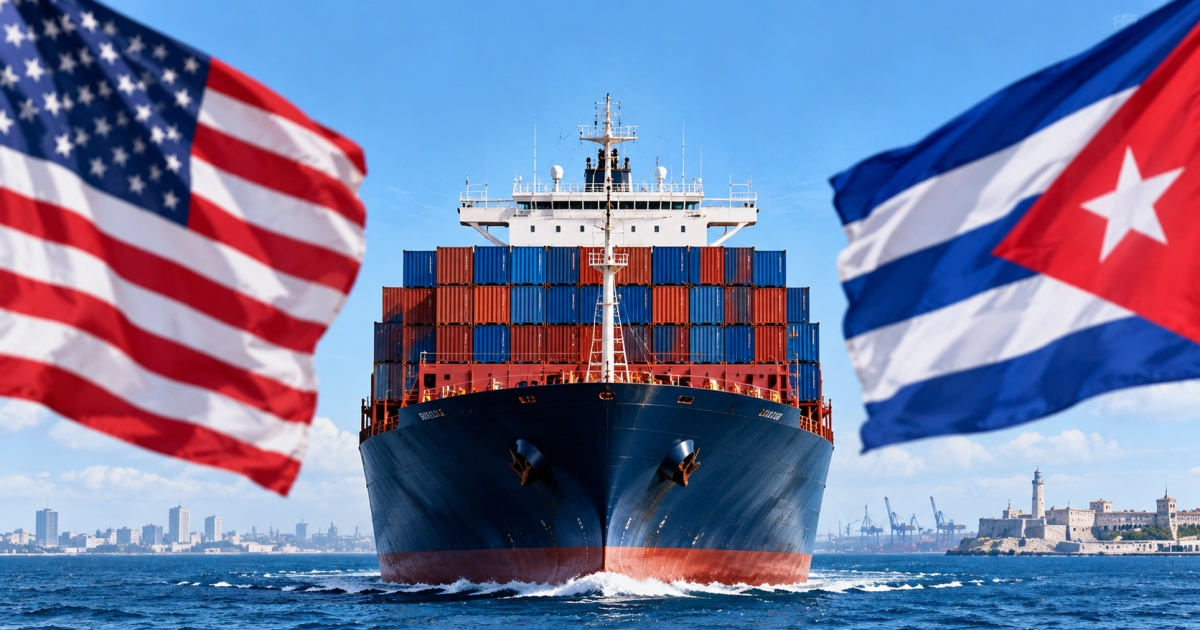
As the United Nations General Assembly prepares to vote on Cuba's resolution against the U.S. embargo, Juan Pablo Segura, the U.S. Deputy Assistant Secretary of State for Western Hemisphere Affairs, took to X to underscore American exports to Cuba in 2025. He urged the international community to stand with the Cuban people rather than its government.
Segura reported that the United States exported over $810 million worth of goods to Cuba in that year, slightly exceeding the $809.6 million reported by the U.S. Census Bureau. This statement is part of the State Department's effort to challenge the resolution from Havana, with discussions scheduled for October 27 and 28 at the United Nations.
"The Cuban people are victims of a failed communist system," Segura wrote. "U.S. legislation has always allowed for the export of food and medicine, resulting in more than $810 million in goods sent to Cuba in 2025, while American humanitarian aid delivers food and hygiene products directly to families in need."
Official U.S. trade statistics indicate that exports to Cuba totaled $809.6 million in 2025, encompassing a range of goods beyond just food and medicine.
Humanitarian Aid and the Aftermath of Hurricane Melissa
In another post on X, Segura highlighted U.S. humanitarian assistance to victims of Hurricane Melissa, which struck eastern Cuba in October 2025. "Following Hurricane Melissa, the Trump administration allocated $9 million in direct aid through the Catholic Church and an additional $100 million via Catholic Relief Services and Samaritan's Purse. We assist the Cuban people directly without subsidizing the regime," the deputy assistant secretary stated.
According to Segura, the U.S. has partnered with religious and humanitarian organizations to deliver aid directly to Cuban families, bypassing the Havana government. The U.S. administration argues that legal exceptions for food and medicine exports, along with humanitarian aid programs, demonstrate there are avenues to supply essential goods to Cuba despite the embargo.
Cuba's Response and the Global Vote
The Cuban government, however, maintains that U.S. sanctions disrupt the island's trade and financial activities, advocating for their removal through the annual U.N. resolution. Segura also accused Cuba's ruling elite of extravagant spending in contrast to the average citizen's earnings, specifically targeting the military conglomerate GAESA, which he claims controls $20 billion in illicit assets.
He warned that supporting the Cuban resolution equates to endorsing state-sponsored human trafficking, corruption, and elite privileges—allegations Washington has made against Havana. Cuban leader Miguel Díaz-Canel acknowledged on October 22 that some nations might reconsider their stance on the resolution, noting that "some people might change their vote out of fear," according to Radio Rebelde.
Germany, a longstanding supporter of the resolution, is among the countries whose position is under scrutiny. The Cuban resolution seeking an end to the U.S. embargo garnered 187 votes in favor in 2024, but only 165 in 2025, with seven opposed and 12 abstentions. While the General Assembly's declaration is not legally binding, it does not compel the U.S. Congress to amend the laws underpinning the embargo.
Understanding U.S.-Cuba Relations and the Embargo
What is the U.S. embargo on Cuba?
The U.S. embargo on Cuba is a comprehensive set of economic sanctions imposed by the United States against Cuba, aimed at restricting trade and financial transactions with the island nation.
How does the U.S. justify humanitarian aid to Cuba despite the embargo?
The U.S. justifies humanitarian aid to Cuba by highlighting legal exceptions that allow for the export of food and medicine, alongside programs that provide direct aid through religious and humanitarian organizations.
Why does Cuba present a resolution against the embargo at the U.N. annually?
Cuba presents a resolution at the U.N. annually to highlight the negative impact of U.S. sanctions on its economy and to seek international support for lifting the embargo.