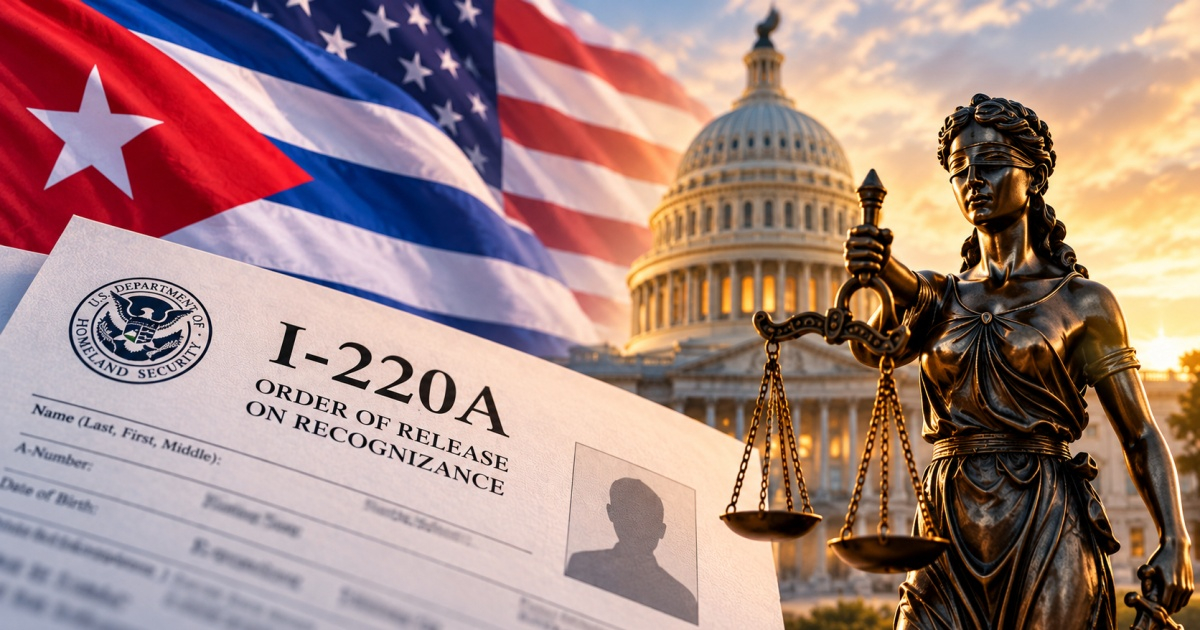
Many Cubans holding an I-220A document, who are hopeful of securing residency through the Cuban Adjustment Act, remain in limbo as various court decisions could impact their cases.
As of Tuesday, October 27, 2026, no sweeping federal ruling has yet determined that the I-220A alone is equivalent to immigration parole or that it grants automatic eligibility for permanent residency.
The Legal Landscape and Cuban Migration
Courts are currently evaluating different aspects: whether certain releases of Cuban immigrants can be classified as parole, the legal authority the government used to detain them, and if those re-detained by ICE are entitled to request a bond hearing.
Decisions from the Board of Immigration Appeals (BIA), the Eleventh Circuit, and the Fifth Circuit, alongside a case before the Supreme Court, shed light on the legal possibilities and constraints for Cubans holding an I-220A.
Understanding the Distinction: I-220A vs. Parole
The Cuban Adjustment Act requires, among other things, that a person has been inspected and admitted or paroled into the United States. The parole granted under section 212(d)(5) of the Immigration and Nationality Act (INA) can meet this requirement.
However, numerous Cubans who crossed the border between 2021 and 2023 received an I-220A, known as an Order of Release on Recognizance, which does not constitute a parole grant by itself.
The United States Citizenship and Immigration Services (USCIS) clarified this distinction in a February 2022 notice, identifying release under section 236 of the INA as legally different from parole. That notice also discussed the possibility of reopening certain cases of Cubans released between January 12, 2017, and November 17, 2021, without broadly recognizing the I-220A as parole.
Key BIA Decisions Affecting I-220A Holders
The BIA has issued several precedential decisions impacting the interpretation of residency requirements and immigrant detention conditions.
In Matter of Cabrera-Fernández (September 11, 2023), the BIA ruled that release under section 236 of the INA is legally distinct from humanitarian parole and does not satisfy the admission or parole requirement of the Cuban Adjustment Act.
The Matter of Q. Li (May 15, 2025) addressed the detention framework for individuals arriving in the U.S. under section 235(b), emphasizing the legal authority under which they were detained and released.
Meanwhile, Matter of Roque-Izada (June 20, 2025) reaffirmed the difference between conditional release under section 236 and the parole required for the Adjustment Act, rejecting the closure of a deportation case based solely on the potential future parole grant by USCIS.
These decisions remain influential for immigration judges, albeit their application must consider binding federal court rulings within each jurisdiction.
Recent Developments in the Eleventh Circuit
On February 23, 2026, the Eleventh Circuit Court of Appeals overturned two BIA decisions, remanding cases involving Cuban families Labrada-Hechavarría and Castillo-Casanova for further proceedings.
These cases involved Cuban families who entered the U.S. without documentation, were detained by the Department of Homeland Security (DHS), and later released. Immigration judges initially ruled that these releases did not constitute parole, a view the BIA initially upheld.
During judicial review, a significant change occurred: in July 2025, the federal government altered its stance, acknowledging that the appellants were subject to detention authority under section 235(a), rather than section 236(a) as previously contended.
The Eleventh Circuit found it had jurisdiction to review the dispute, overturning the BIA decisions. It noted the government's changed interpretation and the BIA's subsequent new decisions regarding the scope of section 235.
This ruling did not determine these releases as parole nor order residency grants, but remanded the cases for the BIA to reconsider in light of the legal issues raised.
Detention Without Bond: A Separate Issue Impacting Immigrants
Discussions around the Cuban Adjustment Act should not be confused with ongoing litigation concerning immigration detention. These latter cases address when ICE can detain an individual during deportation proceedings and whether they can access a bond hearing.
In Matter of Yajure Hurtado (September 5, 2025), the BIA interpreted that certain individuals present in the U.S. without having been admitted are subject to mandatory detention under section 235(b)(2)(A), limiting immigration judges' ability to grant bond.
Federal courts have diverged in their interpretations of these provisions:
- Eleventh Circuit (Florida, Georgia, Alabama): On May 6, 2026, in Hernández Álvarez, the court examined sections 235 and 236's application to individuals already inside the country, supporting the possibility of requesting a bond hearing under section 236(a).
- Fifth Circuit (Texas, Louisiana, Mississippi): Litigation regarding mandatory detention has led to decisions reflecting a different view on the government's detention powers. In Sosnava Rodríguez, the court has also engaged in related proceedings.
- Supreme Court: The case Rhoney vs. Barbosa da Cunha from the Second Circuit addresses detention laws for immigrants in the U.S. without admission, significant for determining federal powers' scope in this area.
These differences can impact detained immigrants across various jurisdictions. However, access to a bond hearing is not solely dependent on the individual's location. Factors such as migration history, legal authority for detention, final deportation orders, and applicable judicial decisions also play a role.
Being granted a bond hearing does not guarantee release; it simply means the individual can request an evaluation of their eligibility for bond.
The Miami Lawsuit: What’s Next After October 30?
The judicial dispute continues in the Southern District of Florida, where Cubans with I-220A are seeking recognition of certain immigration releases as parole for the Cuban Adjustment Act. Plaintiffs have responded to the government's renewed motion to dismiss the case.
The procedural schedule sets Friday, October 30, 2026, as the deadline for the government's new response. This deadline is for a procedural filing, not a date by which the judge must issue a ruling.
Upon completing the briefs, the court may resolve pending issues based on the case's development. Filing the lawsuit does not automatically grant immigration protection to all I-220A holders.
Any collective effect would depend on the court's decisions, the measures ordered, and the individuals legally included in them.
Guidance for Cubans with I-220A While Awaiting Decisions
It is crucial for Cubans with I-220A to adhere to ICE appointments and immigration hearings. The existence of lawsuits does not automatically suspend individual obligations, and missing a hearing could result in a deportation order in absentia, except as provided by law.
Checking the status of the case is essential. The Executive Office for Immigration Review (EOIR) case information system allows individuals to check judicial proceedings using the alien number or A-number.
Reviewing entry and release documents with a lawyer is important to determine under what authority the person was detained, what documents they received, and whether there is a record of admission or parole that may affect their eligibility for the Cuban Adjustment Act.
All immigration documents, including copies of the I-220A, I-94 if available, court notices, ICE appearance receipts, and any related requests or decisions, should be retained. An emergency family plan should be prepared in case of detention, ensuring a trusted person has access to essential documents, the A-number, and legal representative contact information.
Be wary of promises of automatic residency. No pending litigation guarantees residency for all I-220A holders, nor is there a general process that automatically converts this document into parole.
FAQs on I-220A and the Cuban Adjustment Act
Can I file the I-485 if I have an I-220A?
The I-220A alone does not fulfill the admission or parole requirement of the Cuban Adjustment Act. Filing a viable application depends on the complete immigration history and other legal requirements. Individuals with documented parole or unique circumstances should consult a licensed professional before applying for adjustment.
Does the Eleventh Circuit ruling automatically benefit all Cubans with I-220A?
No. The February 23, 2026, decision pertains to two specific cases and orders the BIA to re-examine them. Its arguments may be used in other litigation when circumstances are similar but do not constitute a general parole or residency grant.
Can I request bond if detained by ICE?
It depends on the legal authority for the detention, the status of the immigration proceedings, and applicable jurisprudence. Some individuals may request a bond hearing before an immigration judge, while others are subject to different detention regimes. Eligibility must be evaluated individually.
When will there be a definitive answer regarding the I-220A?
There is no single date. Procedures concerning the Cuban Adjustment Act and detention litigation address different issues. A decision on the right to request bond would not necessarily resolve whether a release documented by an I-220A meets parole requirements for residency. General requirements, deadlines, and necessary documents for applying for residency are explained in our step-by-step guide to the Cuban Adjustment Act.