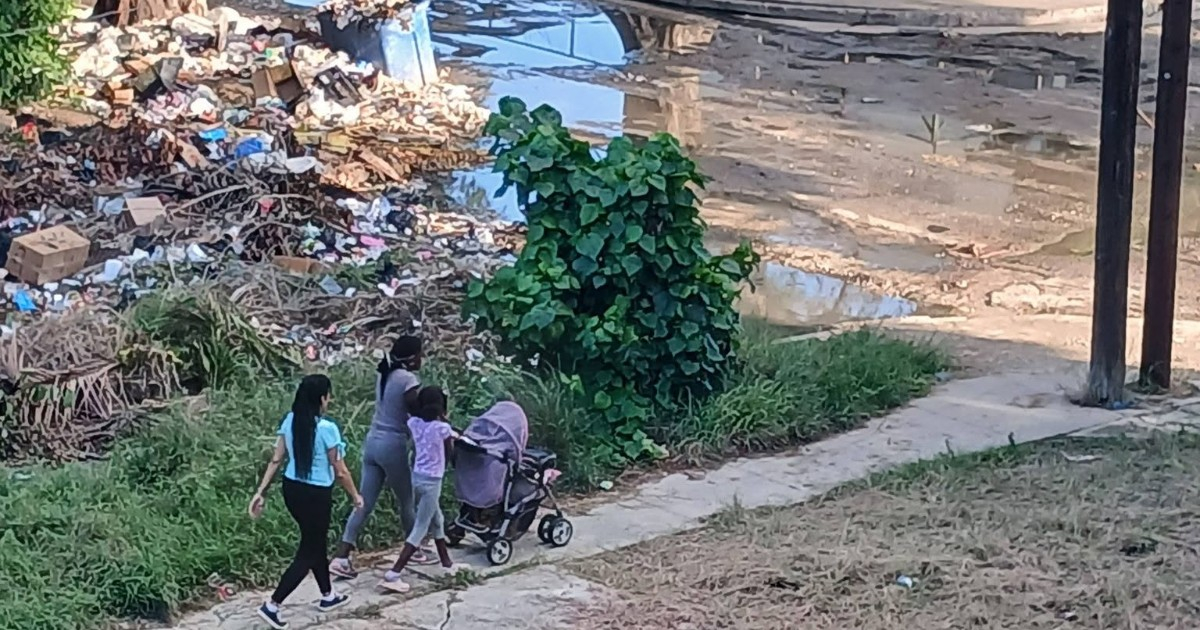
A resident of the Altahabana neighborhood in Havana's Boyeros district took to Facebook to express concern over a significant accumulation of trash at the intersection of 7th and L streets, located just behind the William Soler Pediatric University Hospital and close to the Rafael Orejón secondary school.
Bárbara Eshter Cárdenas shared numerous photos depicting heaps of solid waste, debris, cardboard, plastics, and stagnant water that have nearly obstructed vehicle access in the area.
"The current trend seems to be collecting right up until this block, but the issue is worse: the street is completely blocked, leaving only a narrow path for motorcycles, which is the biggest problem," the concerned resident wrote.
This situation has forced cyclists, motorcyclists, and even horse-drawn carts to traverse the garden of Cárdenas' building to continue along 7th Street, according to her account.
One of the photos shows a family with a baby stroller navigating the sidewalk next to the garbage pile, highlighting the daily exposure of residents and children to the deteriorating environment.
Cárdenas didn't stop at pointing out the trash issue; she also criticized the lack of solutions for the prolonged power outages plaguing the neighborhood.
"There's no effort to implement a rotating circuit for these endless blackouts, unlike other places, and every response given is an absurd excuse," she lamented.
Her remarks ended with a plea of desperation directed at local authorities: "God have mercy on us because the leaders of this place DO NOT EXIST. And if they do, only you know their purpose."
Comments from other users echoed sentiments of indignation and sorrow. "This is why we have so many diseases; it's depressing how far we've fallen," one user wrote. Another mentioned that a family member living in the building was hospitalized with a virus. A third comment attributed the street's decline to leaking sewage and lamented the absence of inspectors to impose penalties.
"It's just trash and more trash, bringing flies, mosquitoes, rats, and all kinds of vile creatures," Cárdenas summarized in her post, capturing the frustration of those living next to a landfill that local authorities have yet to address.
This complaint is part of a broader structural crisis of waste collection in Havana that worsened in 2026. At the start of that year, only 44 of the capital's 106 garbage trucks were operational—41.5% of the fleet—due to diesel shortages and mechanical failures, while the city produced between 24,000 and 30,000 cubic meters of waste daily.
The Boyeros district had already been highlighted in previous reports for micro-dumps left uncollected for over 72 hours. In September 2026, 20 new trucks from China were introduced, yet the problem persisted in several areas of the capital, including the Luyanó neighborhood, where residents reported an active dump site for four months.
The sanitary backdrop adds to public concern: Cuba had recorded 11,235 dengue cases by October 4, 2026, a figure 9.2 times the historical average of the previous five years, with all four virus serotypes circulating simultaneously, according to the Global Dengue Observatory of the London School of Hygiene and Tropical Medicine.
The accumulated trash, leaks, and stagnant water create breeding grounds for the mosquitoes that transmit the disease, a risk that Altahabana residents themselves highlight in their comments.
The William Soler Hospital, a national reference for pediatric surgery, had previously faced complaints in August 2026 for the deterioration of its internal facilities, with photos showing damaged bathrooms, humidity, and debris in its corridors.
Understanding the Waste Crisis in Havana
What is causing the trash accumulation in Havana?
The trash accumulation is primarily due to a lack of operational garbage trucks caused by diesel shortages and mechanical failures, compounded by insufficient waste management infrastructure.
How does the waste problem impact public health in Havana?
The waste problem contributes to the spread of diseases such as dengue by creating breeding grounds for mosquitoes, as well as increasing the risk of other sanitation-related health issues.
Have there been any efforts to solve the waste issue in Havana?
Despite the introduction of 20 new garbage trucks from China, the waste problem persists due to systemic issues and a lack of effective waste management strategies.
Why are residents frustrated with local authorities?
Residents express frustration over the lack of effective solutions from local authorities, both for the waste crisis and for dealing with prolonged power outages.