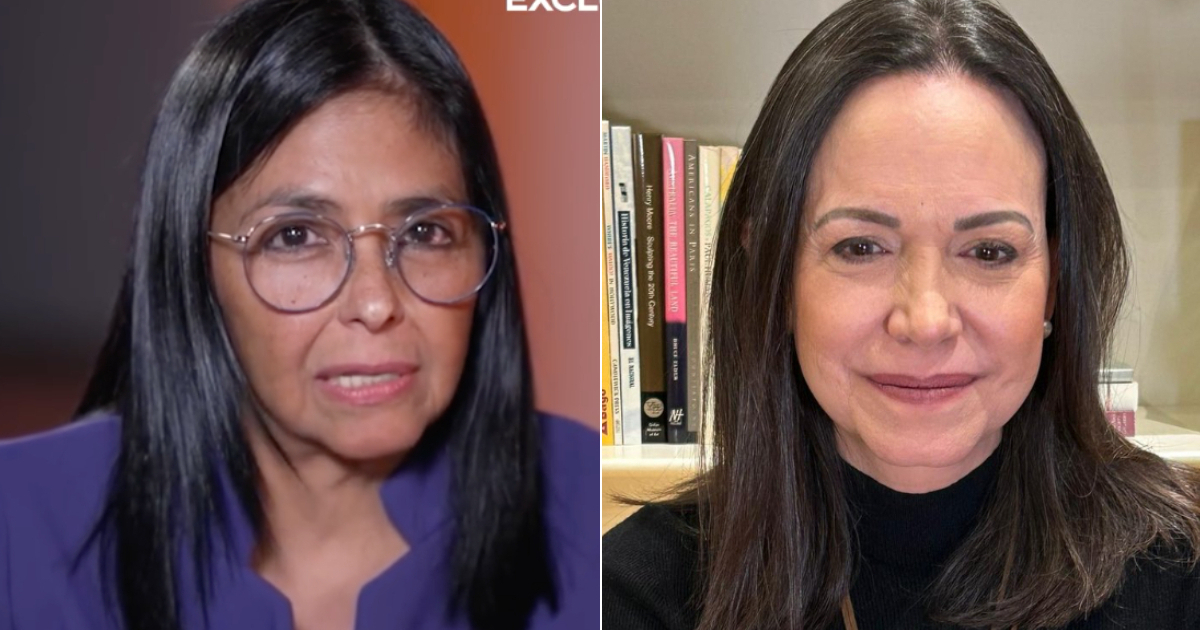
On Monday, U.S. Secretary of State, Marco Rubio, confirmed that the Trump administration had engaged in direct talks with Venezuelan authorities led by Delcy Rodríguez to facilitate María Corina Machado's return to her homeland after almost ten months abroad.
During a phone call with journalists, as reported by the Associated Press and expanded upon by the Spanish newspaper ABC, Rubio detailed that Washington had requested weeks earlier that the opposition leader be allowed to return to Venezuela unimpeded and without facing any repercussions.
"Weeks ago, and I mean several weeks, we communicated with the interim authorities, expressing our expectation that she, as a Venezuelan, should be able to come back to her country. It's her nation, her origin. She should return without any hassle or issues," Rubio stated, according to ABC's translation.
Rubio revealed that Delcy Rodríguez's government responded by affirming that Machado was free to enter Venezuela and could even do so through an airport.
"They told us she could land at the airport if she wished. And we relayed that to her team," he confirmed.
Machado made her return to Venezuela this past Sunday after being away since December 2025, when she left clandestinely to travel to Norway to receive the Nobel Peace Prize.
Her first public appearance was in Barquisimeto, Lara state, where she began a journey to Caracas, welcomed by supporters who came out to greet her.
On Sunday, Rubio had already attributed Machado's return to U.S.-backed political reconciliation talks, but on Monday, he provided further details about the direct negotiations with Rodríguez's government.
Details of the U.S. Involvement
Rubio clarified that Washington had not attempted to prevent Machado's return, with the exception of the days following the earthquakes in Venezuela in June of this year.
He emphasized that during that period, the U.S. prioritized facilitating the entry of humanitarian aid, rescue teams, and emergency flights.
"The only time I personally advised against her return was right after the earthquake," he said, according to ABC.
He acknowledged that previous attempts by Machado to return faced obstacles involving third-party countries, whose authorities had reservations about the diplomatic implications of facilitating her travel.
Obstacles included Copa Airlines' refusal to let Machado board a commercial flight between Panama and Caracas and the inability to arrange alternative routes through Aruba and Curaçao.
Political Repercussions and Future Elections
Rubio stressed that those barriers were not due to opposition from the U.S. government and assured that, according to Washington's information, Machado had managed to enter and move around Venezuela without incident.
"She encountered no issues entering or while being inside the country," he declared.
The revelation from Rubio comes amid discussions between interim Venezuelan authorities and opposition sectors to reform the electoral system and prepare for future elections.
He explained that Washington aims to leverage its influence over Rodríguez's government to ensure the process leads to free and verifiable elections.
"Our goal here is to have elections," he affirmed, according to the Associated Press.
Rubio reiterated that Venezuela needs to stabilize its economy, rebuild its judicial and electoral institutions, and ensure conditions for political participation, including freedom of the press and access to media.
Venezuelan authorities and opposition representatives agreed last week on a roadmap to introduce reforms for elections in 2027, although no official date for the presidential elections has been set.
Rubio asserted that the U.S. will maintain diplomatic and economic pressure to prevent the process from dragging on indefinitely.
"We have deadlines that they have accepted, and so far, they have met every single one," he stated, as per ABC.
The Role of Delcy Rodríguez and U.S. Cooperation
Rubio also defended Washington's cooperation with Delcy Rodríguez following the capture of Nicolás Maduro during a U.S. military operation on January 3, 2026.
Although Rodríguez has publicly criticized that intervention, Rubio indicated that her government has met several U.S. demands.
"In the end, we judge this not by rhetoric, but by actions," he declared.
According to Rubio, achievements include security cooperation, institutional reforms, and a reduction of Cuba and Iran's influence in Venezuela.
He mentioned the interim authorities' collaboration in extraditing individuals sought by U.S. justice, highlighting the case of businessman Alex Saab. These claims align with the version Rubio shared with journalists.
He emphasized that Venezuela remains under U.S. sanctions and that Washington's economic authorizations serve as tools to demand political commitments.
Machado's return also prompted a public response from Delcy Rodríguez, who labeled the opposition leader's arrival as a "show," asserting that she could have returned without turning it into a media event.
"I truly believe politics should not be a spectacle because it is something very serious," Rodríguez stated on Venezuelan state television.
The acting president also urged Machado to show remorse for supporting international sanctions and the U.S. intervention that led to Maduro's capture.
The Vente Venezuela party confirmed that Machado is willing to meet with Delcy Rodríguez as part of the political transition process.
Party spokesperson Claudia Macero assured that the opposition leader is prepared to engage in dialogue with necessary parties, provided the conversations advance concrete agreements for the country.
FAQs on U.S.-Venezuela Relations and María Corina Machado's Return
What role did the U.S. play in María Corina Machado's return to Venezuela?
The U.S., through Secretary of State Marco Rubio, engaged in direct talks with Venezuelan authorities, led by Delcy Rodríguez, to ensure Machado could return without facing obstacles or reprisals.
Why did the U.S. advise against Machado's return after the earthquake?
Rubio advised against her return immediately after the earthquake to prioritize the entry of humanitarian aid, rescue teams, and emergency flights.
What are the implications of the U.S. involvement in Venezuela's political process?
The U.S. aims to use its influence to ensure that Venezuela's political process leads to free and fair elections, while also rebuilding its institutions and stabilizing the economy.