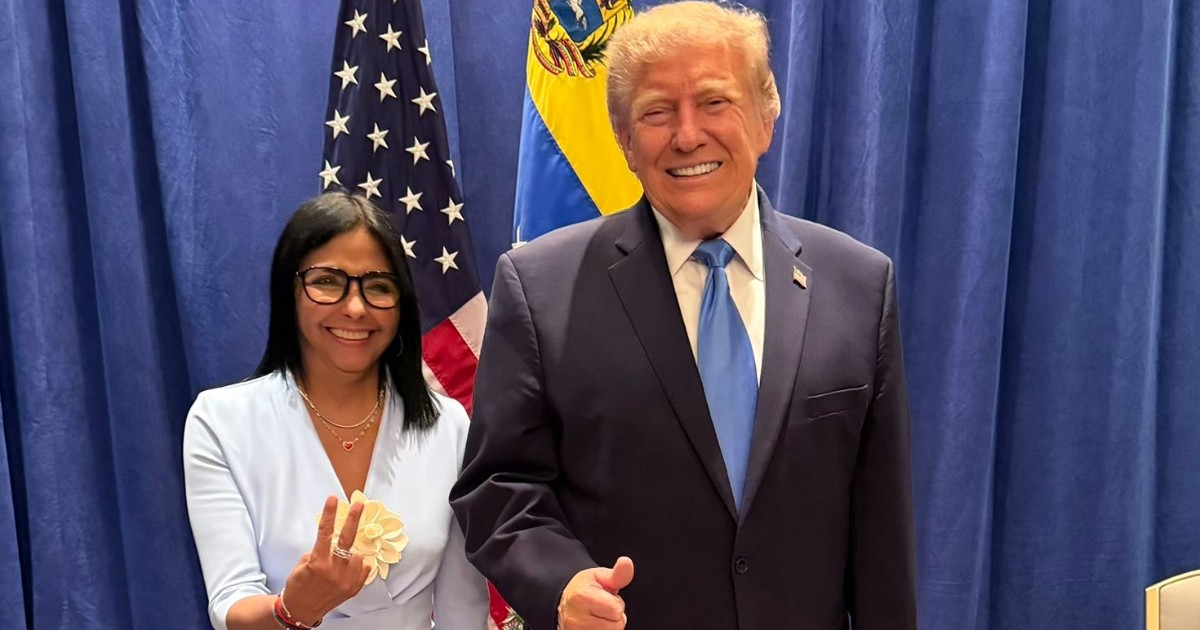
The administration of Donald Trump outlined a clear plan on Monday, aiming for Venezuela's interim leader, Delcy Rodríguez, to step down and pave the way for elections in 2027, according to reports from EFE.
During a teleconference, a senior official from the State Department detailed that this strategy involves two preliminary actions: first, revamping the Supreme Court of Justice (TSJ) before the year's end, followed by a reform of the National Electoral Council (CNE) shortly thereafter.
"Once these elements are in place—a new TSJ by the end of this year and a new CNE soon after, with work already underway—Rodríguez should declare the presidency permanently vacant," the official clarified.
Under current Venezuelan law, such a declaration would trigger a constitutional period of six months to call for new elections, potentially scheduling the vote for the latter half of 2027.
Electoral Process Overhaul
Secretary of State Marco Rubio stressed that Venezuela's electoral framework, crafted under Nicolás Maduro's regime, was designed to rig elections. Therefore, a significant overhaul is essential before any legitimate voting can occur. "We are making real progress in this area. However, if anyone attempts to derail the process, it will inflict severe harm on Venezuela," he warned, as reported by Reuters.
The State Department official also highlighted Washington's core aim: "Our goal is to ensure elections where the losing party acknowledges the fairness of the process."
Machado's Return Amid Political Maneuvering
These statements follow the return of opposition leader María Corina Machado to Venezuela after nearly ten months abroad. Machado came back from Colombia, visited the Divina Pastora sanctuary in Barquisimeto, and traveled approximately 400 kilometers to Caracas, where she was greeted by thousands of supporters.
Rubio clarified that the "only time" he advised Machado against traveling was right after the June 24 earthquake for logistical humanitarian reasons. He denied any U.S. involvement in the obstacles Machado faced upon her return, attributing these to "third-party countries" with vested interests in Venezuela.
The U.S. diplomatic chief disclosed that Washington had informed the interim government "weeks ago" that Machado should be allowed to return and that authorities assured her entry without issues. "We told them, 'Look, our expectation is that she is Venezuelan. She belongs to her country. She should be allowed to return.' They assured us she could enter through the airport if she wished," he recounted.
Meanwhile, Rodríguez dismissed Machado's return as a "show," asserting that the opposition figure could have entered the country through an airport.
The timelines suggested by Washington align broadly with those proposed by Dinorah Figuera, the 2015-elected National Assembly president and head of the opposition delegation in formal talks with the Chavistas. She has projected possible elections for late 2027 or early 2028. Just four days ago, Trump described a potential electoral face-off between Rodríguez and Machado as "interesting," without formally endorsing either candidate.
Despite winning the Nobel Peace Prize in 2025, Machado remains barred from holding public office for 15 years since June 2023. Reviewing this ban is part of the negotiation agenda between the interim government and the opposition.
Key Questions on Venezuela's Political Future
What are the main steps in the U.S. plan for Venezuela's elections?
The U.S. plan involves renewing the Supreme Court of Justice and reforming the National Electoral Council to facilitate fair elections by 2027.
Why is there a need to change Venezuela's electoral infrastructure?
The current electoral system was designed under Nicolás Maduro's regime to manipulate elections, necessitating an overhaul to ensure transparency and fairness in future voting processes.
How did María Corina Machado return to Venezuela?
Machado returned from Colombia, visiting the Divina Pastora sanctuary and traveling to Caracas while being greeted by her supporters, despite facing previous travel obstacles.