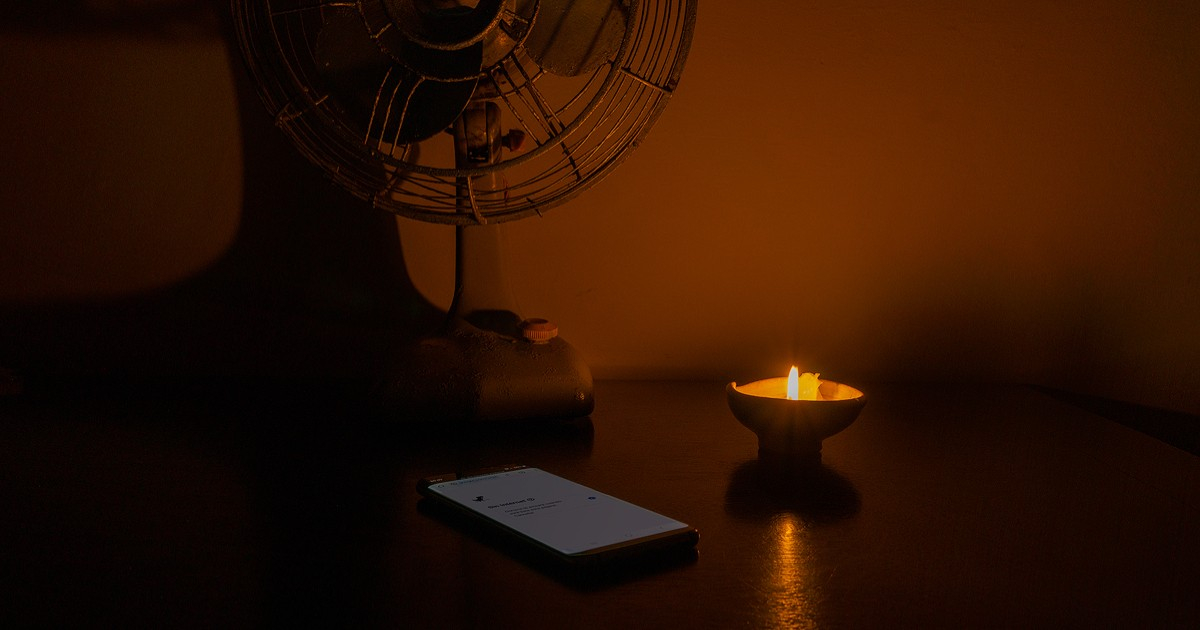
This Monday, Cuba is bracing for yet another widespread blackout. According to a report from the National Electric Union (UNE), the National Electric System (SEN) will have an available capacity of just 1,030 MW during peak demand hours. This is significantly below the anticipated demand of 2,900 MW, resulting in a deficit of 1,870 MW and a projected shortfall of 1,900 MW—covering less than 36% of the nation's needs.
More than 64% of the peak evening demand will remain unmet, leaving millions of Cubans without light.
As of 6 a.m. on Monday, the situation was already dire. The UNE reported availability of 1,030 MW against a demand of 2,250 MW, with 1,176 MW already impacted at that time. The state entity also predicted a midday deficit of 1,250 MW.
Sunday was equally grim. The state-run company admitted that "service was disrupted due to a capacity shortfall for 24 hours," with outages persisting throughout the night. The previous day's peak hit 1,849 MW at 7:30 p.m.
The list of outages is extensive. Offline are unit 1 of the Santa Cruz Thermoelectric Plant (CTE), unit 2 of CTE Felton, and units 3 and 6 of CTE Renté. Under maintenance are unit 8 of CTE Mariel, unit 3 of CTE Santa Cruz, unit 5 of CTE Nuevitas, and unit 5 of CTE Renté. Thermal generation limitations total 508 MW. Additionally, corrective maintenance is expected to take unit 6 of CTE Nuevitas offline, although unit 6 of CTE Renté is anticipated to contribute a mere 60 MW during peak hours. The only relief came from solar energy: photovoltaic parks generated 3,490 MWh on Sunday, with a maximum output of 543 MW at midday. However, this energy vanishes at nightfall, just as demand peaks.
This situation is not an anomaly but part of an ongoing crisis that has persisted for nearly a year. In the previous week, deficits ranged from 1,730 to 1,933 MW daily. October 2 saw the worst record of the month, with 2,130 MW affected, and on October 16, a fire at CTE Santa Cruz reduced availability to 740 MW, leaving 75.5% of the demand unmet. So far in 2023, the SEN has experienced at least eight total collapses, the latest occurring on September 18, taking about 32 hours to recover.
The blackouts have repercussions beyond darkness. The National Institute of Hydraulic Resources acknowledged that around 2.5 million Cubans are experiencing disrupted water supply due to power cuts, which halt pumping systems. The United Nations estimated in September that this figure could reach 3.5 million people.
Understanding Cuba's Electricity Crisis
What is causing the electricity shortages in Cuba?
Cuba's electricity shortages are primarily due to insufficient operational capacity in the National Electric System, compounded by maintenance issues and the failure of several key power units.
How do these power outages affect daily life in Cuba?
Power outages in Cuba disrupt daily activities, impacting lighting, water supply due to halted pumping systems, and various other essential services, affecting millions of citizens.
What measures are being taken to resolve the energy crisis?
Efforts to resolve Cuba's energy crisis include maintenance and repair of existing power units, although the ongoing issues suggest that more comprehensive solutions may be necessary.