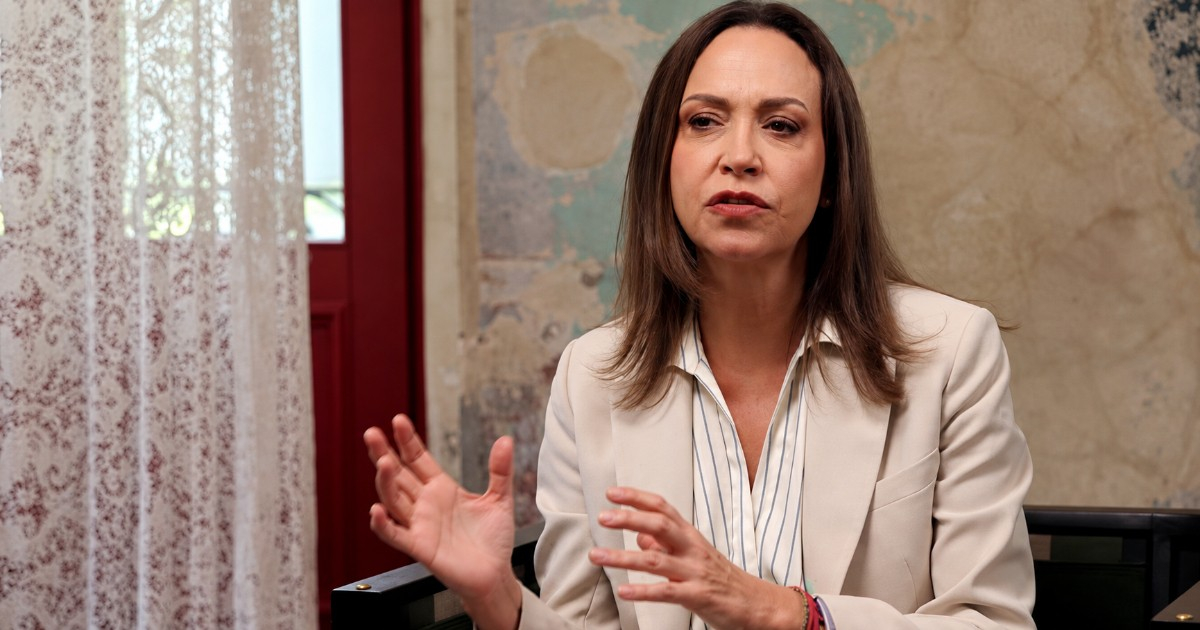
Maria Corina Machado's return to Venezuela this past Sunday marks the end of her nearly ten-month absence from the country. Venezuelan journalist and analyst Boris Muñoz, writing for El País, describes this moment as the beginning of a far more challenging journey. Machado, a prominent opposition leader, must navigate carefully to seek a less traumatic exit from Chavismo while satisfying the public's demand for justice.
Machado announced her return with a brief post on X, stating, "I'm here. With you." Her first public appearance took place at Santa Rosa Church in Barquisimeto, Lara state, where the sanctuary of the Virgen de la Divina Pastora is located. Overwhelmed supporters welcomed her with hugs and expressions of devotion. Among the crowd, a mother's desperate cry, "Bring my children back!" encapsulated the plight of the over 7.8 million Venezuelans forced to emigrate in recent years.
Muñoz sees the end of Machado's "odyssey" as positive news, potentially reinvigorating a transition process suffering from three significant issues: it lacks popular support, is heavily influenced by Washington, and has stalled regime change through an opaque, bureaucratic approach.
The analyst recalls that since January 3, 2026, when U.S. forces apprehended Nicolás Maduro, "a maneuver by Trump excluded Machado from the democratic transition she was prepared to lead." Since then, the Venezuelan government has been led by interim President Delcy Rodríguez, with Washington negotiating the country's institutional reorganization.
Political Dynamics and Machado's Strategic Moves
On the specifics of her return, Muñoz cites sources close to Machado who simply stated that "logistical and political obstacles were overcome." They noted that Machado did not negotiate with Dinorah Figuera's faction or the Chavista government.
Conversely, Marco Rubio attributed her return to U.S.-backed reconciliation talks, which reportedly resulted in the release of over 1,000 political prisoners. Meanwhile, Trump reacted cautiously, remarking, "She's a very pleasant woman. She gave me her Nobel Prize, so how can I say otherwise? And I hope she stays safe."
Muñoz emphasizes that Machado is "walking a tightrope with Trump" and will strategically challenge the Rodríguez government to maintain U.S. support, which he describes as "paradoxical." Analyst Carlos Blanco outlined Machado's immediate goals: mobilizing the nation to restore hope, building a popular organization uniting parties and civil society, fostering a broad opposition alliance, and forging a national agreement to resolve the crisis. With this agreement, Machado aims to hold presidential elections in the first half of 2027, according to the article.
Machado's Resources and Regional Impacts
The article highlights Machado's significant resources for this task: 52% voter intention, 61% positive personal rating, a national structure capable of mobilizing millions, and a strong international profile.
Comparisons with Cuba emerged quickly: UNPACU founder José Daniel Ferrer viewed Machado's return as a model for urging the Cuban opposition to construct an effective unified structure and select a leader, conditioning his own return to the island on this development: "I will go to Cuba with the leader of that effective and functional unity."
The writer concludes his analysis in El País with a cautionary note that captures the complexity of the moment, quoting 19th-century Venezuelan politician Antonio Guzmán Blanco: "Venezuela is like a dry leather: you step on it one side, and it rises on the other." A fourth round of negotiations between the Venezuelan government and the opposition is scheduled for November 2026.
Boris Muñoz holds a Ph.D. in Latin American Literature from Rutgers University and has authored several books, including "La ley de la calle," "Más allá de la ciudad letrada," and "Despachos del imperio" (2007). He has contributed, edited, and written columns for various media outlets in America and Europe, served as a visiting professor at Harvard University's Rockefeller Center for Latin American Studies, and was awarded the María Moors Cabot Prize from Columbia University.
Understanding Maria Corina Machado's Return and Its Implications
Why is Maria Corina Machado's return significant?
Her return marks the end of a long absence and could reinvigorate Venezuela's transition process, which has been criticized for lacking popular support and being bureaucratic.
What are Maria Corina Machado's immediate objectives?
Her goals include mobilizing the nation, creating a popular organization, fostering an opposition alliance, and forging a national agreement to resolve Venezuela's crisis.
How does Maria Corina Machado plan to handle U.S. relations?
She intends to strategically challenge the Venezuelan government without alienating the United States, which plays a significant role in the country's political dynamics.