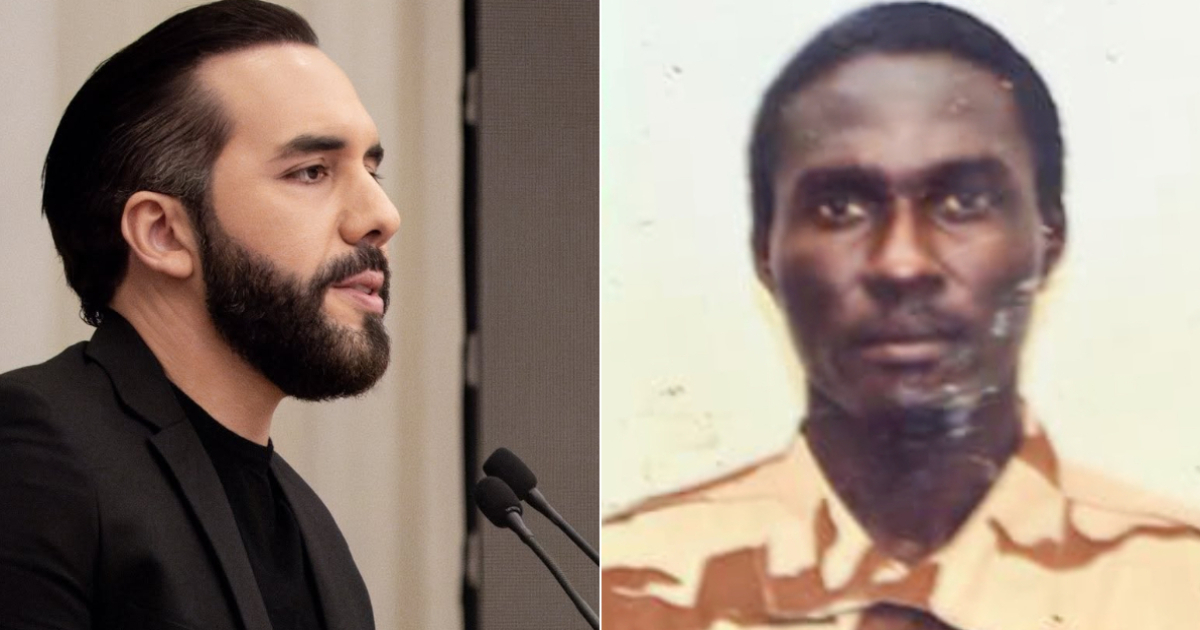
El Salvador's President, Nayib Bukele, refuted a report from The New York Times on Saturday, which claimed that the bodies of the four missing Salvadoran military technicians had been found in Haiti following an ambush. This report was originally conveyed by Reuters from San Salvador and Port-au-Prince.
The American newspaper, citing two sources close to the security mission, reported that four severely burned bodies were recovered outside the Haitian capital and delivered to a Salvadoran military team at the international airport. The newspaper acknowledged that autopsies were necessary to confirm the identities.
Hours after the publication, Bukele responded with a straightforward message on X: "These are not our men."
The president clarified that a non-governmental organization handed over the remains at the airport, claiming they belonged to the four technicians. However, upon examination, it was determined that they did not match.
“The remains are those of a child, a man significantly taller than our technicians, and a person wearing part of a uniform from an army that is not ours,” he wrote. He added that among the remains were identification cards and military uniforms from other countries.
As evidence, Bukele shared photos of a credential from the Gang Suppression Force (GSF) and a national identity card from Chad in the name of Sossal Kamis Alhadj, a private with ID number T-1426, suggesting that at least one of the bodies might belong to a Chadian soldier.
The four Salvadoran technicians disappeared on October 18 when their armored vehicle was attacked with gunfire and explosives in the Santo sector of Croix-des-Bouquets, northeast of Port-au-Prince, while returning from a market to their base.
The vehicle caught fire, and the four managed to escape, but contact was lost with them. This was the first significant attack on the GSF since the mission began operations.
Local media linked the ambush to the Chèn Méchan and 400 Mawozo gangs, which dominate the area, although no group has publicly claimed responsibility.
Days before, Bukele announced a military operation with elite troops deployed in Haiti to rescue the four compatriots "alive and unharmed,” with about 100 special forces arriving in Port-au-Prince on October 23.
Search efforts focused on Croix-des-Bouquets, Plaine du Cul-de-Sac, Santo, Marassa, and Shada, in coordination with the Haitian National Police.
The GSF operates with the authorization of the UN Security Council and has a ceiling of 5,500 personnel, although at the time of the incident, it had just about 2,000 soldiers from six contributing countries. This Sunday, the Council extended its mandate for an additional six months, until March 31, 2027.
Haitian gangs have expanded significantly since the assassination of President Jovenel Moïse in 2021, taking control of large areas of Port-au-Prince and displacing between 1.4 and 1.5 million people.
With Bukele’s statement, the whereabouts of the four Salvadoran technicians remain officially unconfirmed.
“All who have enlisted are believers, and we have entrusted this mission to God,” the Salvadoran leader stated days before receiving remains he claims do not belong to his officers.
FAQs on Missing Salvadoran Soldiers in Haiti
What did President Bukele say about the remains found in Haiti?
President Bukele stated that the remains found in Haiti do not belong to the missing Salvadoran technicians, as they included a child, a taller man, and a person in a uniform not from their army.
Who are the gangs linked to the ambush in Croix-des-Bouquets?
Local media have connected the ambush to the Chèn Méchan and 400 Mawozo gangs, which have control over that area in Haiti.
What measures has El Salvador taken to find the missing technicians?
El Salvador deployed elite troops to Haiti to conduct a search operation for the missing technicians, focusing on specific areas in coordination with the Haitian National Police.