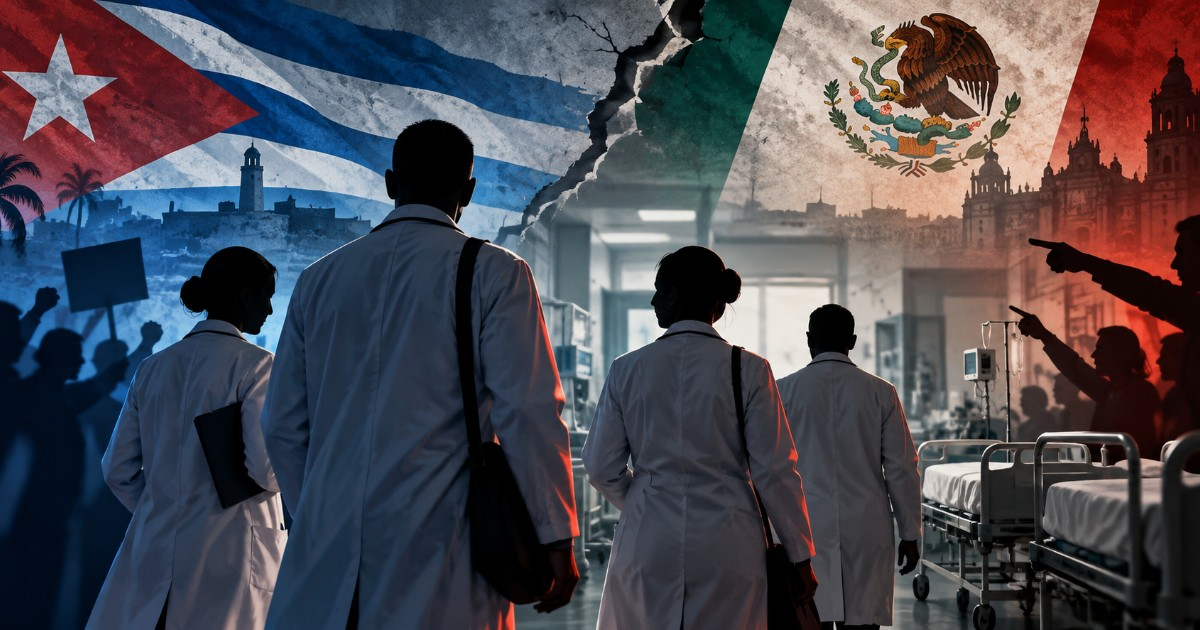
Mexican President Claudia Sheinbaum has refuted claims suggesting that Cuban doctors working in Mexico receive higher wages than their local counterparts. She emphasized that the hiring process is "direct" and free from intermediary companies, amidst growing controversy over payments to the Havana regime and reports on the working conditions of these medical missions.
"The notion that Cuban doctors earn more than Mexican doctors is false, absolutely false," Sheinbaum declared during her Friday morning briefing, as reported by Mexican media outlets Por Esto! and El Financiero.
Addressing assertions that Cuban medical professionals are engaged through a company, Sheinbaum stated, "The hiring is direct, and they earn exactly the same as a Mexican doctor, meaning there is no difference."
Sheinbaum defended the involvement of Cuban doctors in Mexico's public health system, highlighting their crucial role in remote communities where it is challenging to recruit Mexican specialists. "They help us significantly in many remote areas where they are working because no specialist doctors are available to go there," she remarked, according to Mexican press coverage.
However, Sheinbaum's statements contrast with documented history of payments to Cuban state enterprises and recent allegations from Cuban professionals about experiencing salary delays during their time in Mexico.
Questions persist regarding how much the Mexican government currently pays for each Cuban doctor, how much of that amount goes directly to the doctors, and what, if any, portions are funneled to entities connected to the Cuban regime.
The Mexican Institute of Social Security (IMSS) shared details about its workers' compensation. According to El Financiero, a first-level family doctor with a year of experience, working an eight-hour shift five days a week, earns a net monthly salary of 39,120 Mexican pesos, following a salary increase effective October 16th. Prior to this adjustment, which included a 4% raise in the salary scale and another 4% boost in rent assistance, the net pay was 36,896 pesos monthly.
These figures pertain to specific IMSS positions and do not serve as a benchmark for what Cuban doctors receive. While Sheinbaum assured equivalency in remuneration, she did not provide an updated breakdown of payments to Cuban professionals.
The claim that there are no intermediaries is significant due to known contracts in recent years between Mexican institutions and the Cuban Medical Services Marketer (CSMC), a state company linked to the Cuban Ministry of Public Health. In August 2022, a leaked agreement revealed monthly payments of $1,177,300 for 610 Cuban doctors in Mexico. Originally published by El Financiero, the document outlined transfers to a CSMC account at the International Bank of Commerce in Havana.
The agreement detailed a contractual salary equivalent to around 39,000 Mexican pesos gross per professional, but it did not confirm that the entire amount was deposited directly into each doctor's personal account.
This 2022 agreement does not affirm that these conditions remain as of October 2026. Nevertheless, it serves as documented evidence of hiring through a Cuban state company, differing from the direct hiring process Sheinbaum now describes.
The controversy reignited in June 2025 with revelations that Mexico had allocated over 2,019 million Mexican pesos, more than $105 million at the time, to the hiring, maintenance, and distribution of Cuban professionals from 2022 to 2025. The investigation, initially reported by El Universal based on official documents and contracts, identified payments to both Mexican logistics companies and Cuban entities tied to medical missions.
Of the total documented, at least 472 million Mexican pesos were paid to a Cuban state company between July 2022 and December 2023, through agreements settled in euros.
According to that investigation, IMSS-Welfare lacked sufficient information to determine what portion of the transferred resources actually ended up in the hands of health professionals, referred to in part of the documentation as "external collaborators."
The contracts examined at that time do not independently establish the current functioning of the entire program. However, they illustrate that for years there existed an institutional payment structure involving Cuban companies, raising the question of whether this mechanism has been replaced and since when.
Further complicating the issue, this month saw allegations from Cuban doctors working in Mexico claiming they had gone over two months without receiving their salaries. On October 4th, three Cuban doctors publicly reported delays in their pay without receiving explanations from their superiors. One doctor noted that delays affected both mechanisms for receiving money: an account tied to the Cuban Medical Services Marketer and another linked to the Bank of Welfare.
"There is no payment either from the Banjército account—which is supposedly the payment from the Marketer—or from [Bank of] Welfare, which is the Mexican part of the mission. And we are forbidden to speak or make any complaints," one doctor disclosed.
According to these accounts, since March 2026, the doctors have been receiving two monthly payments totaling approximately 44,716 Mexican pesos, divided among maintenance and housing and transportation support.
The professionals also reported pressure not to publicize the payment issues. In an internal communication, mission leaders acknowledged delays attributed to administrative changes without initially providing a concrete date for regularizing the deposits.
Sheinbaum's defense comes amid increasing political pressure from the United States over how Cuba exports medical services. Recently, Republican Congresswoman María Elvira Salazar sent a letter to U.S. Trade Representative Jamieson Greer, urging an examination of the Cuban doctors' program in Mexico during the review of the United States-Mexico-Canada Agreement (USMCA).
Salazar called for holding the Mexican government accountable for what she considers a forced labor system that economically benefits the Havana regime. The congresswoman claimed that Cuban professionals face mobility restrictions, family separation, and salary withholdings. She also asserted that, in some cases, doctors receive only a small fraction of the funds foreign governments allocate for their services.
Salazar referenced the 2025 Trafficking in Persons Report by the U.S. Department of State, which kept Cuba at Tier 3 and expressed concerns about the labor conditions of international medical missions.
Key Issues Surrounding Cuban Doctors in Mexico
How are Cuban doctors hired in Mexico?
According to President Sheinbaum, Cuban doctors are hired directly without intermediaries, earning the same as Mexican doctors.
What are the controversies over the payments to Cuban doctors?
Controversies arise from discrepancies between Sheinbaum's claims of direct payment and documented payments to Cuban state companies, raising questions about how funds are distributed.
Has the U.S. taken any action regarding Cuban doctors in Mexico?
U.S. Congresswoman María Elvira Salazar has urged an examination of the Cuban doctors' program during the USMCA review, citing concerns over forced labor practices.