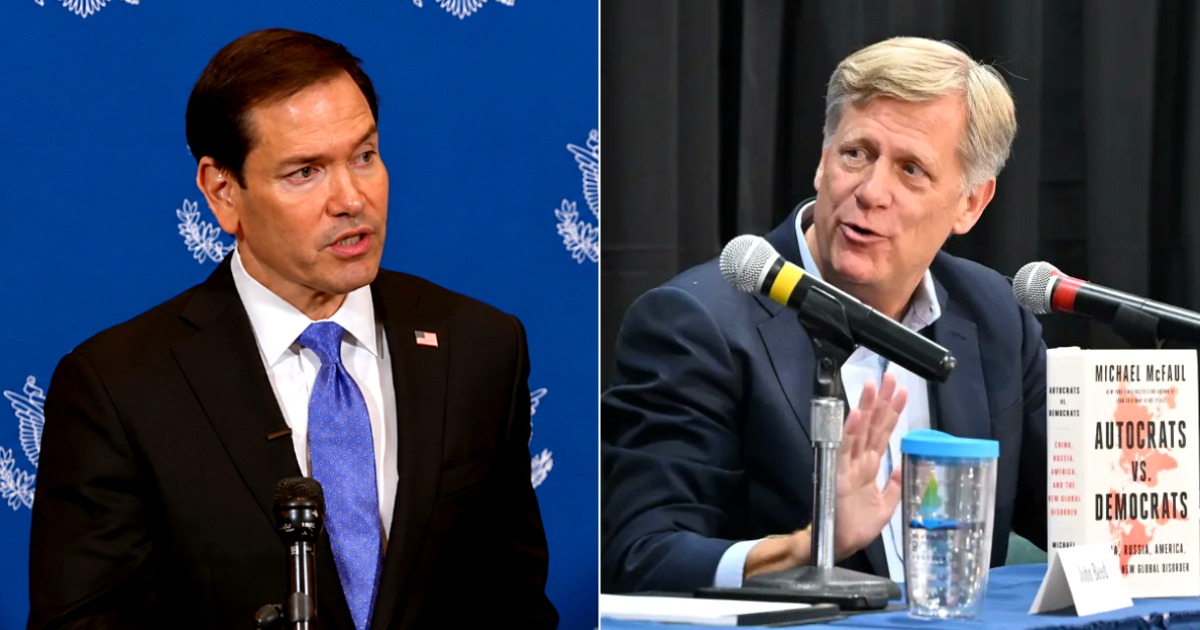
Michael McFaul, a highly regarded Political Science professor at Stanford University, and an expert in democratic transitions, issued a pointed critique this Saturday directed at Secretary of State Marco Rubio.
McFaul, who served as the U.S. ambassador to Russia during the Obama administration, cautioned the current Secretary of State that backing "autocrats and oligarchs" in Venezuela rather than supporting democracy should raise concerns among those hoping for his commitment to democratization in Cuba.
"Your choice to support autocrats and oligarchs in Venezuela over democracy should make anyone hoping for your commitment to Cuban democracy think twice," McFaul expressed on social media platform X.
The academic further emphasized, "There is no better way to inspire Cuban democrats than by backing democracy in Venezuela," reflecting his often critical stance on the foreign policies of the Trump administration.
McFaul's statement came in response to Rubio's call the previous day on his official account, urging Cubans striving for "positive change" on the island to seize the moment through a "discreet partnership with the CIA."
This appeal by Rubio was part of a coordinated effort with the intelligence agency itself: the CIA shared a nearly identical message in Spanish on its social media, accompanied by a two-minute video, and also released an operational guide on Instagram on how to contact the agency covertly.
The Cuban regime reacted with derision: the Deputy Foreign Minister mocked the call, while other officials accused the Trump administration of acting as a "terrorist and rogue state."
Contradictions in Rubio's Foreign Policy
McFaul's critique highlights an apparent underlying contradiction in Rubio's foreign policy: while he demands democratization in Cuba, Washington's approach in Venezuela seems to prioritize stabilization and business over genuine political transition.
Following the capture of Nicolás Maduro on January 3, 2026, the Chavismo remains in power under interim President Delcy Rodríguez. Rubio has devised a three-phase plan for Venezuela: stabilization, economic recovery and reconciliation, and eventually, a political transition towards legitimate elections.
Nonetheless, by the end of this week, there is no set date for elections, the Chavismo maintains its security and intelligence structures, and María Corina Machado—Nobel Peace Prize laureate in 2025—remains in exile in Panama after at least seven unsuccessful attempts to return to her country.
This concern is not new. Former U.S. Ambassador James Story warned in May that each day without progress toward democracy diminishes Washington's influence and strengthens the Chavismo. In October, the United Nations pointed out that nearly nine months after Maduro's capture, the regime's repressive apparatus remained intact.
Long-Term Implications for Cuban Democracy
McFaul, an expert in comparative autocracies and regime changes in post-socialist countries, has long cautioned about the dangers of prioritizing stability over democracy in transitional contexts.
His experience — including steering White House policy toward Russia and Eastern Europe under Obama — grants him a unique authority to assess whether Washington’s policies align with its stated objectives.
Jorge Rodríguez, a key figure in Chavismo, announced that presidential elections would occur within "constitutional times," a phrase analysts interpret as the potential continuation of the interim government until 2030, thus solidifying the regime under a new guise and dashing democratic hopes in both Venezuela and, by extension, Cuba.
Understanding the Impact of U.S. Policies on Cuban and Venezuelan Democracy
What is the main criticism Michael McFaul has towards Marco Rubio's policies?
McFaul criticizes Rubio for supporting autocrats and oligarchs in Venezuela rather than promoting democracy, potentially undermining hopes for democratization in Cuba.
How did the Cuban regime respond to Rubio's call for change?
The Cuban regime reacted with ridicule, with the Deputy Foreign Minister mocking the call and other officials labeling the Trump administration as a "terrorist and rogue state."
What are the phases of Rubio's plan for Venezuela?
Rubio's plan consists of three phases: stabilization, economic recovery and reconciliation, and finally, a transition to legitimate elections.
What is the current status of elections in Venezuela?
As of now, there is no defined date for elections, and the Chavismo retains its security and intelligence structures intact.