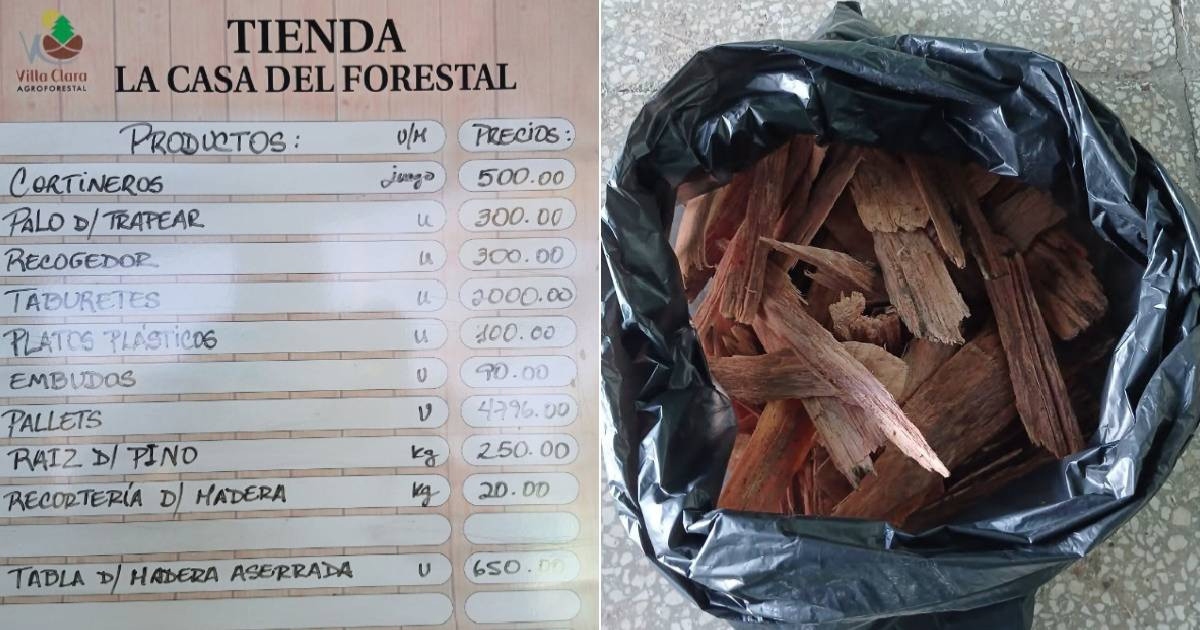
The Villa Clara Agroforestry Company has brought back their popular pine wood bags, known as "pinotea," at the state-run store, the Forester’s House, located in Santa Clara. These bags are available for 250 pesos and are intended to help with lighting charcoal.
Situated across from the Buen Viaje market, the shop has advertised these bags as "perfect for quick, easy, and safe lighting" and described them as "highly sought after," according to a Facebook post shared this past Friday.
The surge in demand for these natural fire starters comes amidst Cuba's ongoing energy crisis, highlighted by a shortage of liquefied gas and frequent power outages, forcing many families to rely on charcoal for cooking.
While some customers welcomed the state-offered pinotea at 250 pesos with relief, others voiced concerns about the quality of similar products sold privately. One individual mentioned a vendor at the Escambray fair selling these bags for 300 pesos, claiming they "barely ignite."
Another customer expressed gratitude for the information, as they had been searching for pine roots to light charcoal for days. Nonetheless, purchasing the product at the Forester’s House remains an option only for those who can visit the Santa Clara location.
Several customers have urged the expansion of offerings to other municipalities, citing the difficulty of traveling. Others questioned the consistency of supply, recalling promises made during the store's inauguration in early October.
"Where are you, ma'am, who said you would keep the shelves stocked with dedication, and not just for the opening day's photo?" one commenter asked.
Irony colored the reactions to the post, with one individual sarcastically celebrating "Cuba advances," while another succinctly summarized the situation as "the same old misery."
The Forester’s House opened on October 9 as Cuba's first store of its kind, specializing in forest sub-products. In addition to pinotea bags, the catalog includes sawdust, small fire starters, pine roots, wood scraps at 20 pesos per kilogram, sawn wood boards at 650 pesos, and stools priced at 2,000 pesos.
Since January, the state company Cupet has halted gas distribution in eastern provinces. By late September, the sale of gas ceased nationwide due to stock depletion.
The scarcity of alternatives has driven up the cost of domestic fuel. In the informal market, a sack of charcoal can fetch between 3,200 and 5,000 pesos in various provinces. This upper range far exceeds the minimum monthly salary of 3,210 pesos and accounts for more than 70% of the official median salary of 6,930 pesos.
The Food Monitor Program estimated that 35% of the Cuban population resorted to charcoal or wood for cooking due to the lack of electricity and gas.
In September, Holguin writer José Poveda Cruz captured the irony of reverting to basic cooking methods amid Cuba's crisis. "First we discovered fire; then we invented progress; and now we are learning to light it again," he wrote.
Understanding the Energy Crisis and Resource Availability in Cuba
Why are pine wood bags popular in Cuba right now?
Pine wood bags, or "pinotea," are in demand due to Cuba's current energy crisis, characterized by a shortage of gas and frequent power outages, prompting many to use charcoal for cooking.
What challenges are faced in accessing these products in Cuba?
Access to products like pinotea is limited to those who can visit specific locations, such as the Forester’s House in Santa Clara, with many calling for broader availability across municipalities.
How has the energy crisis affected domestic fuel costs?
The lack of energy alternatives has significantly increased domestic fuel costs, with charcoal prices in the informal market soaring well above the average monthly salary in Cuba.