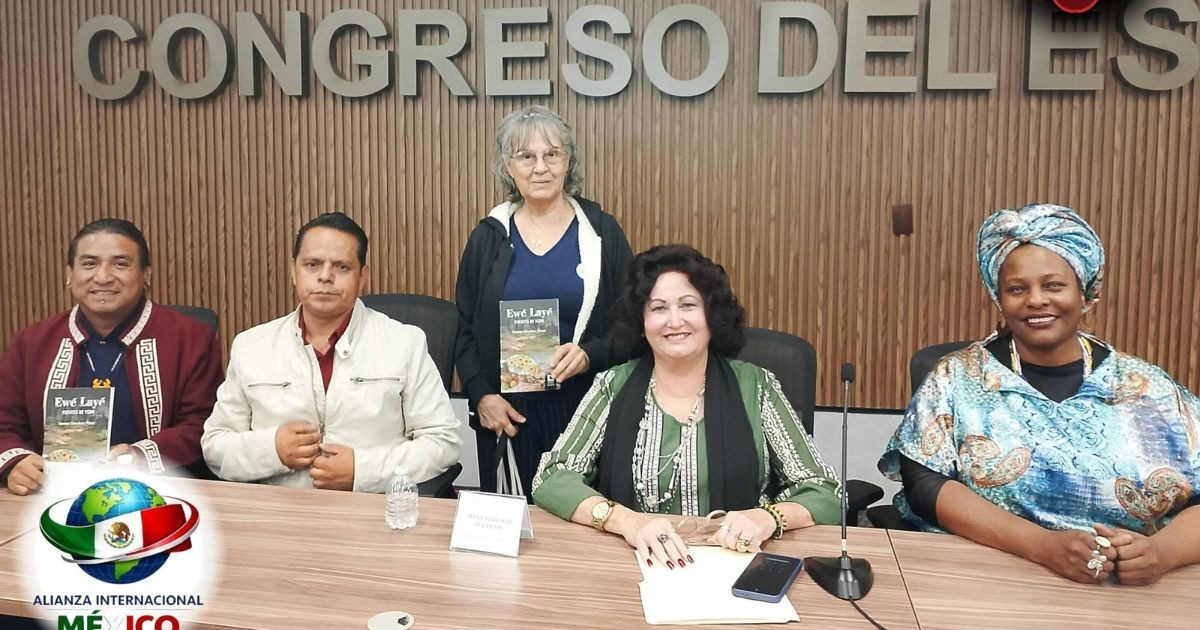
This Friday, Red Connection TV reported on social media that the State Congress of Puebla, Mexico, hosted the unveiling of the book "Ewé Layé – Sources of Life" by Cuban writer, composer, and researcher Tomasa González Pérez.
The event, held in the prestigious legislative venue, gathered representatives from various countries, local officials, and the general public to explore a work that intertwines ethnobotany, Afro-Cuban spirituality, and poetry.
Originating from Sancti Spíritus, González Pérez described her book as the culmination of extensive field research. "This is a compilation of years of study on the plants and rituals of Afro-Cuban culture. Readers will find plants, their scientific names, and the properties each orisha addresses," she explained.
The book delves into the traditions of the Regla de Ocha, the Regla de Palo Monte, and the Regla de Ifá, featuring a poem for each deity in the Afro-Cuban pantheon along with detailed information about their corresponding plants. "You'll find all the orishas, their syncretism with plants, and the poems I wrote for each. This book can be useful to anyone, regardless of their religion or beliefs," emphasized the author.
Originally published in 2003 by Ediciones Luminaria, "Ewé Layé – Sources of Life" has seen subsequent editions under Ciencias Sociales and Ediciones Cubanas/Artex, before joining the catalog of Editorial Letras Cubanas. A digital version was distributed by Ruth Casa Editorial in 2025, available on international e-book platforms.
At the presentation, González Pérez was joined by fellow Cuban and Mexico-based visual artist Anabel Cuesta Máñez, who presides over Alianza Internacional México, the organization supporting the event. Notable attendees included Óscar Emilio Carranza León, director general of the "Gilberto Bosques Saldívar" Institute for Legislative, Financial, and Socioeconomic Research of the Puebla Congress, and Odilón Jiménez, Acajete's culture and sports councilor.
The venue also featured an international corridor with crafts and cuisine from eight countries—Cuba, Venezuela, Chile, Argentina, France, Morocco, and Algeria—broadening the event into a rich multicultural exchange.
The book documents Afro-Cuban culture, a product of centuries of transculturation and syncretism between African traditions—primarily Yoruba and of Congo or Bantu origins—Catholicism introduced during colonization, and other Cuban cultural expressions.
In the Regla de Ocha or Santería, orishas are associated with specific plants believed to have medicinal and spiritual properties. For instance, Ochún is linked to the Virgin of Charity of El Cobre, Cuba's patroness, while Yemayá is connected to the Virgin of Regla. These ethnobotanical and religious insights were first captured in seminal works like "El monte" (1954) by Lydia Cabrera and remain integral to Cuba’s living cultural and religious traditions.
González Pérez holds a degree in Education and has taught at primary, polytechnic, and university levels. She is a member of the Union of Writers and Artists of Cuba (UNEAC), the Economic Society of Friends of the Country, and the Cuban Association of Musical Authors' Rights, among other organizations. Her works also include the poetry collection "Colgada del cielo."
The presentation at the Puebla Congress underscores the growing interest in preserving and promoting Afro-Cuban roots beyond the island, especially as the Cuban diaspora in countries like Mexico becomes a crucial conduit for these traditions.
As reported by Red Connection TV during the event, the day "provided a platform for literature, research, and cultural exchange between Cuba and Mexico, emphasizing the importance of preserving and sharing the roots, traditions, and expressions of Afro-Cuban culture."
Frequently Asked Questions about "Ewé Layé – Sources of Life"
What is the main focus of "Ewé Layé – Sources of Life"?
The book focuses on the plants and rituals of Afro-Cuban culture, providing scientific names, properties, and their associations with orishas.
Who accompanied Tomasa González Pérez at the book presentation?
Anabel Cuesta Máñez, a Cuban visual artist based in Mexico, accompanied her, along with notable figures such as Óscar Emilio Carranza León and Odilón Jiménez.
How does the book relate to Afro-Cuban religious practices?
It details the relationship between orishas and specific plants, highlighting their medicinal and spiritual significance within Afro-Cuban religious practices.