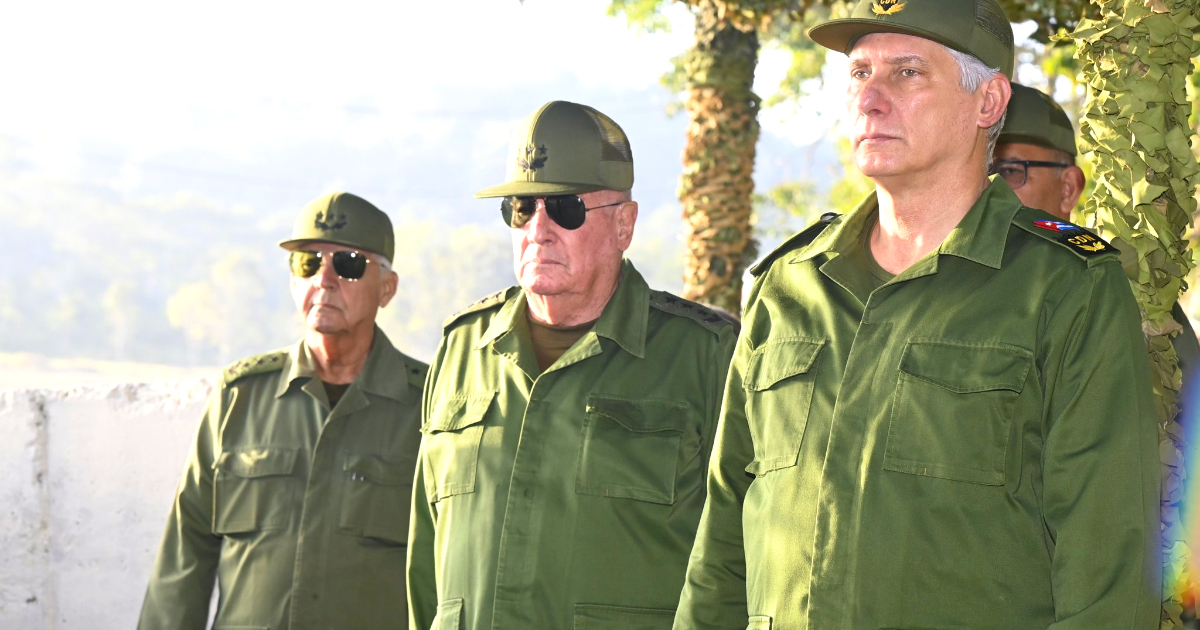
An academic report released Thursday by the platform CubaxCuba highlights that a democratic transition in Cuba will require not only subordinating the Revolutionary Armed Forces (FAR) to civilian authority but also dismantling their political influence and placing the economic network they administer through GAESA under democratic oversight.
Entitled "Armed Forces and Subordination to Civil Power," the study by the Comparative Democratic Transitions initiative analyzes the experiences of Spain, Chile, Poland, and Venezuela to outline the challenges Cuba would face in a potential democratization process.
The principal conclusion of the report is that "no transition can be solidified as long as the military retains veto power over civilian authority." However, the authors caution that merely removing the military's political influence is insufficient if they maintain independent economic resources and autonomy outside the supervision of democratic institutions.
The Economic Core of Military Power
The report underscores that the military's economic power, particularly through GAESA, poses one of the biggest hurdles to transforming Cuba's political system. GAESA, established in the 1990s under the Ministry of the FAR, holds significant control over Cuba's lucrative tourism sector, hotel chains, commercial corporations, and financial entities.
According to independent investigations, the military conglomerate controls a staggering portion of the Cuban economy. In a study published by Cuba Siglo XXI in November 2025, economist Emilio Morales estimated that the military controls over 70% of the Cuban economy and 95% of its financial resources.
Meanwhile, economist Pavel Vidal Alejandro analyzed leaked financial statements from GAESA for 2023 and 2024 and calculated that its economic weight ranges from a third to 40% of the national economy. Despite differences in estimates and methodologies, both studies highlight an extraordinary concentration of economic resources under military control, lacking effective mechanisms for transparency and civilian oversight.
GAESA: Economic Power Beyond Political Change
The analysis reveals that FAR embodies unique characteristics, distinguishing it from other examined armies: it emerged from the revolution itself, is subordinated to a hegemonic party, and has become a significant economic player. GAESA's vast financial resources, including $14.5 billion in bank deposits in 2024, illustrate the financial challenge of bringing this conglomerate under a future democratic government's control.
The report recalls that General Luis Alberto Rodríguez López-Calleja, who led GAESA for decades until his death in 2022, was a member of the Communist Party's Political Bureau. Moreover, the current Prime Minister, Manuel Marrero Cruz, previously chaired the Gaviota tourism corporation, part of the military conglomerate.
Lessons from Global Transitions
The study examines historical experiences from Spain, Chile, Poland, and Venezuela, shedding light on different paths concerning military-civilian relations. In Spain, military reform progressed in stages post-Franco, while in Chile, military autonomy and economic privileges lingered long after Pinochet's rule.
Poland's transformation of a communist-subordinate military into a democratic institution involved gradual civilian integration into the Defense Ministry, despite ongoing tensions. Conversely, Venezuela's case illustrates the progressive erosion of civilian control, with the military expanding into various economic sectors.
The FAR's Negotiating Power in a Cuban Transition
Another significant finding is that the negotiating power of the FAR during a transition would influence the extent of reforms. Chile's experience shows that a military negotiating its exit conditions can keep privileges for years, whereas Poland illustrates the challenges of disentangling the military from communist influence.
Cuba's unique history, where the FAR is a foundational pillar of the regime—unlike in other countries—adds complexity. The system's ability to maintain military discipline is evidenced by the 1989 trial resulting in the execution of General Arnaldo Ochoa and others, indicating the political system's power to enforce discipline within its own ranks.
A Gradual Reform Approach
The researchers suggest a gradual strategy for a Cuban transition, separating the military's national defense, political intervention, and economic control functions. Initially, ensuring the military does not oppose democratization is crucial. Subsequently, the chain of command should be reorganized under civilian authority, with new institutions established for defense responsibilities.
While maintaining a professional military strictly for defense, the FAR's political involvement should cease, and its business activities should be subject to transparency, parliamentary control, and restructuring if necessary. Attempting to tackle all these dimensions simultaneously may provoke military resistance, yet delaying economic reform risks entrenching an autonomous power.
The FAR under Increasing U.S. Pressure
This analysis emerges as Washington intensifies sanctions on Cuba's military and security structures. In 2026, Donald Trump's administration announced sanctions against the Ministry of the Armed Forces, among others. Secretary of State Marco Rubio declared Trump's support for a Cuba governed by its citizens, not a military elite controlling national resources.
While the CubaxCuba report does not address these sanctions or propose a U.S. transition strategy, it places the FAR's political and economic control at the heart of discussions about Cuba's future. CubaxCuba, described as a civic think tank, is co-directed by historian and Doctor of Philosophical Sciences Alina Bárbara López Hernández, who recently published an essay on building organizational structures within Cuban society to drive political change.
"Designing this sequence is one of the most urgent intellectual tasks for those considering the transition," the report concludes, emphasizing that the FAR's subordination to civilian power cannot solidify as long as they retain political and economic prerogatives outside democratic control.
Key Questions on Cuba's Military and Economic Transition
What is the significance of GAESA in Cuba's economy?
GAESA is a military-controlled conglomerate that holds significant power over Cuba’s economy, managing vital sectors like tourism, commerce, and finance, and controlling an estimated 70% of the economy according to some studies.
How does the Cuban military's economic power affect potential political reforms?
The military's economic power presents a barrier to political reforms because it provides them with resources and autonomy, making it difficult to integrate them fully under civilian democratic control.
What lessons can Cuba learn from other countries' transitions regarding military power?
Countries like Spain and Poland show the importance of gradual reforms and civilian oversight, while Venezuela illustrates the risks of military entrenchment in politics and economics.