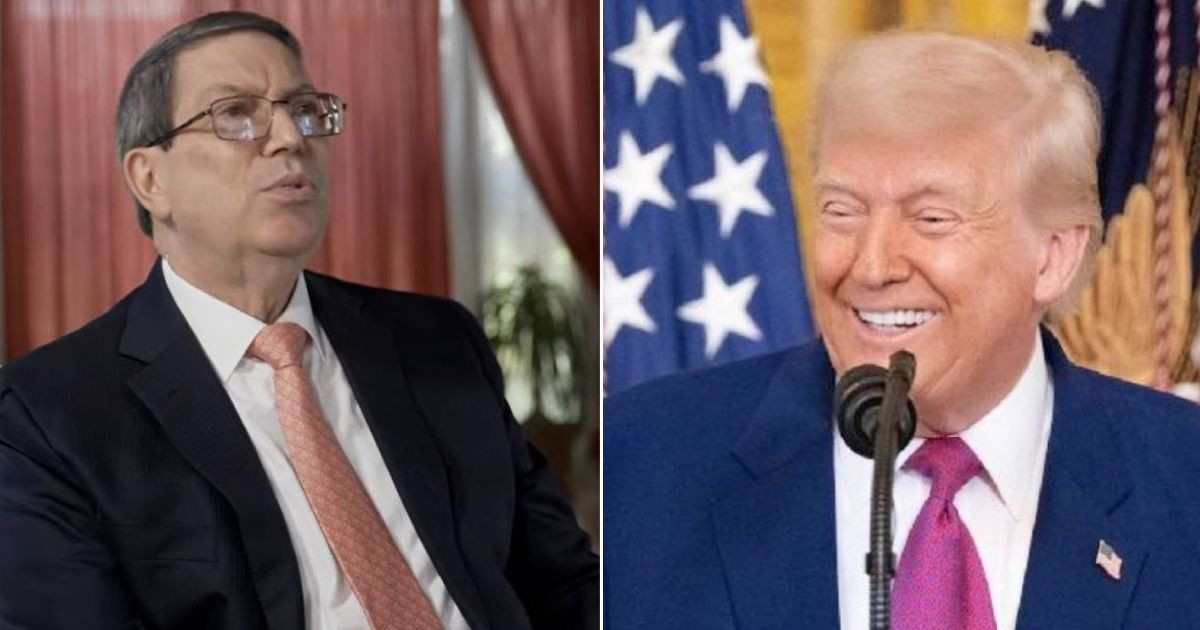
Cuban Foreign Minister Bruno Rodríguez Parrilla once again employed his rhetorical prowess this Friday to counter the recent remarks made by U.S. President Donald Trump about the potential deployment of military vessels near Cuba's shores.
Rodríguez took to his account on X with a message that combined a picturesque tourist image with a geological warning: "We reject any threats regarding U.S. ambitions towards Cuba. Our shores feature beautiful beaches, but also jagged rocks, inhospitable to those arriving with hostile intentions and desires for domination."
This tweet emerged just hours after Trump, during a Republican rally at the Alico Arena in Fort Myers, Florida — in anticipation of the November 3rd legislative elections — painted a scenario where U.S. ships returning from operations in Iran would make a strategic stop near Cuba.
"In fact, what we're going to do with Cuba is return from Iran. Those beautiful ships will pass by Cuba. We'll have one stop about 50 yards from the shore. They'll raise their hands," Trump declared to his followers.
Trump further mentioned dispatching Secretary of State Marco Rubio to "seal the deal" with Havana, concluding with a succinct "We don't have to stop," leaving open the interpretation of what not stopping might entail.
On the same day, Rubio posted on X, making a direct appeal regarding possible future actions concerning the island: an invitation to those seeking change in Cuba to discreetly collaborate with the CIA, citing "disappointment over broken promises, corruption, and the privileged lives of a few" as motivations. This unusually explicit message from a high-ranking official follows another from October 5th, where he had already urged the Cuban military apparatus to "open their eyes" to the regime's reality.
The "jagged rocks" metaphor chosen by Rodríguez refers to the karst limestone formations found along Cuban coasts: irregular and sharp rock formations present in areas such as Guanahacabibes, Havana, Caguanes, and Cabo Cruz. This imagery is intended to depict an impregnable Cuba. What it fails to convey is the reality faced by millions of Cubans enduring prolonged blackouts, food and medicine shortages, and an economy in freefall after 67 years of dictatorship.
It is not the first time Rodríguez has responded with "vigorous rejection" to Washington's provocations. In May, when Trump threatened to send the aircraft carrier USS Abraham Lincoln within 100 meters of the Cuban coast, the foreign minister warned that a military aggression would result in "a bloodbath," with thousands of Cuban and American casualties. And on October 14th, Rodríguez accused Rubio of "blackmailing" foreign leaders to decrease support for the annual UN resolution against the embargo, with voting scheduled for October 27th and 28th.
International support has significantly dwindled: from 187 votes in favor in 2024, it dropped to 165 in 2025, and further to 136 in a special session in July 2026. Although this session was procedural and does not equate to the annual resolutions on the matter, it is symbolically illustrative. This week, Rodríguez accused a Latin American government of pressuring other countries to change their vote, seemingly another battle lost in advance.
The foreign minister's tweet was accompanied by the hashtag #CubaIsNotAThreat. "Night is falling on them, and they're more alone than ever," responded one user commenting on Rodríguez's characteristically "vigorous" statement.
Understanding the Tensions Between Cuba and the United States
What was Bruno Rodríguez's response to U.S. military threats?
Bruno Rodríguez dismissed U.S. threats by highlighting the natural defenses of Cuba's shores, which include both beautiful beaches and jagged rocks, suggesting they are unwelcoming to hostile forces.
What did Donald Trump propose regarding U.S. naval presence near Cuba?
Donald Trump suggested that U.S. ships returning from operations in Iran would make a strategic stop near Cuba, with one vessel getting as close as 50 yards from the Cuban coast.
How has international support for Cuba changed in recent years?
International support for Cuba has decreased significantly, with votes in favor of the annual UN resolution against the embargo dropping from 187 in 2024 to 136 in a procedural session in July 2026.